
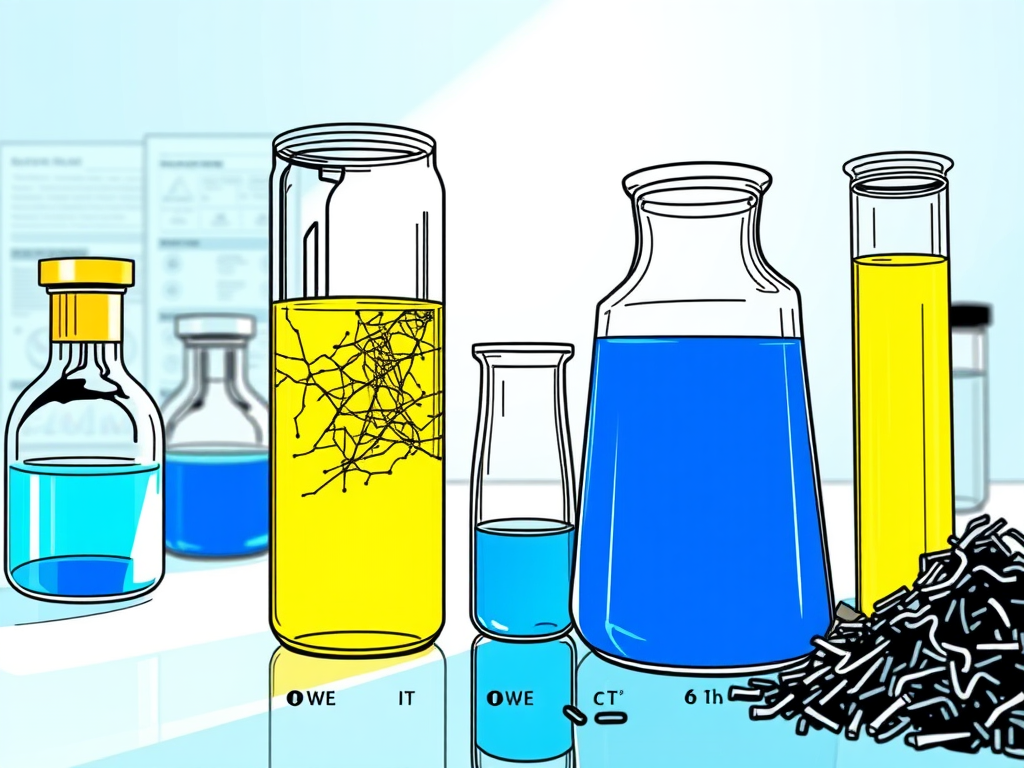
A recent study published on Preprints.org by Mariana Consiglio Kasemodel, Valéria Guimarães Silvestre Rodrigues, Bruna Soares Campelo Vallim, and Érica Leonor Romão, explores the effectiveness of biocharBiochar is a carbon-rich material created from biomass decomposition in low-oxygen conditions. It has important applications in environmental remediation, soil improvement, agriculture, carbon sequestration, energy storage, and sustainable materials, promoting efficiency and reducing waste in various contexts while addressing climate change challenges. More derived from mango and pitanga tree pruning waste in removing Methylene Blue (MB) dye from water. Their findings indicate that biochar produced at a lower temperature of 300°C achieves the same maximum adsorption capacity as biochar produced at 500°C, both reaching 19.4 mg/g. This is a significant insight for sustainable wastewater treatment.
The study investigated the impact of the thermochemical process temperature and particle size on the biochar’s ability to adsorb MB. Tree pruning waste, typically disposed of improperly or in landfills, presents an opportunity for valorization into useful adsorbents, contributing to a circular economy. Biochar, a carbon-rich porous solid, is created through a thermochemical process in an inert atmosphere. Its porous structure and surface charge allow it to retain cations like organic dyes.
The researchers found that increasing the treatment temperature from 300°C to 500°C shifted the biochar’s characteristics from acidic to alkaline, and its redox potential became more reducing. This was accompanied by an increase in electrical conductivity. These changes generally favor the adsorption of cations. While the raw pruning material showed high removal rates, its perishability and susceptibility to microbial activity make biochar a more stable alternative.
The initial concentration of MB directly influenced the removal efficiency. As the initial MB concentration increased, the removal efficiency decreased. However, the adsorption capacity, the amount of dye adsorbed per gram of biochar, increased with higher initial MB concentrations, driven by the increased concentration gradient. For example, biochar produced at 500°C (BTP-500) achieved an adsorption capacity of 29 mg/g at an initial concentration of 400 mg/L.
Particle size also played a crucial role in adsorption performance. Finer particles, particularly those smaller than 0.25 mm, demonstrated higher removal efficiencies, exceeding 95% for all biochar types. This is attributed to the greater availability of adsorption sites in smaller particles. Conversely, larger particle sizes (0.60 to 2.00 mm) resulted in significantly lower efficiencies, under 60%.
The study employed Langmuir, Freundlich, and Temkin isotherm models to understand the adsorption process. The equilibrium adsorption of MB was best described by the Langmuir and Freundlich models for both biochar types. The Langmuir model suggests monolayer adsorption on a homogeneous surface, while the Freundlich model indicates multilayer adsorption on heterogeneous surfaces. Critically, the modeled maximum adsorption capacity (qm) for both BTP-300 and BTP-500 was identical at 19.4 mg/g. This remarkable finding suggests that using a lower pyrolysisPyrolysis is a thermochemical process that converts waste biomass into bio-char, bio-oil, and pyro-gas. It offers significant advantages in waste valorization, turning low-value materials into economically valuable resources. Its versatility allows for tailored products based on operational conditions, presenting itself as a cost-effective and efficient More temperature (300°C, a torrefaction process) can produce a biochar with comparable adsorption effectiveness to that produced at a higher, more energy-intensive temperature (500°C). This aligns with sustainable development goals by reducing energy consumption during biochar production.
The Temkin model, which describes a decline in adsorption energy, indicated that the adsorption of MB onto the biochar occurred physically, as the Temkin constant ‘b’ was less than 8 kJ/mol. Furthermore, the Freundlich parameter ‘n’ (5.97 for both materials) suggests a favorable adsorption process.
This research underscores the potential of mango and pitanga pruning waste biochar as an efficient and sustainable adsorbent for methylene blue. The key takeaway is the comparable performance of biochar produced at a lower temperature, offering a more energy-efficient pathway for producing effective adsorbents from agricultural waste. Further detailed surface characterization is indicated to fully understand the impact of the thermochemical process on the biochar’s structure and functional groups.
Source: Kasemodel, M. C., Rodrigues, V. G. S., Vallim, B. S. C., & Romão, E. L. (2025). Investigation of the Adsorption of Mango and Pitanga Pruning Waste Biochar for the Removal of Methylene Blue. Preprints.org.



Leave a Reply