
Key Takeaways
- Combining plastic film mulch with biocharBiochar is a carbon-rich material created from biomass decomposition in low-oxygen conditions. It has important applications in environmental remediation, soil improvement, agriculture, carbon sequestration, energy storage, and sustainable materials, promoting efficiency and reducing waste in various contexts while addressing climate change challenges. More is a highly effective way to conserve soil water and boost crop yields in dry, rain-fed agricultural areas.
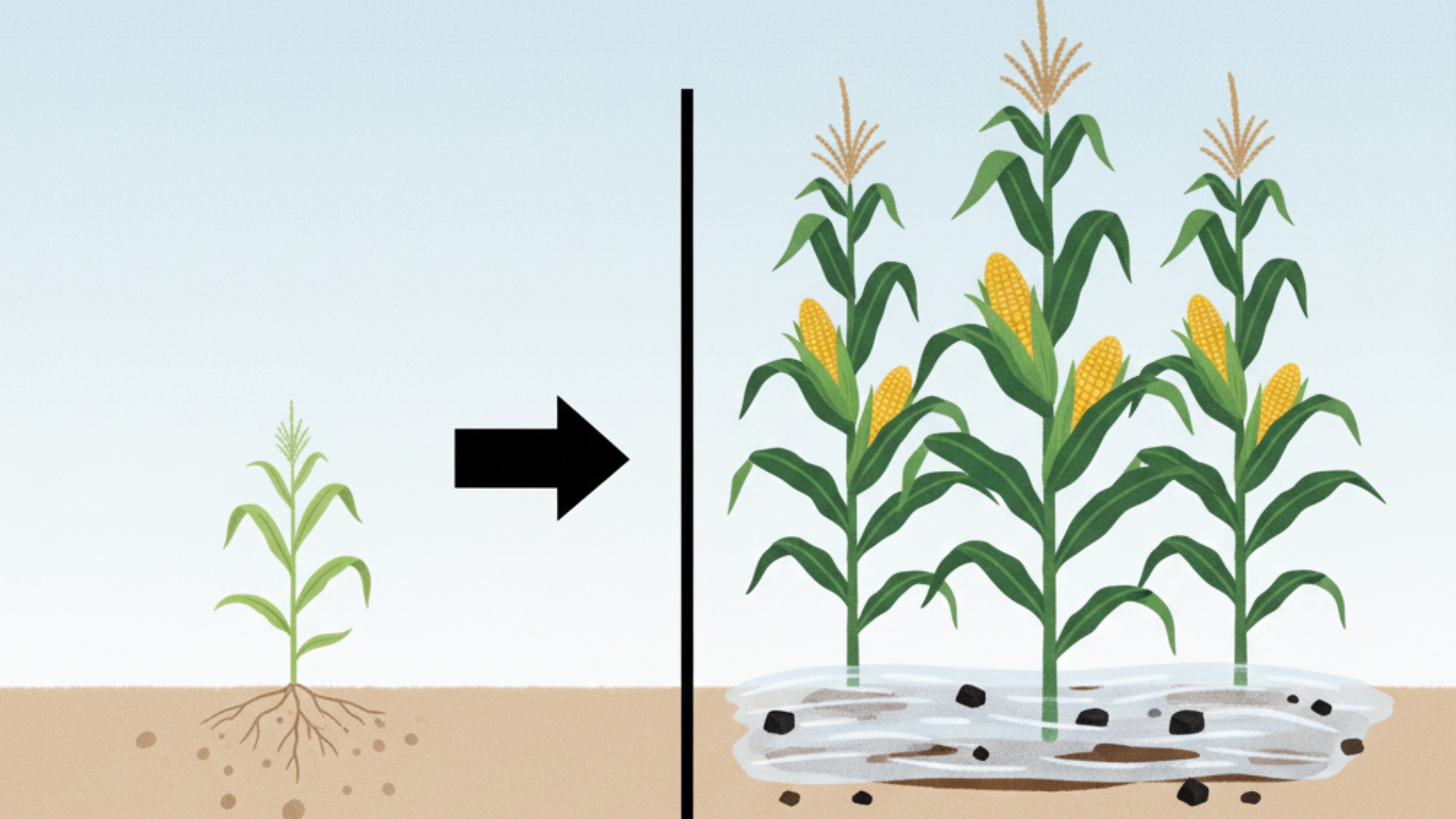
- The co-application of plastic film and biochar significantly increased maize yield by 22.86% over flat planting without mulch.
- Plastic film mulch dramatically increases Water Use Efficiency (WUE), increasing it by an average of 68.5% in Gansu. This is primarily because it reduces the amount of water lost to evapotranspiration (ET).
- The practice is most effective in areas with light soil types, showing a significant impact compared to medium or heavy soils.
- The use of biochar alongside plastic film is touted as an effective way to mitigate the negative effects of residual plastic film buildup in the soil.
Rain-fed agriculture in dryland regions, especially across northern China, faces constant threats from water scarcity and poor soil fertility. To cope, farmers widely adopt plastic film mulched ridge-furrow farming to reduce water loss through evapotranspiration (ET), thereby improving crop yields and Water Use Efficiency (WUE). However, the residual plastic film left in the fields poses its own problem, potentially impeding soil structure and plant growth. Addressing this challenge, a meta-analysis by Erastus Mak-Mensah, Peter Bilson Obour, Eunice Essel, Qi Wang, and John K. Ahiakpa, titled “Influence of plastic film mulch with biochar application on crop yield, evapotranspiration, and water use efficiency in northern China: A meta-analysis,” and published in the journal PeerJ, systematically evaluated how the combined application of plastic film mulch and biochar influences key agricultural metrics.
The analysis confirms that plastic film mulch alone provides substantial benefits. Compared to no-mulching, the use of plastic film led to significant average yield increases for wheat (75.7% in Gansu), potato (20.2% in Ningxia), and maize (12.9% in Shaanxi). These dramatic increases are directly attributed to water conservation: plastic film reduced ET by up to 12.8% in Gansu, while simultaneously increasing WUE by 68.5% in the same province. The overall plastic film mulched ridge-furrow approach significantly increased WUE by 16.1% in regions with an air temperature greater than 9°C.
The most compelling results emerged from the combination of plastic film and biochar. The co-application of these materials led to a significant jump in maize yield over three years, increasing it by 22.86% compared to the traditional flat planting without mulching in the Shanxi and Shaanxi regions. Biochar, a carbon-rich soil amendmentA soil amendment is any material added to the soil to enhance its physical or chemical properties, improving its suitability for plant growth. Biochar is considered a soil amendment as it can improve soil structure, water retention, nutrient availability, and microbial activity. More, improves soil water adsorption capacity, fertility, microbial activity, and organic matter content, all of which enhance crop production. When paired with the moisture-conserving effects of plastic film, biochar helps optimize the soil environment for plants to efficiently use the conserved water.
The effectiveness of plastic film mulching was notably dependent on soil characteristics. The practice had a significant impact on light soil types (such as sandy and sandy loam soils) compared to medium and heavy soil types. Additionally, plastic film significantly improved yield in light soils by 43% compared with flat planting without mulching in areas with a soil bulk density greater than 1.3 g cm−3. The effect on WUE was also significant in regions with heavy soil type and texture (20.68% increase). Moreover, the practice exerted a greater impact on crop yield in areas with high soil available N (>50 mg kg−1) and high soil available P (>20 mg kg−1).
Ultimately, the meta-analysis concludes that the co-application of plastic film with biochar is a highly recommended and integrated agronomic practice for dry-land farming. It serves not only as a proven strategy to boost yields and enhance water use efficiency, but it’s also seen as an essential practice to potentially mitigate the adverse effects of plastic film residue buildup and greenhouse gas emissions, suggesting it’s a vital method for sustainable agriculture in a changing climate.
Source: Mak-Mensah, E., Obour, P. B., Essel, E., Wang, Q., & Ahiakpa, J. K. (2021). Influence of plastic film mulch with biochar application on crop yield, evapotranspiration, and water use efficiency in northern China: A meta-analysis. PeerJ, 9, e10967.


Leave a Reply