
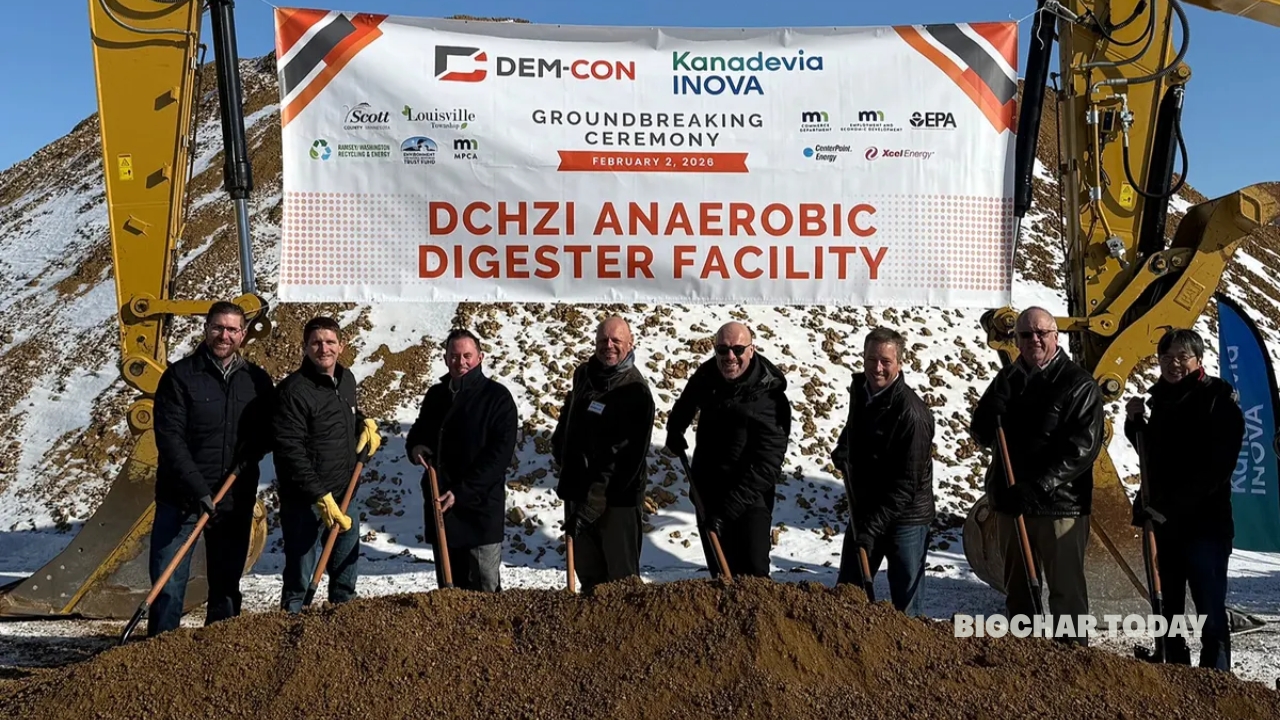
Kanadevia Inova, in partnership with Dem-Con Companies, LLC, has officially broken ground on the Louisville Township Renewable Gas Project in Minnesota, United States. This large-scale facility is designed to process 75,000 tonnes of organic waste annually, utilizing an integrated approach to produce both renewable natural gas (RNG) and biocharBiochar is a carbon-rich material created from biomass decomposition in low-oxygen conditions. It has important applications in environmental remediation, soil improvement, agriculture, carbon sequestration, energy storage, and sustainable materials, promoting efficiency and reducing waste in various contexts while addressing climate change challenges. More. Scheduled to begin operations in 2027, the project represents a significant development in North American circular waste management by combining anaerobic digestion with advanced gasificationGasification is a high-temperature, thermochemical process that converts carbon-based materials into a gaseous fuel called syngas and solid by-products. It takes place in an oxygen-deficient environment at temperatures typically above 750°C. Unlike combustion, which fully burns material to produce heat and carbon dioxide (CO2), gasification More technology. The facility expects to generate 200,000 MMBtu of RNG and approximately 8,000 tonnes of biochar per year, serving as a primary outlet for organic feedstockFeedstock refers to the raw organic material used to produce biochar. This can include a wide range of materials, such as wood chips, agricultural residues, and animal manure. More from Ramsey and Washington counties.
The project addresses the complex challenge of managing impure organic waste streams and meeting stringent state-level decarbonization goals. In Minnesota, food waste constitutes approximately 24% of household refuse, which traditionally contributes to methane and carbon dioxide emissions when left to decompose in landfills. Furthermore, the regional waste infrastructure requires more sophisticated methods to handle source-separated organics and the biodegradable fractions of municipal solid waste. There is also a growing need for scalable solutions that can address “forever chemicals” (PFAS) and provide reliable carbon sequestration methods to lower the overall carbon intensity of energy production.
To resolve these issues, the facility employs a dual-technology system featuring high-solids anaerobic digestion (HSAD) and gasification. The HSAD process utilizes bacteria in oxygen-free environments to convert organic matter into biogas, which is subsequently upgraded to pipeline-quality RNG for offtake by CenterPoint Energy and Xcel Energy. The remaining solid digestate from the digestion process is not discarded; instead, it is fed into a gasification unit. This secondary thermal treatment stage converts the digestate into biochar, effectively stabilizing the carbon and providing a mechanism to break down persistent chemical contaminants that are often found in municipal organic streams.
The anticipated outcomes of this facility include the production of carbon-sequestering biochar suitable for soil remediation, filtration, and agricultural moisture retention. By diverting 75,000 tonnes of waste from landfills, the project will significantly reduce local greenhouse gas emissions while providing enough renewable energy to power roughly 2,700 homes. Additionally, the production of 8,000 tonnes of biochar establishes a new industrial benchmark for the co-production of biomethane and solid carbon products. This integrated model, supported by the Minnesota Environment and Natural Resources Trust Fund, serves as a pilot for resilient, low-carbon waste infrastructure in the United States.




Leave a Reply