
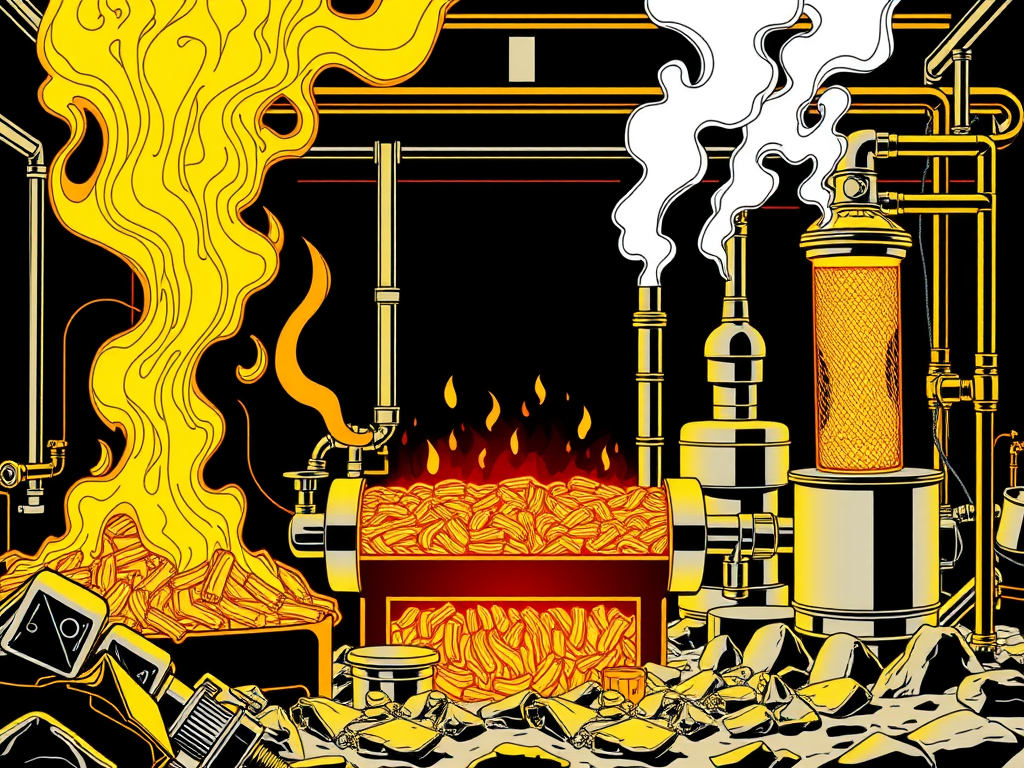
Recent study published in the Journal of Physics: Conference Series, explored how iron (Fe) catalysts affect the breakdown of sugarcane bagasse, a byproduct of sugar production, using pyrolysisPyrolysis is a thermochemical process that converts waste biomass into bio-char, bio-oil, and pyro-gas. It offers significant advantages in waste valorization, turning low-value materials into economically valuable resources. Its versatility allows for tailored products based on operational conditions, presenting itself as a cost-effective and efficient More. Pyrolysis, a process that heats biomassBiomass is a complex biological organic or non-organic solid product derived from living or recently living organism and available naturally. Various types of wastes such as animal manure, waste paper, sludge and many industrial wastes are also treated as biomass because like natural biomass these More in the absence of oxygen, can convert sugarcane bagasse into valuable products like bio-oil, biocharBiochar is a carbon-rich material created from biomass decomposition in low-oxygen conditions. It has important applications in environmental remediation, soil improvement, agriculture, carbon sequestration, energy storage, and sustainable materials, promoting efficiency and reducing waste in various contexts while addressing climate change challenges. More, and syngasSyngas, or synthesis gas, is a fuel gas mixture consisting primarily of hydrogen and carbon monoxide. It is produced during gasification and can be used as a fuel source or as a feedstock for producing other chemicals and fuels. More. The study found that adding an iron catalyst changes the yields and chemical makeup of these products.
The researchers discovered that the highest yield of bio-oil, 46.07%, was achieved at a pyrolysis temperature of 500°C without a catalyst. However, when the process was performed with an iron catalyst, the yields changed. Adding 2.5 grams of iron catalyst reduced the bio-oil yield to 38.80% while significantly increasing gas production to 34.60%.
The study also examined how the iron catalyst altered the chemical composition of the bio-oil. Using Gas Chromatography-Mass Spectrometry (GC-MS), the researchers found that the catalyst increased the presence of simpler compounds, such as fatty acids (19.33%) and hydroperoxides (23.63%), while reducing the content of a complex compound called levoglucosan (from 70.52% to 16.45%).
These findings are important for optimizing the pyrolysis process to produce biofuels. By carefully controlling the temperature and using an appropriate amount of iron catalyst, it is possible to tailor the production of bio-oil and syngas from sugarcane bagasse. This can lead to more efficient use of agricultural waste and the development of sustainable energy sources.
SOURCE: Jamilatun, S., Arifah, Z., & Mufandi, I. (2025). Comparative Analysis of Product Yield and Chemical Composition in Sugarcane Bagasse Pyrolysis with and without Iron Catalysis. Journal of Physics: Conference Series, 2989(1), 012007.



Leave a Reply