
Key Takeaways
- Parallel biocharBiochar is a carbon-rich material created from biomass decomposition in low-oxygen conditions. It has important applications in environmental remediation, soil improvement, agriculture, carbon sequestration, energy storage, and sustainable materials, promoting efficiency and reducing waste in various contexts while addressing climate change challenges. More processing lines enable farms to treat high-moisture manure and dry crop straw separately, achieving full compliance with strict land-application regulations.
- Operating a farm-scale parallel pyrolysisPyrolysis is a thermochemical process that converts waste biomass into bio-char, bio-oil, and pyro-gas. It offers significant advantages in waste valorization, turning low-value materials into economically valuable resources. Its versatility allows for tailored products based on operational conditions, presenting itself as a cost-effective and efficient More system reduces manure management greenhouse gas emissions by 75 percent while sequestering 350 metric tonnes of carbon dioxide equivalent annually.
- Heat integration between dry crop lines and wet manure lines resolves thermal bottlenecks, generating enough excess energy to avoid 29 metric tonnes of additional carbon dioxide emissions per year.
- Straw availability, driven by crop rotation and weather, is the primary factor influencing system economics and energy balance.
- Purchasing external straw during low-yield years is the most cost-effective operational strategy to maintain thermal balance and maximize climate benefits.
Agricultural operations face mounting pressure to reduce greenhouse gas emissions, particularly those stemming from manure storage and crop residue disposal. Converting agricultural waste into stable biochar offers a decentralized pathway for long-term carbon dioxide removal. However, practical adoption at the farm scale is hindered by regulatory and technical hurdles. Mixing different biomassBiomass is a complex biological organic or non-organic solid product derived from living or recently living organism and available naturally. Various types of wastes such as animal manure, waste paper, sludge and many industrial wastes are also treated as biomass because like natural biomass these More sources prior to pyrolysis violates land-application safety regulations in several jurisdictions, including the United Kingdom and the European Union. Furthermore, processing high-moisture animal manure requires extensive thermal energy, creating severe operational energy deficits. Existing single-feedstock systems or non-compliant co-pyrolysis models fail to provide a scalable, regulation-compliant architecture for typical mixed agricultural enterprises.
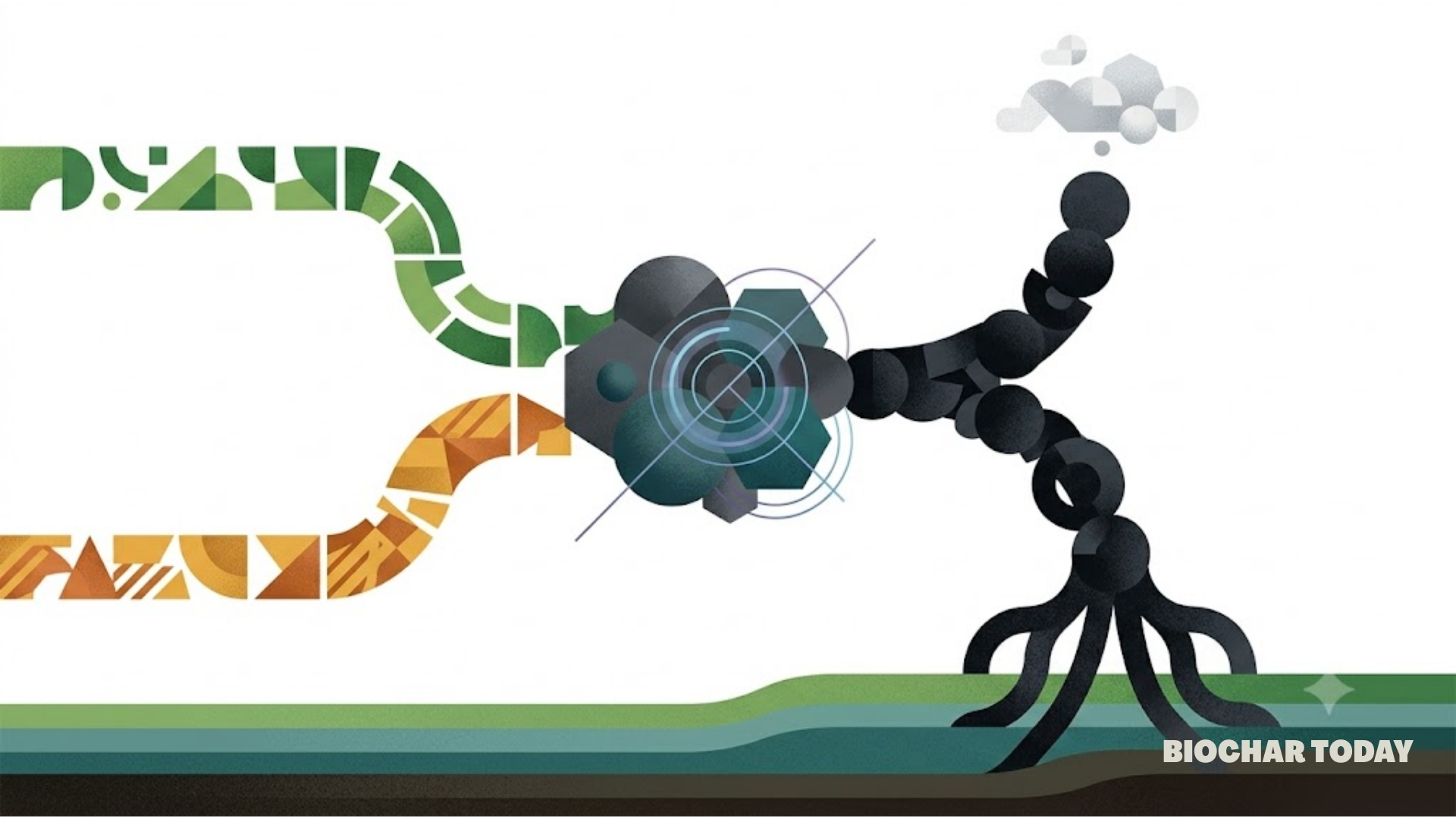
To address these implementation barriers, the research team designed an integrated, parallel-line biochar production system tailored for farm-scale deployment. Evaluated using operational data from the 230-hectare University of Leeds Research Farm, the system configuration processes dry crop straw and dewatered pig manure through two separate pyrolysis units operating at 600 degrees Celsius. Dewatering reduces manure moisture prior to thermal drying, while syngasSyngas, or synthesis gas, is a fuel gas mixture consisting primarily of hydrogen and carbon monoxide. It is produced during gasification and can be used as a fuel source or as a feedstock for producing other chemicals and fuels. More and liquid bio-oils recovered from both lines are combusted in a centralized burner. Thermal energy generated from the straw pyrolysis line is redirected to meet the drying demands of the wet manure line. The authors conducted a comprehensive cradle-to-grave life cycle assessment and techno-economic assessment to evaluate global warming potential, operational costs, and energy balances under multi-year crop rotation scenarios.
The results show that the integrated biochar system converts 330 metric tonnes of straw and the solid fraction of 9,750 metric tonnes of manure into nearly 300 metric tonnes of biochar annually. At the farm level, this operational model reduces manure management emissions by 75 percent and sequesters 350 metric tonnes of carbon dioxide equivalent per year. Recovered process heat fulfills internal drying requirements while generating surplus thermal energy that avoids an additional 29 metric tonnes of carbon dioxide emissions annually. The initial carbon abatement cost was calculated at 226 pounds sterling per metric tonne of carbon dioxide equivalent, driven primarily by capital expenditure, operational labor, and grid electricity use. Sensitivity analyses revealed that interannual variations in straw yield exert the largest influence on economic and environmental performance. During low-straw harvest years, purchasing supplementary straw to meet system heat requirements proved far more effective than reducing manure processing volumes or utilizing grid electricity.
This research highlights the viability of modular, multi-line pyrolysis architectures for farm-scale decarbonization. Separate feedstockFeedstock refers to the raw organic material used to produce biochar. This can include a wide range of materials, such as wood chips, agricultural residues, and animal manure. More processing preserves full regulatory compliance, allowing the resulting biochar to be legally applied to agricultural soils. Cross-line thermal integration eliminates the heavy energy penalty associated with high-moisture livestock waste, turning an operational bottleneck into a net-negative energy cycle. While initial equipment costs remain high, scaling operations through multi-farm cooperatives or integrating renewable farm power can reduce abatement costs significantly. This system framework provides a practical roadmap for agricultural producers seeking to meet net-zero targets while managing diverse waste streams.
Source: Tang, Y., Ford, J., & Cockerill, T. T. (2026). Environmental and economic assessment of biochar production systems from agricultural residues. Biochar, 8, Article 24.




Leave a Reply