
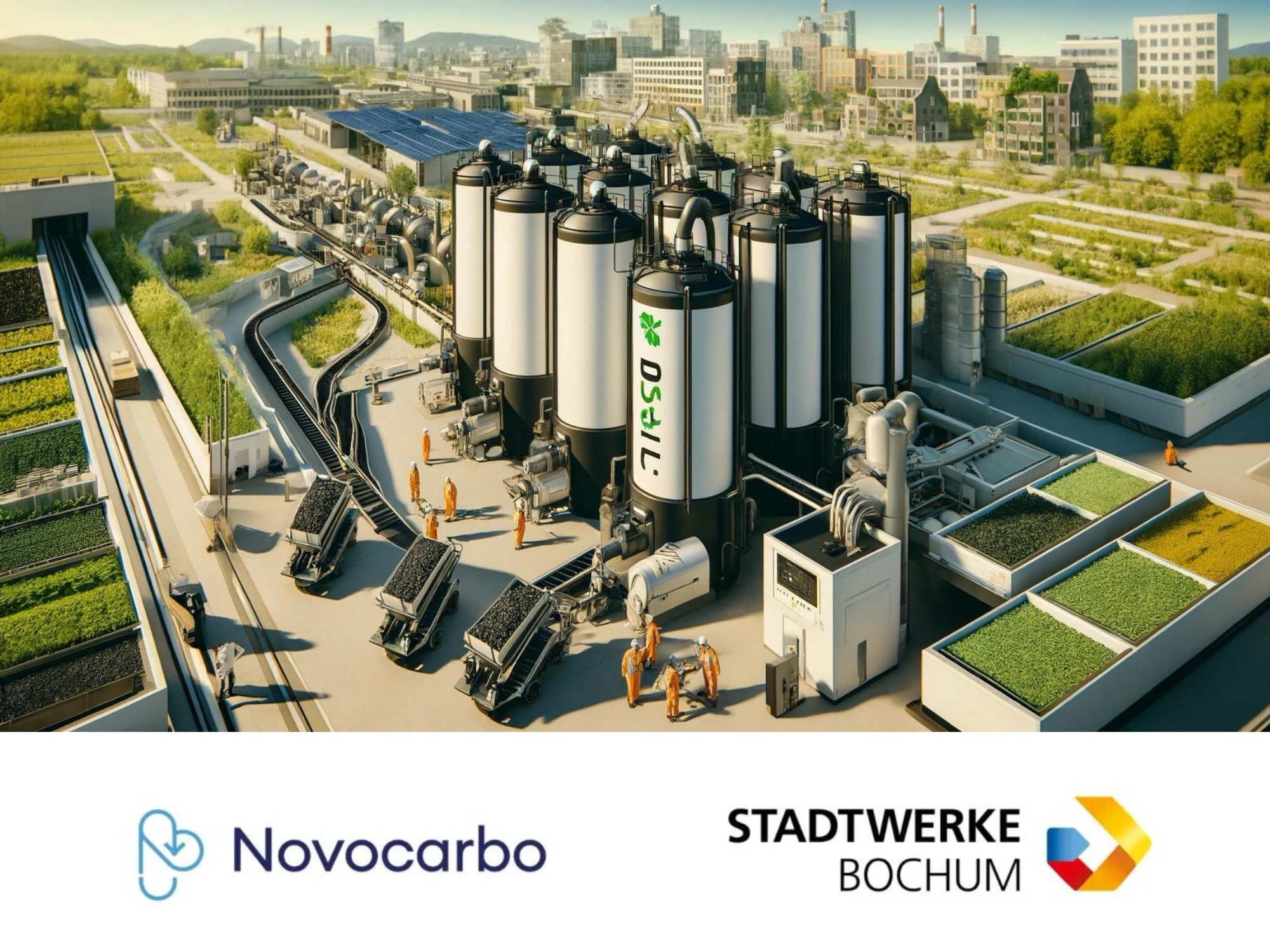
Novocarbo, a German climate tech company, has initiated the construction of its largest Carbon Removal Park (CDR-Park) in Bochum, Germany, in collaboration with Stadtwerke Bochum, the city’s municipal utility. This new venture is set to integrate biocharBiochar is a carbon-rich material created from biomass decomposition in low-oxygen conditions. It has important applications in environmental remediation, soil improvement, agriculture, carbon sequestration, energy storage, and sustainable materials, promoting efficiency and reducing waste in various contexts while addressing climate change challenges. More production with climate-neutral heat supply for the district heating network that currently supports approximately 26,000 households.
The facility employs Biochar Carbon Removal (BCR) technology, which involves pyrolysisPyrolysis is a thermochemical process that converts waste biomass into bio-char, bio-oil, and pyro-gas. It offers significant advantages in waste valorization, turning low-value materials into economically valuable resources. Its versatility allows for tailored products based on operational conditions, presenting itself as a cost-effective and efficient More of regional, biogenic waste materials to produce biochar and generate regenerative heat. Biochar effectively captures and stores carbon, offering a sustainable alternative that can be utilized as a soil conditioner in agriculture or as an additive in the construction industry.
Projected to commence at the end of 2024 on a site managed by USB Bochum GmbH, the CDR-Park will feature four PX1500 pyrolysis units from PYREG. This installation is expected to remove around 6,000 tonnes of CO2 annually, produce 3,300 tonnes of biochar, and generate 15,000 MWh of climate-neutral heat across an area of 4,500 m² starting from mid-2025.
Stadtwerke Bochum has acknowledged the project’s potential to significantly decarbonize Bochum’s heating infrastructure. The initiative also marks a first-time collaboration with a municipal utility in a major German city for Novocarbo, enhancing its portfolio of Carbon Removal Parks.
Since its foundation in 2017, Novocarbo has established various Carbon Removal Parks throughout Germany and aims to develop around 200 such sites by 2033. With an investment of approximately 14 million euros for the Bochum site, the project reflects both the company’s commitment to accelerating the transition to net-zero emissions and its strategy to support decarbonization in one of Germany’s most densely populated metropolitan regions.
READ MORE: Novocarbo And Stadtwerke Bochum To Offer Green District Heating With Biochar






Leave a Reply