
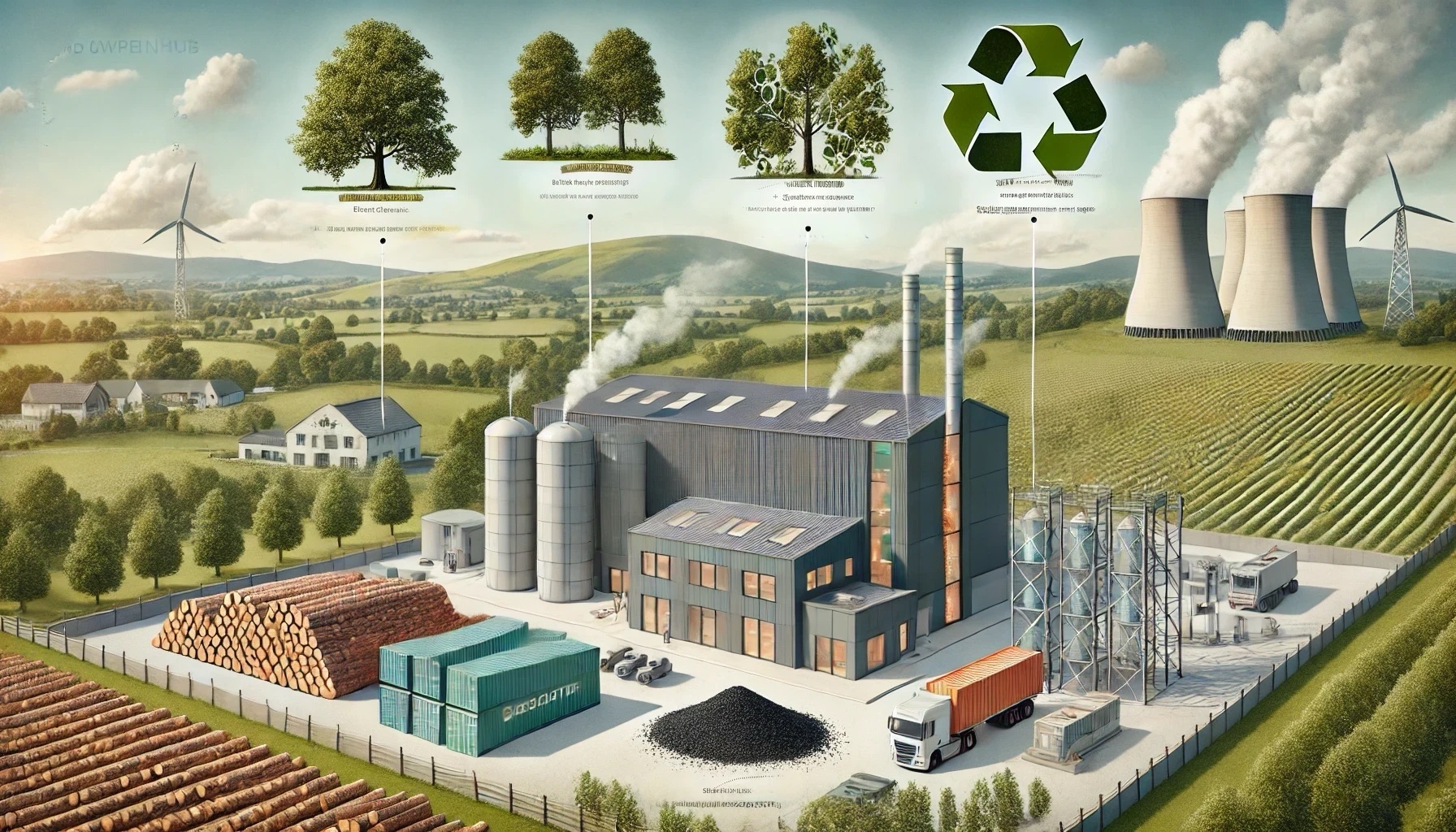
Plans have been submitted for a new green waste processing plant in Herefordshire, UK aimed at producing biocharBiochar is a carbon-rich material created from biomass decomposition in low-oxygen conditions. It has important applications in environmental remediation, soil improvement, agriculture, carbon sequestration, energy storage, and sustainable materials, promoting efficiency and reducing waste in various contexts while addressing climate change challenges. More. Berkshire-based company Onnu has applied for planning permission to construct a “green hub” near Leominster. The facility will convert felled trees and branches into biochar while also generating energy. The plant will be situated in a 1,000-square-meter building on the site of a former waste transfer station near the Cadbury’s factory at Marlbrook, where industrial units have already received planning approval.
Onnu claims that the facility will benefit the local tree care industry by providing a sustainable way to repurpose what would otherwise be waste—approximately 25,000 tonnes of tree material annually, including a significant amount of ashAsh is the non-combustible inorganic residue that remains after organic matter, like wood or biomass, is completely burned. It consists mainly of minerals and is different from biochar, which is produced through incomplete combustion. Ash Ash is the residue that remains after the complete More trees felled due to ash dieback. The process, known as pyrolysisPyrolysis is a thermochemical process that converts waste biomass into bio-char, bio-oil, and pyro-gas. It offers significant advantages in waste valorization, turning low-value materials into economically valuable resources. Its versatility allows for tailored products based on operational conditions, presenting itself as a cost-effective and efficient More, involves heating organic material in the absence of oxygen, breaking it down into gases and a carbon-rich biochar. The gases will then be burned to generate energy to sustain the pyrolysis process, dry the feedstockFeedstock refers to the raw organic material used to produce biochar. This can include a wide range of materials, such as wood chips, agricultural residues, and animal manure. More, and produce electricity.
This electricity will power two adjacent shipping container-type data centres, which will be available for rent to companies needing additional computing capacity, particularly in the pharmaceutical industry. The produced biochar has multiple applications in farming, horticulture, manufacturing, and construction. It enhances soil by retaining nutrients and water, provides a greener alternative to plant fertilizers, and can increase methane yields in anaerobic digestion systems. Additionally, biochar locks up atmospheric carbon for potentially hundreds of years, contributing to environmental sustainability.
READ MORE: Plan turn Herefordshire’s green waste into biochar and to power AI





Leave a Reply