
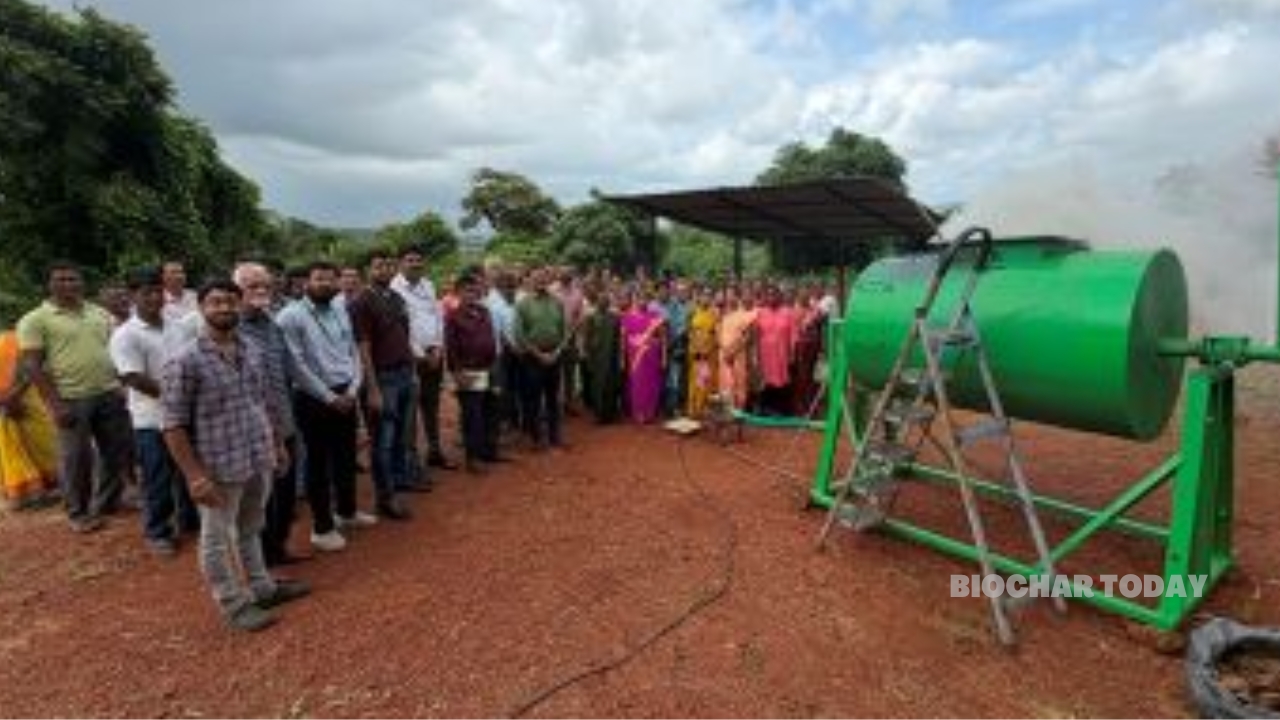
The ICAR–Central Coastal Agricultural Research Institute (ICAR-CCARI), in collaboration with Core CarbonX Solutions Pvt. Ltd., organized a specialized workshop titled “Carbon Pathshala: Voluntary Carbon Market (VCM) for Farmers” at ICAR-KVK in Old Goa, India. Held under an ongoing research project focused on plantation-based systems, the event aimed to integrate local agricultural practices with environmental market frameworks. About 100 farmers from regions including Keri, Priol, Madkai, Cumbarjua, and Karmali participated in technical sessions demonstrating the operational conversion of agricultural residues into high-value environmental assets.
Smallholder farmers in coastal agricultural regions face significant challenges in managing abundant plantation biomassBiomass is a complex biological organic or non-organic solid product derived from living or recently living organism and available naturally. Various types of wastes such as animal manure, waste paper, sludge and many industrial wastes are also treated as biomass because like natural biomass these More residues efficiently while lacking access to supplemental revenue channels. Traditional disposal methods often waste carbon-rich organic material that could otherwise enhance soil infrastructure. Furthermore, rural agricultural communities encounter steep technical and procedural barriers when attempting to navigate the complex verification, project cycles, and registration requirements necessary to participate in global voluntary carbon markets.
To address these operational and knowledge barriers, ICAR-CCARI, ICAR-CIAE, and Core CarbonX Solutions delivered actionable technical methodologies directly to local producers. Researchers demonstrated field-scale biocharBiochar is a carbon-rich material created from biomass decomposition in low-oxygen conditions. It has important applications in environmental remediation, soil improvement, agriculture, carbon sequestration, energy storage, and sustainable materials, promoting efficiency and reducing waste in various contexts while addressing climate change challenges. More production using a portable pyrolysisPyrolysis is a thermochemical process that converts waste biomass into bio-char, bio-oil, and pyro-gas. It offers significant advantages in waste valorization, turning low-value materials into economically valuable resources. Its versatility allows for tailored products based on operational conditions, presenting itself as a cost-effective and efficient More unit designed to convert coconut and plantation waste into stable carbon. Concurrently, technical experts mapped out the end-to-end carbon project cycle, training farmers on residue management, soil application techniques, and the precise carbon accounting protocols required to generate verified, tradable carbon credits from biochar sequestration.
The initiative successfully established a practical framework linking coastal agroforestry residue management directly to voluntary carbon trading platforms in India. By converting waste biomass into biochar, participating farmers gain a dual benefit: long-term enhancement of local soil health and access to an additional income stream via verified carbon credits. This pilot validation in Kulagar farming systems demonstrates how structured capacity-building can successfully connect smallholder agricultural operations to international carbon markets.


Leave a Reply