
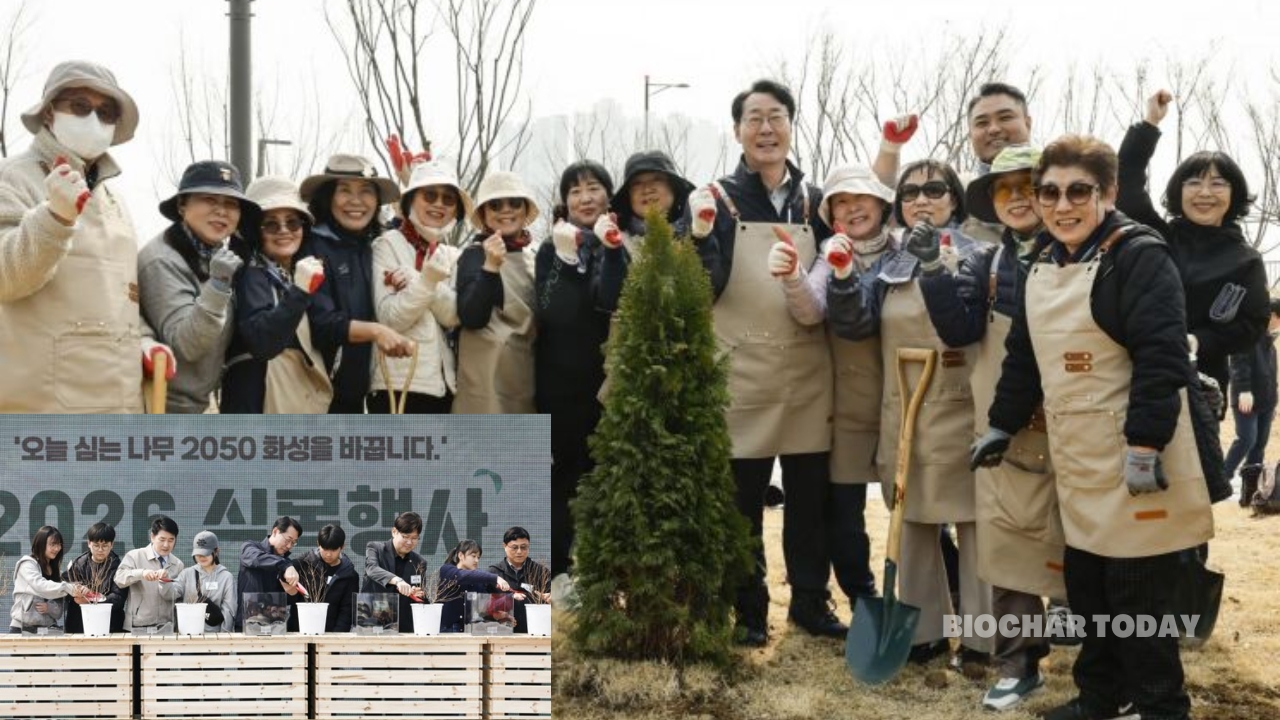
Hwaseong Special City, South Korea, recently conducted its “2026 Tree Planting Event” at Yedang Park, marking a significant integration of biocharBiochar is a carbon-rich material created from biomass decomposition in low-oxygen conditions. It has important applications in environmental remediation, soil improvement, agriculture, carbon sequestration, energy storage, and sustainable materials, promoting efficiency and reducing waste in various contexts while addressing climate change challenges. More into municipal environmental strategy. Mayor Jung Myunggeun, alongside the Hwaseong Suwon Osan Forestry Cooperative and local council members, led the initiative to plant over 400 trees across various species, including crape myrtle and emerald green arborvitae. This event serves as a foundational component of the city’s broader commitment to achieving carbon neutrality by 2050. By incorporating biochar into the planting process, the city demonstrates a transition toward scientific, circular resource management in urban landscaping.
The primary challenge addressed by the Hwaseong administration is the escalating climate crisis and the necessity for cities to move beyond traditional, passive greening efforts. Standard urban forestry often struggles with low survival rates for saplings and limited carbon sequestration potential in compacted urban soils. Furthermore, municipal governments face the ongoing issue of managing tree waste and woody biomassBiomass is a complex biological organic or non-organic solid product derived from living or recently living organism and available naturally. Various types of wastes such as animal manure, waste paper, sludge and many industrial wastes are also treated as biomass because like natural biomass these More generated from urban maintenance. Traditional disposal methods often lead to the release of stored carbon, missing the opportunity to leverage these waste streams for long-term environmental benefit.
To mitigate these issues, Hwaseong Special City has adopted a solution that focuses on the circular use of recycled tree waste. By converting municipal woody biomass into biochar, the city has created a soil amendmentA soil amendment is any material added to the soil to enhance its physical or chemical properties, improving its suitability for plant growth. Biochar is considered a soil amendment as it can improve soil structure, water retention, nutrient availability, and microbial activity. More that effectively sequesters carbon while enhancing the local soil environment. During the commemorative ceremony, participants used this biochar during the planting of 430 trees, symbolically and practically demonstrating an environmentally friendly approach to carbon management. This method transforms what was previously considered waste into a stable carbon sink that supports the health and longevity of the city’s green infrastructure.
The immediate outcomes of this initiative include the successful planting of six distinct tree species and the distribution of 800 companion trees to citizens to encourage residential participation in carbon-neutral practices. Administratively, the event signals Hwaseong’s intent to prioritize “sustainable green city” policies through the use of advanced climate technologies. By integrating biochar into public works, the city provides a scalable model for how municipal waste management and urban forestry can be unified to meet 2050 carbon neutrality targets. The project reinforces the role of local government in facilitating tangible, measurable responses to global climate shifts.


Leave a Reply