
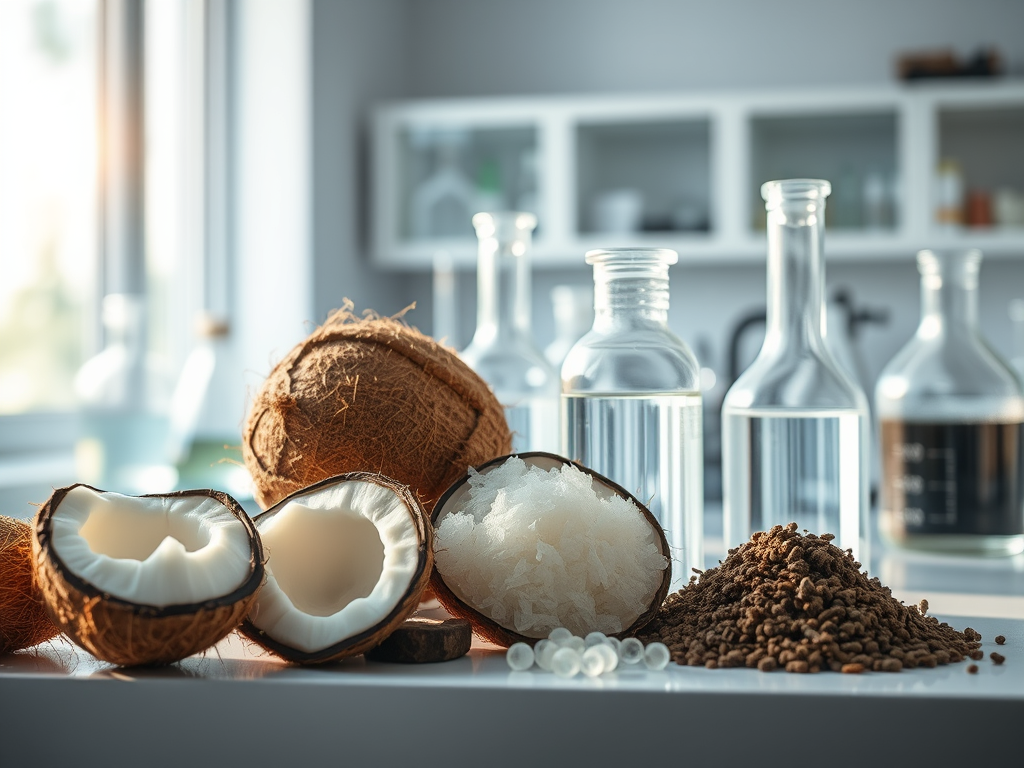
Industrial byproducts such as chlorobenzenes, chloroanilines, and chloronitrobenzenes are a major source of contamination in soil and groundwater, posing a risk to human health and ecosystems. At a former pesticide production site in Brazil, these chemicals are present in high concentrations, necessitating a solution for groundwater treatment. A recent Master of Applied Science thesis by Gabriel Negrelli Garcia investigated the use of locally sourced, coconut-derived materials as sustainable sorbents to tackle this problem. The study aimed to identify a suitable material for a treatment train that could remove these contaminants from water at site-relevant concentrations.
The research tested four coconut-derived materials: raw coconut husk, shell, and fiber (“Coconut”); two types of coconut-derived biocharBiochar is a carbon-rich material created from biomass decomposition in low-oxygen conditions. It has important applications in environmental remediation, soil improvement, agriculture, carbon sequestration, energy storage, and sustainable materials, promoting efficiency and reducing waste in various contexts while addressing climate change challenges. More prepared at 450∘C and 600∘C; and activated carbonActivated carbon is a form of carbon that has been processed to create a vast network of tiny pores, increasing its surface area significantly. This extensive surface area makes activated carbon exceptionally effective at trapping and holding impurities, like a molecular sponge. It is commonly More (AC) synthesized by phosphoric acid activation and pyrolysisPyrolysis is a thermochemical process that converts waste biomass into bio-char, bio-oil, and pyro-gas. It offers significant advantages in waste valorization, turning low-value materials into economically valuable resources. Its versatility allows for tailored products based on operational conditions, presenting itself as a cost-effective and efficient More at 450∘C. The primary objective was to evaluate the adsorption and desorption properties of these materials for a mixture of five chemicals present at the contaminated site.
The results were highly promising, with all four materials effectively adsorbing the target chemicals. The study found that all sorbents achieved at least a 70% reduction in aqueous phase concentration of the chemicals in the mixture. The most effective material for overall adsorption was the activated carbon, which achieved up to a 99.99% reduction in chemical concentrations when tested at a comparable mass to the biochars. However, when considering desorption—the release of adsorbed chemicals—the biochar pyrolyzed at 600∘C (Biochar600) was found to be the most advantageous.
Biochar600 demonstrated negligible desorption, even after four sequential desorption steps. This is a critical finding for remediation, as it means the contaminants would remain securely bound to the material, preventing them from re-entering the environment. In contrast, raw coconut and activated carbon both showed measurable desorption, with the raw coconut having a stronger desorption hysteresis, indicating that the chemicals were more strongly bound to it than to the AC.
The study also shed light on the impact of material preparation on performance. Pyrolysis and activation altered the functional group composition and physicochemical properties of the sorbents. Biochar600, for instance, had high aromatic content and a BET surface area more than 10 times higher than that of raw coconut, contributing to its strong adsorption capacity and stability. Raw coconut was still effective, removing at least 81% of the chemicals and desorbing less than the activated carbon, making it a viable option without extensive processing.
This research confirms that coconut-derived materials, particularly biochar, can be a sustainable and effective solution for treating complex mixtures of high-concentration organic pollutants in water. The data and regression parameters from this study provide a solid foundation for designing and scaling up a pilot-scale treatment system for field application, addressing a significant gap in current scientific literature.
Source: Garcia, G. N. (2025). Adsorption and Desorption of Mixtures of Chlorinated Benzenes, Anilines and Nitrobenzene on Coconut-Derived Husk, Biochar, and Activated Carbon (Master of Applied Science Thesis). University of Toronto.



Leave a Reply