
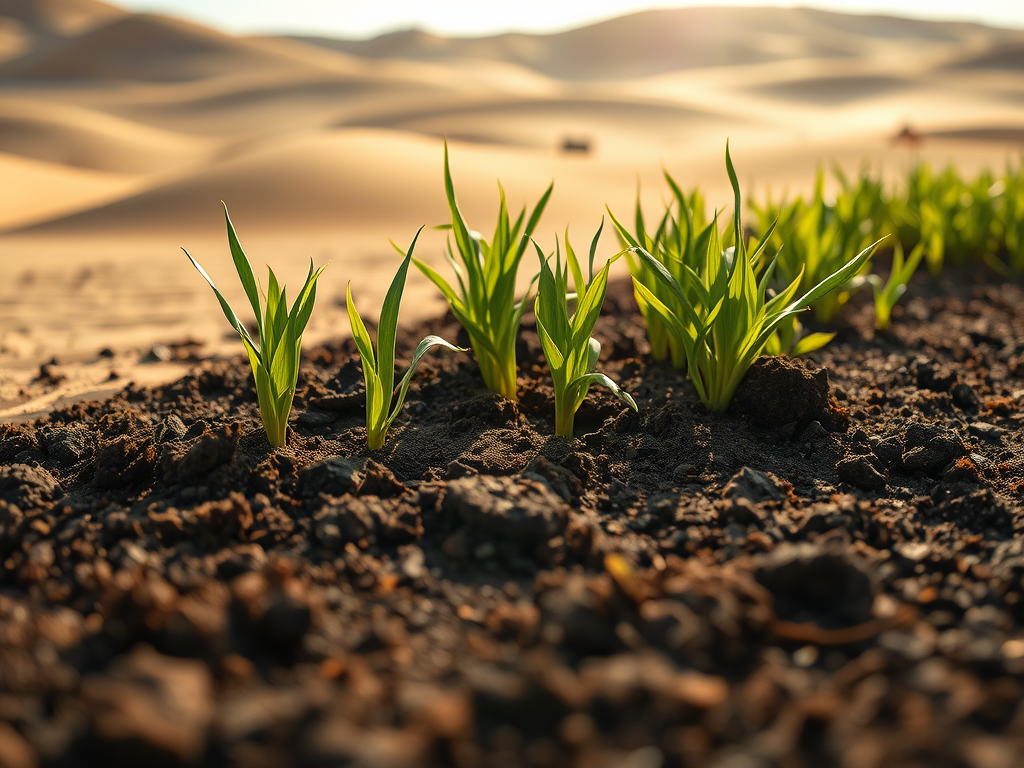
Can deserts bloom? Recent research from the Tengger Desert in China reveals a promising recipe for turning barren sandy soils into fertile landscapes. Scientists explored how the trio of biocharBiochar is a carbon-rich material created from biomass decomposition in low-oxygen conditions. It has important applications in environmental remediation, soil improvement, agriculture, carbon sequestration, energy storage, and sustainable materials, promoting efficiency and reducing waste in various contexts while addressing climate change challenges. More, polyethylene oxide (PEO), and seaweed fertilizer could transform desert soils, addressing challenges like poor water retention, erosion, and low fertility. The results are nothing short of remarkable- Have a look at this research combining biochar, organic fertilizers, and polymers in a better way to maintain the long-term productivity of sandy soils and alleviate the effects of drought erosion.
The experiment involved carefully blending 6% biochar, 0.6% PEO, and 2% seaweed fertilizer. This golden combination delivered transformative effects: soil bulk density dropped by nearly 10%, porosityPorosity of biochar is a key factor in its effectiveness as a soil amendment and its ability to retain water and nutrients. Biochar’s porosity is influenced by feedstock type and pyrolysis temperature, and it plays a crucial role in microbial activity and overall soil health. Biochar More increased by 14%, and water-holding capacity improved by 6.7%. These changes mean healthier soils that hold moisture longer, even in harsh desert conditions. But the spell didn’t stop there. The erosion rate plummeted by over 99%, while soil aggregates—the clumps that hold soil together—increased by up to 37.4%. With better structure and stability, the soil became a more welcoming home for plant roots. This was evident in a seed germination boost of 26.7%.
What makes this trio work so well? PEO creates a protective film to bind soil particles and prevent erosion, while biochar and seaweed fertilizer enhance soil nutrients and structure. However, the study also highlighted the importance of moderation: too much PEO can block oxygen flow to roots, and overloading biochar or seaweed fertilizer risks harming plants. While these findings are exciting, they are based on small-scale lab tests. The next steps? Large-scale field trials to confirm long-term benefits and refine application techniques for practical use.
Our take
This study underscores the transformative power of biochar in enhancing soil health, even in extreme conditions like deserts. Collaborative, science-driven solutions to global agricultural challenges are imperative and We encourage continued research to refine application methods and scale these innovations for real-world impact. With biochar leading the way, the dream of turning deserts green feels closer than ever.
Li, Haoying, et al. (2025). Co-application of polyethylene oxide (PEO), biochar, and seaweed fertilizer improves desert soil properties. Scientific Reports. https://doi.org/10.1038/s41598-025-85915-1




Leave a Reply