
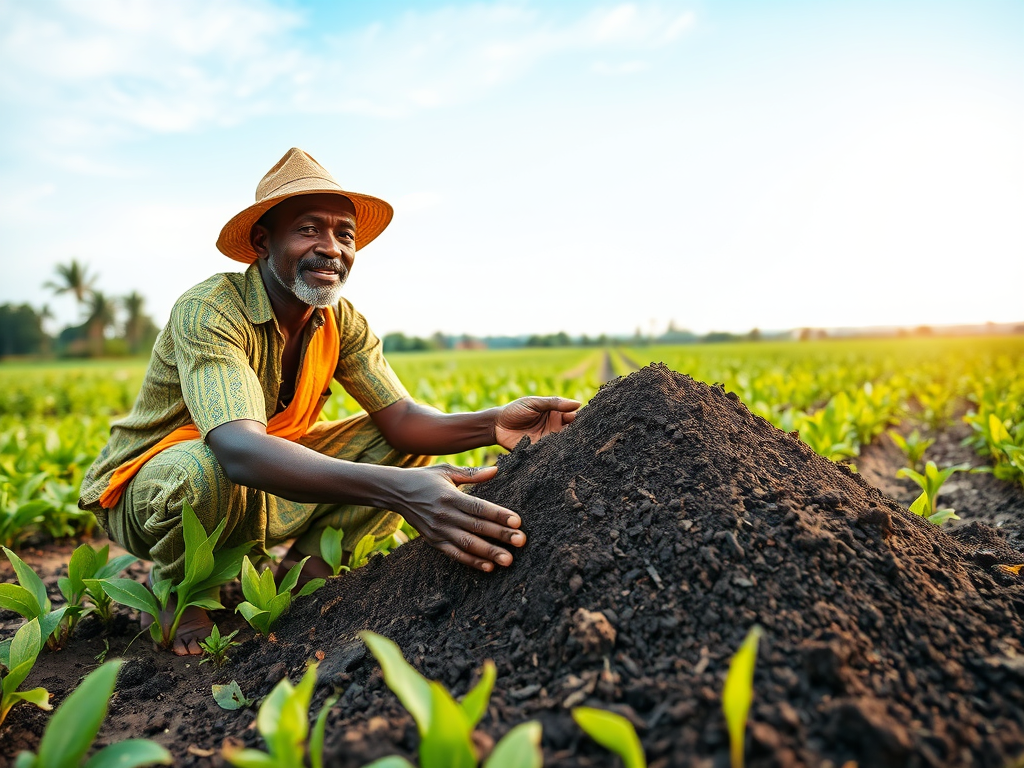
In the Tolon district of Ghana, a survey of 384 subsistence farming households found that the majority of farmers are willing to adopt biocharBiochar is a carbon-rich material created from biomass decomposition in low-oxygen conditions. It has important applications in environmental remediation, soil improvement, agriculture, carbon sequestration, energy storage, and sustainable materials, promoting efficiency and reducing waste in various contexts while addressing climate change challenges. More as a soil amendmentA soil amendment is any material added to the soil to enhance its physical or chemical properties, improving its suitability for plant growth. Biochar is considered a soil amendment as it can improve soil structure, water retention, nutrient availability, and microbial activity. More. This study, published in the journal Environment, Development and Sustainability, was conducted by Ammal Abukari, Ishmael Hashmiu, James Kaba Seutra, Akwasi Adutwum Abunyewa, and Olivia Agbenyega to address the lack of research on farmer perceptions and acceptability of biochar at the farm level. The findings indicate that 83.33% of farmers surveyed are willing to accept biochar as a soil amendment, with only 16.67% not willing to do so. The most common reasons cited for non-acceptance were a lack of knowledge about biochar (18.75%), not knowing how it is produced (42.19%), and believing that its production is labor-intensive (39.06%).
The study used a perception index model to determine farmer perceptions, finding that farmers strongly agreed with all positive statements about biochar. The most dominant perceptions were that biochar application is eco-friendly and that it increases crop yield. These perceptions ranked first and second with mean perception indices of 4.08 and 4.04, respectively. Farmers also had positive perceptions that biochar has no residual effects on crop cereals (mean PI of 4.03) and improves the soil’s physicochemical properties (mean PI of 3.91). Other favorable perceptions included that biochar can sustain soil fertility better than chemical fertilizers (mean PI of 3.65) and that it is less costly than chemical fertilizers (mean PI of 3.41).
In spite of these positive perceptions, farmers generally regarded biochar application as technically demanding (mean PI of 3.79) and labor-intensive (mean PI of 3.77). This finding aligns with other studies that have also found biochar production to be labor-intensive, mainly due to feedstockFeedstock refers to the raw organic material used to produce biochar. This can include a wide range of materials, such as wood chips, agricultural residues, and animal manure. More collection, storage, and transportation. While some farmers felt that biochar application does not require any special skills, this view had the lowest mean PI of 3.31 and was ranked 12th, indicating that this opinion was not widely held.
Using a probit regression model, the researchers found that a farmer’s willingness to accept biochar is significantly influenced by several socioeconomic factors. The study’s findings indicate that educational level, farming experience, access to extension services, membership in farmer groups, access to biochar, and access to credit all had a significant positive influence on biochar acceptance. The pseudo R² value suggests that 56.83% of the variation in the independent variables is explained by the probit model, showing its strong predictive ability.
Farming experience had the highest effect on the probability of biochar acceptance. The study found that for every unit increase in farming experience, there was a 5.8% increase in the probability of biochar being accepted by smallholder farmers. The positive influence of farming experience aligns with existing literature, which suggests that early adopters with extensive experience gain an advantage from new technologies and have better access to information and knowledge. Likewise, consistent interactions with extension officers and membership in farmer groups were shown to increase the likelihood of a farmer accepting biochar. The study concludes that these findings can support the promotion of biochar as a cost-effective and eco-friendly way to improve crop production, especially in areas with degraded soils, which is consistent with Sustainable Development Goals 2, 12, and 13.
Source: Abukari, A., Hashmiu, I., Seutra, J. K., Abunyewa, A. A., & Agbenyega, O. (2025). Farmers’ perceptions and acceptability of Biochar as a soil amendment in the Tolon district of Ghana. Environment, Development and Sustainability.





Leave a Reply