
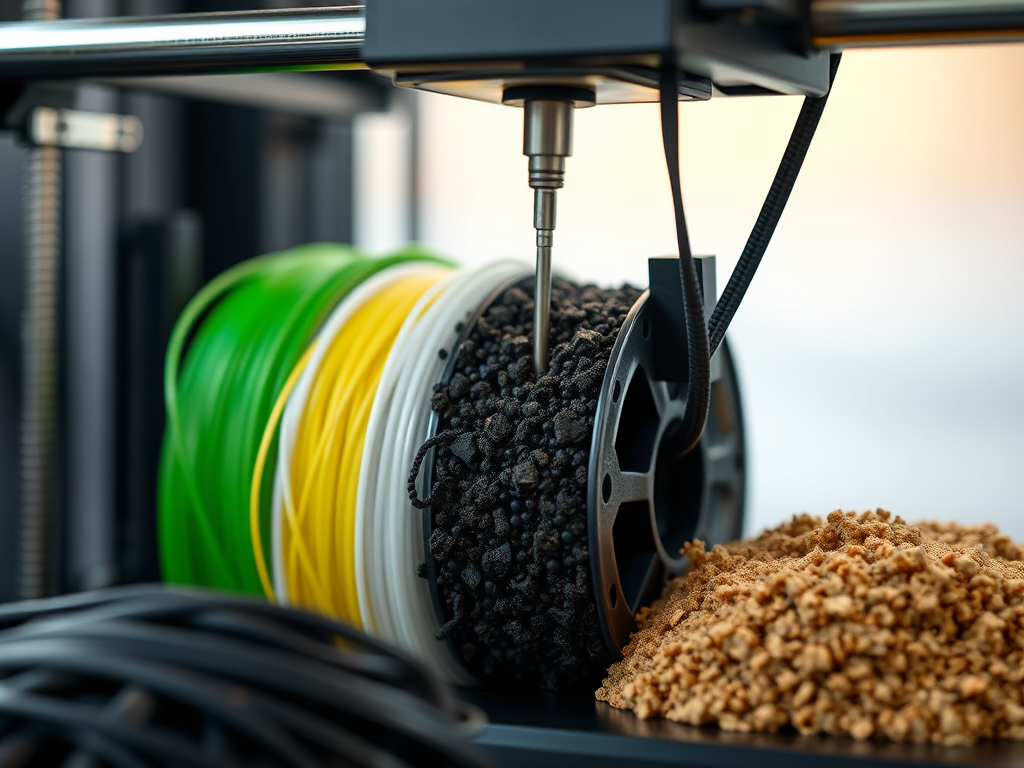
Nectarios Vidakis and colleagues, in their study published in BiocharBiochar is a carbon-rich material created from biomass decomposition in low-oxygen conditions. It has important applications in environmental remediation, soil improvement, agriculture, carbon sequestration, energy storage, and sustainable materials, promoting efficiency and reducing waste in various contexts while addressing climate change challenges. More , investigate the impact of biochar content on the quality metrics of biocomposites used in additive manufacturing. The study focuses on five popular polymers: Acrylonitrile Butadiene Styrene (ABS), High-Density Polyethylene (HDPE), Polyethylene Terephthalate Glycol (PETG), Polylactic Acid (PLA), and Polypropylene (PP). These biocomposites were evaluated for critical quality indicators (CQIs) such as porosityPorosity of biochar is a key factor in its effectiveness as a soil amendment and its ability to retain water and nutrients. Biochar’s porosity is influenced by feedstock type and pyrolysis temperature, and it plays a crucial role in microbial activity and overall soil health. Biochar More, dimensional accuracy, and surface roughness.
Using material extrusion (MEX) 3D printing, the researchers incorporated biochar as a filler in varying proportions (2–10 wt%). Results demonstrated that a 4 wt% biochar loading consistently delivered optimal quality across most polymers, minimizing porosity and dimensional deviation while maintaining tensile strength. However, PETG performed differently, showing its best results at 6 wt%.
Advanced testing methods like micro-computed tomography (µ-CT) and atomic force microscopy (AFM) revealed how biochar’s presence influenced structural and mechanical properties. For instance, reduced porosity and enhanced geometric accuracy were closely tied to increased tensile strength. This effect varied among the polymers, with HDPE benefiting most from biochar reinforcement.
The study highlights biochar’s potential as an eco-friendly additive in 3D printing. By optimizing biochar content, manufacturers can enhance the performance and sustainability of biocomposites, paving the way for greener additive manufacturing solutions.
SOURCE: Vidakis, N., Petousis, M., Sagris, D., David, C., Mountakis, N., Spiridaki, M., Maravelakis, E., Charitidis, C., & Stratakis, E. (2025). Enhancing biocomposite critical quality indicators (CQIs): The impact of biochar content in additive manufacturing. Biochar, 7(22). https://doi.org/10.1007/s42773-024-00400-8





Leave a Reply