
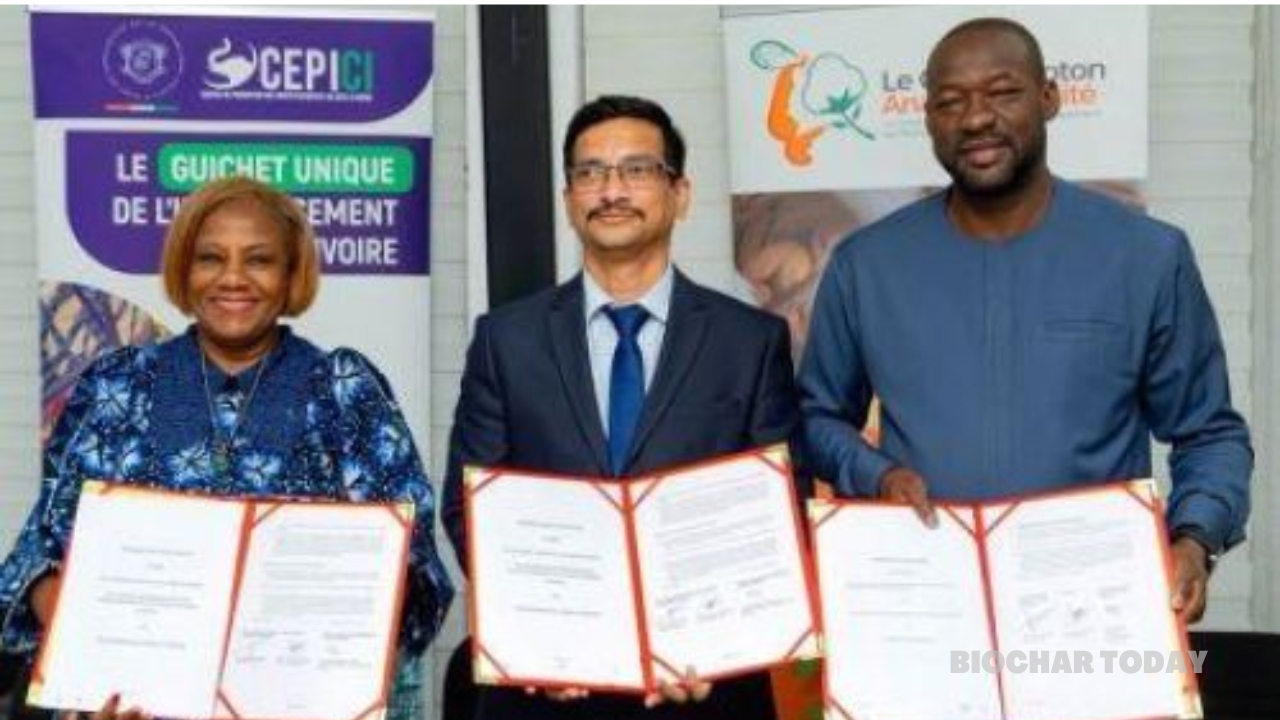
In Côte d’Ivoire, growing international investment is expanding industrial infrastructure to process cashew nut shells into higher-value biomassBiomass is a complex biological organic or non-organic solid product derived from living or recently living organism and available naturally. Various types of wastes such as animal manure, waste paper, sludge and many industrial wastes are also treated as biomass because like natural biomass these More derivatives and biocharBiochar is a carbon-rich material created from biomass decomposition in low-oxygen conditions. It has important applications in environmental remediation, soil improvement, agriculture, carbon sequestration, energy storage, and sustainable materials, promoting efficiency and reducing waste in various contexts while addressing climate change challenges. More. On September 11, 2026, Indian firm Essar Biofuels Ltd signed a memorandum of understanding valued at over $75 million with the Cotton, Cashew and Shea Council (CCAK) and the Investment Promotion Center (CEPICI) to construct a cashew nut shell liquid (CNSL) and cardanol extraction facility. This agreement follows recent sector developments, including Singapore-based Valency International commissioning a commercial plant in Attinguié capable of processing 20,000 metric tons of shells annually to yield nearly 6,000 metric tons of biochar. Additionally, Ivorian processor Foods’Co secured €3 million from Belgian fund BIO to establish a CNSL and briquette facility in Béoumi.
The expansion addresses the critical waste-management and financial challenges created by rapidly scaling domestic cashew processing. Côte d’Ivoire processed approximately 660,000 metric tons of raw cashews in 2025—roughly 42% of national production—up from 344,026 metric tons in 2024. Because shells represent nearly 70% of raw cashew nut weight, this operational expansion generated vast volumes of residual biomass. According to market analysis by French nonprofit Nitidæ, underutilized shell residues impose substantial storage, transportation, and disposal costs on processors, while unmanaged stockpiles create environmental liabilities.
To resolve these residue bottlenecks, public authorities and private investors are deploying an integrated processing strategy that targets global bio-based material markets. The CCAK organized dedicated industry workshops in Abidjan to align financial partners, project developers, and processors around high-value outputs, including cardanol, briquettes, and biochar. Private entities are introducing commercial technology to convert low-value shells near primary processing centers. These facilities utilize pyrolysisPyrolysis is a thermochemical process that converts waste biomass into bio-char, bio-oil, and pyro-gas. It offers significant advantages in waste valorization, turning low-value materials into economically valuable resources. Its versatility allows for tailored products based on operational conditions, presenting itself as a cost-effective and efficient More and chemical extraction to transform agricultural waste into standardized industrial feedstocks and biochar, aligning with national targets to process 50% of the domestic cashew crop locally by 2030.
This multi-company investment wave converts operational waste liabilities into structured revenue streams while establishing Côte d’Ivoire within the global CNSL market, which is projected to grow from $446 million in 2026 to $718 million by 2035. Localized biochar and briquette production creates stable commercial outlets for agricultural residue, optimizes supply chain logistics, and lowers overall waste-handling expenses for Ivorian cashew processors.


Leave a Reply