
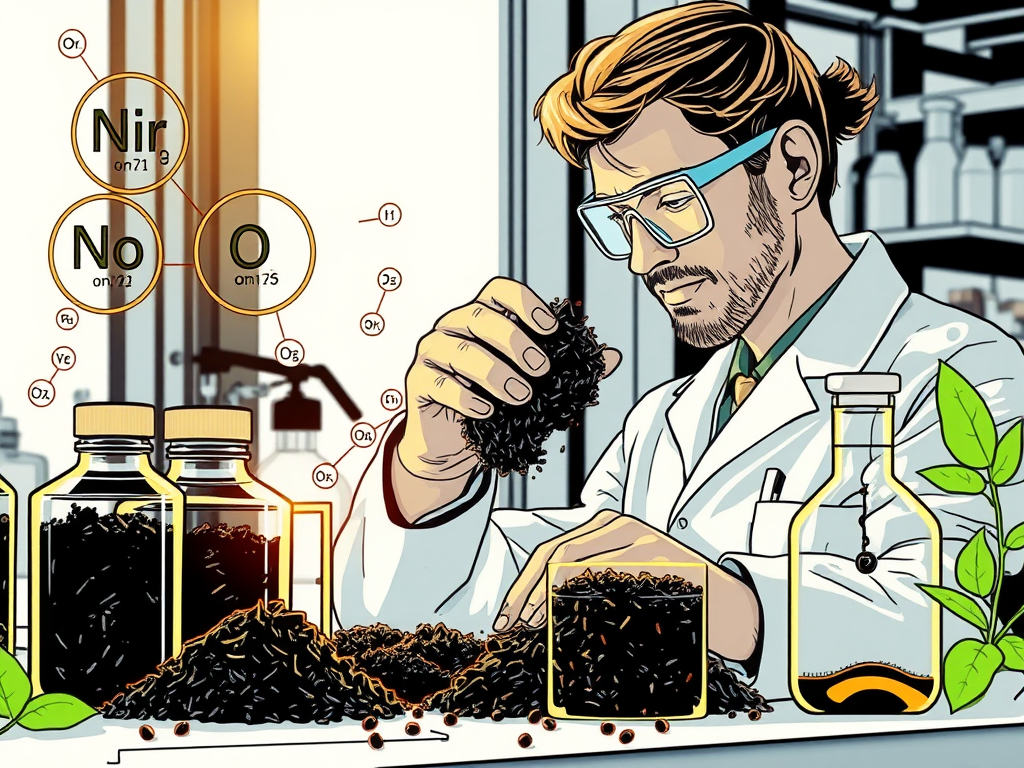
In a recent review published in Agricultural Ecology and Environment, Jianhua Qu, Hongxuan Chu, and colleagues systematically analyzed how doping, or modifying, biocharBiochar is a carbon-rich material created from biomass decomposition in low-oxygen conditions. It has important applications in environmental remediation, soil improvement, agriculture, carbon sequestration, energy storage, and sustainable materials, promoting efficiency and reducing waste in various contexts while addressing climate change challenges. More with various elements can transform it into a highly effective agent for detoxifying heavy metal-contaminated agricultural soils. Biochar, a carbon-rich material made from abundant biomassBiomass is a complex biological organic or non-organic solid product derived from living or recently living organism and available naturally. Various types of wastes such as animal manure, waste paper, sludge and many industrial wastes are also treated as biomass because like natural biomass these More sources, is already a promising tool due to its ready availability and environmental compatibility, but its basic form, called pristine biochar, often lacks the adsorption efficacy needed for practical remediation. The core idea is to introduce new atoms like Nitrogen (N), Oxygen (O), Sulfur (S), or Phosphorus (P) to create better surface chemistry and additional active sites, which in turn leads to superior metal-binding performance. Pristine biochar primarily works by locking up heavy metals through physical adsorption, electrostatic interaction, ion exchange, and surface complexation. However, these mechanisms alone are often insufficient, necessitating the development of element-doped biochar (EDBC).
The study highlights how different element dopants contribute distinct advantages, greatly surpassing the performance of raw biochar. Nitrogen-doping is highly effective because it introduces N-containing functional groups like pyridinic N, pyrrorolic N, and graphitic N. These groups serve as active centers for complexation reactions with heavy metals, facilitated by the nitrogen atoms’ lone pair electrons, and they elevate the basicity of the biochar surface, enhancing electrostatic interactions. For instance, N-doped BC derived from Oleifera shells achieved a maximum adsorption capacity of 723.6 mg/g for Pb(II). Phosphorus-doping is extremely valuable because P-containing functional groups (P-OH, P=O, P-O-C linkages) not only refine the internal pore structure to increase the specific surface area but, most importantly, enable the formation of highly stable phosphate precipitation compounds with heavy metal ions. One P-doped BC, synthesized from oleifera shells, showed Pb(II) passivation was primarily driven by the creation of phosphate precipitation.
Oxygen-doping mainly introduces O-containing functional groups, notably carboxyl (-COOH) and hydroxyl (-OH) groups, which are critical for promoting surface coordination and increasing negative surface charges through deprotonation, boosting electrostatic attraction. Sulfur-doping is particularly potent because S-containing functional groups (e.g., thiophene sulfur, −SO3H) can form strong metal-sulfur coordination bonds, which have higher bond energies than those formed by O or N groups. Na2S-modified BC, for example, showed a passivation performance for Cd ions (37.27%) nearly three times that of raw BC. S-modified biochar can also reduce bioavailable Cd in soil by a significant 70.28%. The study also emphasizes that EDBC’s practical efficacy in agricultural settings is often maximized when combined with other remediation strategies. For example, when EDBC is used alongside phytoremediationThis is a technique that uses plants to clean up contaminated soil or water. Biochar can enhance phytoremediation by improving soil conditions and promoting plant growth, allowing plants to absorb and break down pollutants more effectively. More (using plants), the biochar improves soil physicochemical properties, such as aeration and structure, which creates better conditions for plant growth. Concurrently, the EDBC immobilizes heavy metals, reducing their toxicity and stress on the plants. A combination of P/S co-doped BC and a green manure crop significantly enhanced the plant’s tolerance to Cd stress, while increasing soil available P content by 86.17%. Similarly, in microbial remediation, EDBC’s large specific surface area makes it an excellent microbial carrier, providing essential nutrients and protective habitats for microbe colonization. The synergy is pronounced: the application of an Fe/S-doped BC-bacteria composite improved soil fertility (available K and P elevated to 26.79 and 52.25 mg/kg, respectively) and diminished the unstable fraction of Pb by 55.43%. Overall, EDBC represents a pivotal advancement in sustainable environmental remediation, but future work must focus on developing targeted doping strategies, addressing the potential risk of secondary metal leachingLeaching is the process where nutrients are dissolved and carried away from the soil by water. This can lead to nutrient depletion and environmental pollution. Biochar can help reduce leaching by improving nutrient retention in the soil. More, and expanding research to include anionic metal groups.
Source: Qu, J., Chu, H., Wang, M., Yu, R., Wang, S., Liu, T., Tao, Y., Han, S., & Zhang, Y. (2025). Synthesis, mechanism, and application of element-doped biochar for heavy metal contamination in agricultural soils. Agricultural Ecology and Environment, 1, e002.




Leave a Reply