
Key Takeaways
- Massive Climate Win: By combining a water-saving method with engineered soil material, rice farmers can cut one of the most potent greenhouse gas emissions—methane—by up to 90%.
- No Sacrifice on Yield: Unlike some climate-friendly farming methods, this approach not only maintained but increased rice yield by up to 12% over the long term, ensuring food security.
- The “Fix” for BiocharBiochar is a carbon-rich material created from biomass decomposition in low-oxygen conditions. It has important applications in environmental remediation, soil improvement, agriculture, carbon sequestration, energy storage, and sustainable materials, promoting efficiency and reducing waste in various contexts while addressing climate change challenges. More: Raw biochar can sometimes backfire initially. The key is to use acid-modified biochar, which neutralizes the material’s pHpH is a measure of how acidic or alkaline a substance is. A pH of 7 is neutral, while lower pH values indicate acidity and higher values indicate alkalinity. Biochars are normally alkaline and can influence soil pH, often increasing it, which can be beneficial More and prevents a spike in methane production during the first critical year.
- Save Water and Soil: This strategy combines water conservation (Alternate Wetting and Drying) with soil improvement (biochar), making it a true dual solution for agriculture in water-stressed regions.
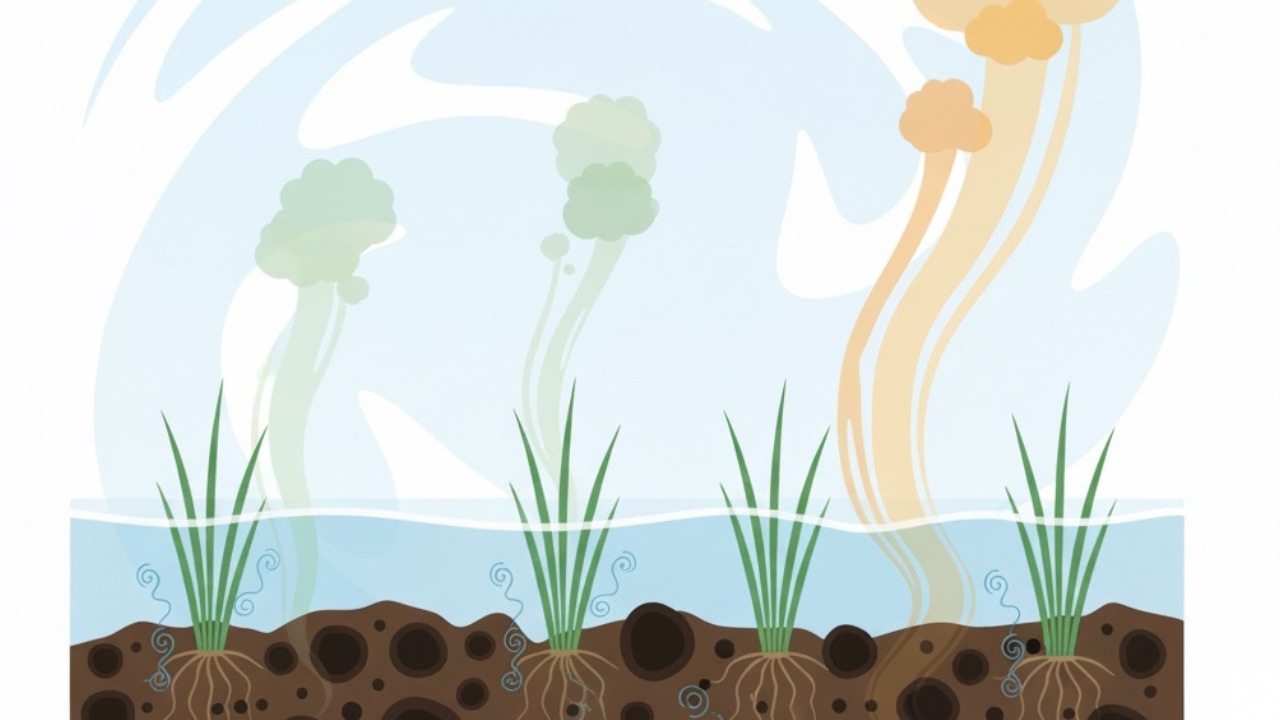
The world’s most important staple crop is rice, feeding over half the global population. Yet, the traditional method of growing rice in continuously flooded paddies creates an enormous environmental challenge: methane (CH4) emissions. Methane from these anaerobic rice fields contributes significantly—over 75%—to the total greenhouse gas (GHG) emissions from croplands. Compounding this climate challenge is the issue of water scarcity, as rice farming consumes vast amounts of water. To secure food production while meeting climate goals, scientists must find ways to reduce both water use and methane emissions without sacrificing the crop yield. A
3-year field study, “Engineered biochar effects on methane emissions and rice yield under alternate wetting and drying in paddy soils,” published in Environmental Technology & Innovation by Chang Liu, Taotao Chen, Feng Zhang, Hongwei Han, Benji Yi, Jun Meng, Daocai Chi, Yong Sik Ok, and colleagues, provides a robust, dual-solution to this problem.
The core strategy studied involves combining two key sustainable practices: Alternate Wetting and Drying (AWD) irrigation and the application of acid modified biochar (B20A). AWD is a proven water-saving technique where fields are periodically drained and allowed to dry out before being flooded again. This practice dramatically reduces the anaerobic conditions necessary for methane-producing bacteria. Consequently, AWD alone cut CH4 emissions by 63–80% and reduced water consumption by 10–12%. However, this method comes with a trade-off: the repeated drying and re-wetting cycles can increase the loss of soil nutrients and potentially threaten long-term soil fertility and yield stability. This is where biochar enters the equation to improve soil health, retain nutrients, and sequester carbon. However, initial studies often found that raw biochar can actually cause a spike in CH4 emissions and even decrease crop yield in the first year. This “first-year negative impact” is often due to biochar’s naturally high pH, which can initially stimulate methane-producing microbes.
The innovative step taken by the research team was to apply acid modification to the biochar. Before application, the rice straw biochar was treated with a weak sulfuric acid solution. This engineering process was critical because it neutralized the biochar’s alkaline properties, dropping its pH from a high of 10.14 down to a near-neutral 7.01. Crucially, the modification enhanced the biochar’s chemical surface, adding more oxygen-containing and acidic functional groups. This adjustment eliminated the initial negative side effects; the acid modified biochar (B20A) suppressed CH4 emissions by 19% in the first year while maintaining a stable yield, effectively solving the “first-year problem”.
The synergy between the AWD irrigation and the B20A biochar proved to be the winning strategy over the three-year study. The combined treatment, IAWDB20A, achieved the most dramatic environmental benefits, decreasing total seasonal CH4 emissions by 75–89% compared to the traditional continuously flooded field with no biochar. This led to an equally impressive reduction in the Greenhouse Gas Emission Intensity (GHGI) of 75–90%, meaning farmers can produce far more rice for every unit of GHG released. The success is rooted in the soil, where the biochar provided a long-term benefit, increasing soil organic carbon (SOC) by 27–44% , and enhancing soil health.
Furthermore, the yield benefits were validated over time. While the raw biochar showed a 6% yield reduction in the first year, the engineered biochar (B20A) enhanced the grain yield by 8% and 12% in the subsequent two years (2020 and 2021) compared to the control plots. This demonstrated that the long-term gains in soil fertility and root growth, driven by the stable biochar amendment, translate directly into higher productivity. By coupling water-saving irrigation with a stable, engineered soil amendmentA soil amendment is any material added to the soil to enhance its physical or chemical properties, improving its suitability for plant growth. Biochar is considered a soil amendment as it can improve soil structure, water retention, nutrient availability, and microbial activity. More, this research offers a pathway for rice farming to simultaneously achieve climate change mitigation, water resource conservation, and improved food security.
Source: Liu, C., Chen, T., Zhang, F., Han, H., Yi, B., Meng, J., Chi, D., & Ok, Y. S. (2025). Engineered biochar effects on methane emissions and rice yield under alternate wetting and drying in paddy soils. Environmental Technology & Innovation, 38, 104133.



Leave a Reply