
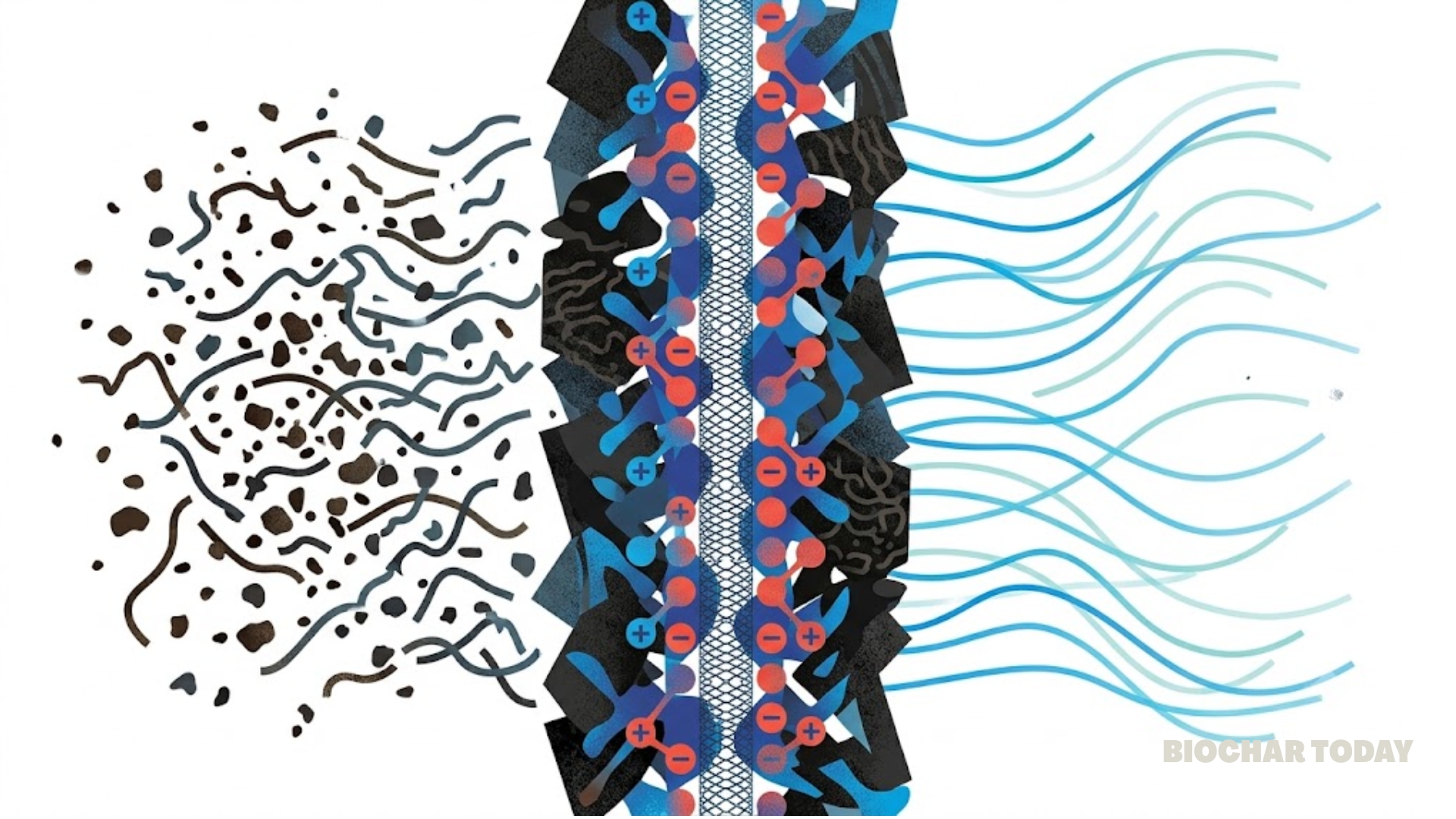
BiocharBiochar is a carbon-rich material created from biomass decomposition in low-oxygen conditions. It has important applications in environmental remediation, soil improvement, agriculture, carbon sequestration, energy storage, and sustainable materials, promoting efficiency and reducing waste in various contexts while addressing climate change challenges. More is a sustainable, low-cost material traditionally viewed as either an adsorbent (soaking up pollutants) or a catalyst (using external oxidants like H2O2 to create free radicals for degradation) in wastewater treatment. However, this new research, “Structure-performance relationship of biochar for direct degradation of organic pollutants,” published in Carbon Research by Fan Zhang, Yuan Gao, Yajie Gao, and Rui Han, reveals a frequently overlooked capability: direct degradation. This process relies on the biochar itself acting as an electron donor to break down pollutants without needing any external oxidants.
To address the ambiguity between adsorption, direct degradation, and the oxidant-free indirect degradation (where biochar activates dissolved oxygen to create reactive oxygen species, ROS) , the researchers conducted quantification and electrochemical tests. Their key finding is that direct degradation contributes significantly to the overall cleanup, averaging up to 40%±10% of the total degradation performance for organic pollutants tested. Overall, the entire degradation process (direct plus indirect) accounts for approximately 30%±10% of the total pollutant removal, while pure adsorption makes up about 70%±10%.
The study conclusively demonstrated that the direct degradation capacity of biochar is highly and positively correlated with its electron-donating capacity (EDC) (R2=0.867). This means biochar primarily functions as an electron donor, reductively transforming pollutants through direct electron transfer. The EDC was found to be significantly higher than the electron-accepting capacity (EAC), confirming the dominance of reductive degradation processes.
Further analysis linked this EDC directly to the material’s specific chemical structures. The electron-donating power of biochar primarily stems from oxygen-containing surface functional groups, specifically C−O and O−H moieties. The correlation between C-O groups and EDC was a high 0.947, and between O-H groups and EDC was 0.903. These functional groups donate electrons to the organic pollutants, facilitating degradation. Additionally, the graphitic structure (ordered sp2-carbon) was shown to enhance the electron transfer efficiency, further promoting direct degradation.
Crucially, the study found that dissolved oxygen in natural water can compete with organic pollutants for electrons from the biochar, which may reduce the direct degradation efficiency by 30% to 70%. The direct degradation mechanism offers significant practical benefits. The direct degradation performance remained stable even after five cycles, retaining over 90% of its efficiency. This is superior to many metal-based catalysts which suffer from rapid efficiency loss due to passivation or leachingLeaching is the process where nutrients are dissolved and carried away from the soil by water. This can lead to nutrient depletion and environmental pollution. Biochar can help reduce leaching by improving nutrient retention in the soil. More. The maximum direct degradation capacity of 11 mg/g achieved by the modified biochar is comparable to high-performance iron-based catalysts (which reach about 15 mg/g) but without the associated risk of metal leaching. This stability, combined with the ability to function efficiently without light or external oxidants, highlights a promising and cost-effective new role for biochar in sustainable wastewater treatment.
Source: Zhang, F., Gao, Y., Gao, Y., & Han, R. (2025). Structure-performance relationship of biochar for direct degradation of organic pollutants. Carbon Research, 4(1): 53.




Leave a Reply