

Key Takeaways
- Common agricultural waste, like canola straw, can be turned into biocharBiochar is a carbon-rich material created from biomass decomposition in low-oxygen conditions. It has important applications in environmental remediation, soil improvement, agriculture, carbon sequestration, energy storage, and sustainable materials, promoting efficiency and reducing waste in various contexts while addressing climate change challenges. More, a low-cost, super-sponge material that cleans up groundwater contaminated with oil and gasoline.
- The biochar works incredibly fast; oil and gas concentrations dropped by over 40% in the first minute of adding it to the water.
- For some harmful oil compounds, the biochar removed more than 99% of the contamination at the highest dose tested.
- This cleaning process is like the pollutants getting chemically glued to the biochar’s tiny pores (called chemisorption), rather than just sticking slightly.
- Using biochar is a win-win: it manages farm waste and cleans up spills, supporting a circular economy.
A study in the journal Chemosphere by Abhijeet Pathy, M. Anne Naeth, and Scott X. Chang investigated a simple and green way to purify dirty groundwater: using biochar made from canola straw. When oil and gasoline spill, they pollute the groundwater below, and those soluble contaminants—like BTEX (found in gasoline) and PAHs (toxic oil compounds)—can spread and harm us and the environment. The scientists wanted to see if this common farm waste could act like a filter to catch 12 different kinds of pollutants at the same time, mimicking a real spill scenario.
The results were impressive. The biochar acted like a powerful sponge, dramatically cutting down the contamination right away. The concentration of F1 hydrocarbons, the lighter, more water-soluble components, dropped by over 40% in the first minute alone. It kept working, reaching a 95% cleanup rate for F1 after 15 days. Even better, F2 hydrocarbons—slightly heavier but still mobile—were almost completely gone, sinking below the detectable level within just 24 hours. The biochar proved its strength against the toxic BTEX compounds as well. For example, ethylbenzene was virtually eliminated with a 99% removal efficiency over the 15-day test. Toluene and xylene also reached high removal rates of 98% and 99%, respectively. The most toxic compounds, the PAHs, were quickly removed, with most concentrations disappearing below the detection limit in just a day. These high rates confirm the biochar was doing the heavy lifting, as contamination in control groups (without biochar) only reduced slightly from natural evaporation.
The researchers looked at how much biochar was needed for the best cleanup. While a small amount was enough to completely remove the PAHs and F2 hydrocarbons, the high concentrations of F1 and BTEX needed a boost. For F1, increasing the biochar dose from 0.5 g L−1 to 2 g L−1 raised the cleanup rate from 76% to 98%. Similarly, benzene removal increased from 66% to 97% over the same dosage increase. This means more biochar provides more surface area and more “sticky spots” to catch the pollutants.
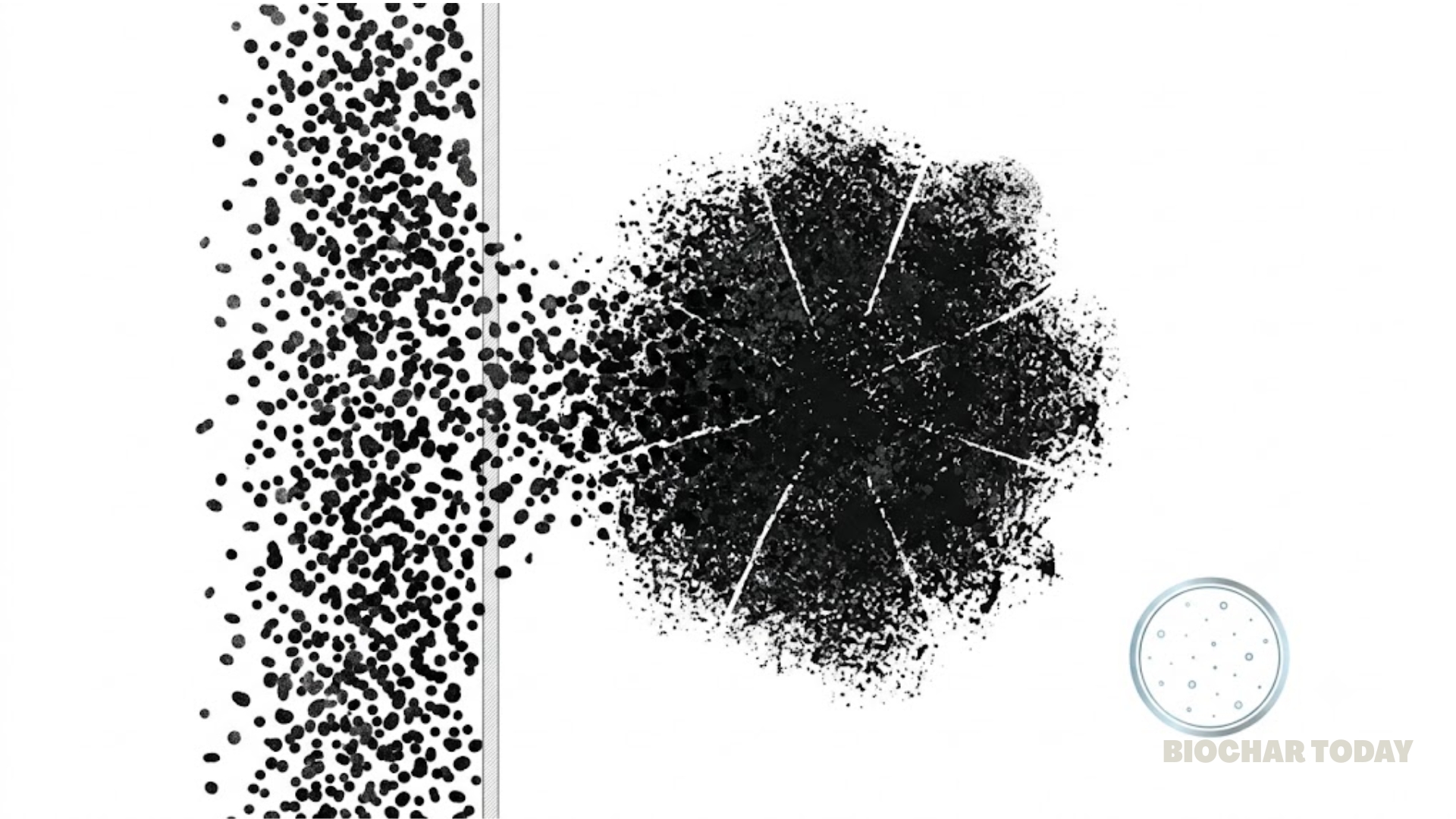
To explain why it works so well, the team investigated the cleanup mechanisms. The speed and high removal rates suggest that the petroleum molecules aren’t just physically trapped; they are being chemically bound to the biochar’s surface—a process called chemisorption. Think of the biochar surface like a dense forest of tiny carbon rings. The contaminants, which are also made of carbon rings, are attracted to these surfaces and stack up on them like pancakes. This is called π-π interaction. They also stick due to a force called hydrophobic interaction, which means the water-hating oil molecules strongly prefer the water-hating carbon surface of the biochar. The biochar also has a complex, Swiss cheese-like structure, confirmed by porosityPorosity of biochar is a key factor in its effectiveness as a soil amendment and its ability to retain water and nutrients. Biochar’s porosity is influenced by feedstock type and pyrolysis temperature, and it plays a crucial role in microbial activity and overall soil health. Biochar More analysis, with lots of tiny pores. The smallest pores grab the small BTEX molecules first, while the slightly larger pores allow for many layers of contaminants to build up, helping to capture the large PAH molecules. Furthermore, the groundwater itself plays a role: the presence of calcium ions seems to increase the stickiness of the biochar for the pollutants.
In conclusion, canola straw biochar is not just another cleanup tool; it’s a dual-purpose material that manages farm waste while providing a highly effective, rapid, and chemically driven solution for complex groundwater contamination. This research provides the crucial groundwork for developing large-scale, cost-effective biochar filters to tackle real-world oil and gas spills.
Source: Pathy, A., Naeth, M. A., & Chang, S. X. (2025). Crop straw biochar enhances hydrocarbon adsorption in ground water. Chemosphere, 393, 144775.



Leave a Reply