
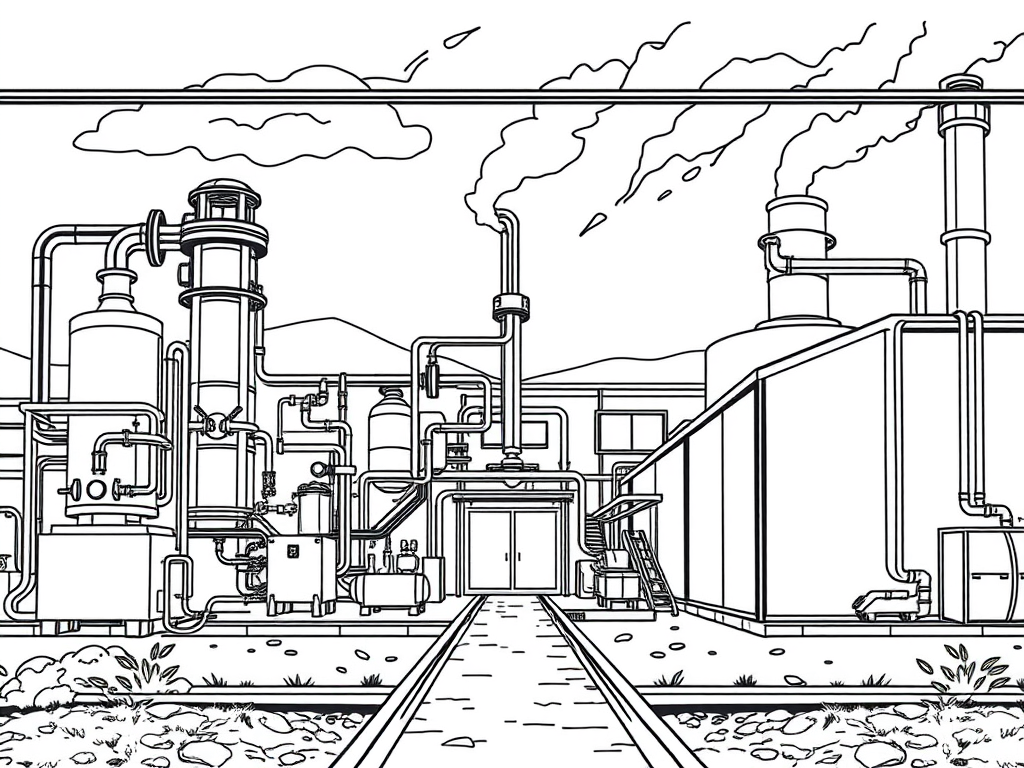
A comprehensive review in the Biofuel Research Journal by Mohammadali Kiehbadroudinezhad, Homa Hosseinzadeh-Bandbafha, Warren Mabee, Sonil Nanda, Hamid Afshari, Mohammad Saeedi, Bruce Rathgeber, and Khaled Zoroufchi Benis explores how thermochemical technologies, coupled with carbon capture, can transform animal manure into valuable energy and products, significantly reducing greenhouse gas (GHG) emissions. The research highlights the potential for net-negative outcomes in manure management, offering a sustainable solution to a growing environmental challenge.
The global livestock industry, while crucial for food security, faces a monumental challenge: managing the ever-increasing volume of animal manure. Global manure production, measured by nitrogen content, has more than doubled since 1961, intensifying pressure on agricultural systems and the environment. Improperly managed manure releases harmful gases like ammonia (NH_3) and hydrogen sulfide (H_2S), contributing to air pollution and climate change. Traditional methods such as open stockpiling and lagoon storage exacerbate these issues, with GHG emissions ranging from 16,000 to 84,000 g CO_2eq per tonne of manure for storage alone. While composting offers some benefits, it too results in substantial GHG losses, with up to 46% of nitrogen and 67% of carbon potentially lost as gases.
Thermochemical conversion pathways—pyrolysis, gasificationGasification is a high-temperature, thermochemical process that converts carbon-based materials into a gaseous fuel called syngas and solid by-products. It takes place in an oxygen-deficient environment at temperatures typically above 750°C. Unlike combustion, which fully burns material to produce heat and carbon dioxide (CO2), gasification More, and hydrothermal processing—offer a promising alternative. These methods convert manure into energy, biocharBiochar is a carbon-rich material created from biomass decomposition in low-oxygen conditions. It has important applications in environmental remediation, soil improvement, agriculture, carbon sequestration, energy storage, and sustainable materials, promoting efficiency and reducing waste in various contexts while addressing climate change challenges. More, and other valuable products, providing a dual benefit of waste management and energy recovery. Compared to traditional biochemical methods, thermochemical processes are highly efficient due to their short reaction times (seconds to minutes) and superior ability to break down complex organic compounds like lignin.
Among these, pyrolysisPyrolysis is a thermochemical process that converts waste biomass into bio-char, bio-oil, and pyro-gas. It offers significant advantages in waste valorization, turning low-value materials into economically valuable resources. Its versatility allows for tailored products based on operational conditions, presenting itself as a cost-effective and efficient More is versatile, producing biochar, bio-oil, and syngasSyngas, or synthesis gas, is a fuel gas mixture consisting primarily of hydrogen and carbon monoxide. It is produced during gasification and can be used as a fuel source or as a feedstock for producing other chemicals and fuels. More by adjusting parameters like temperature and residence timeResidence time refers to the duration that the biomass is heated during the pyrolysis process. The residence time can influence the properties of the biochar produced. More. Slow pyrolysis, for instance, is ideal for biochar production (around 35% yield), which can sequester carbon in soil for centuries. Fast pyrolysis, operating at higher heating rates, prioritizes bio-oil production (around 60% yield), offering efficient energy recovery. Cow and horse manures are particularly suitable for pyrolysis due to their high energy content and balanced composition, while poultry manure also shows promise for producing nutrient-rich biochar.
Gasification converts manure into syngas (a mixture of CO, CO_2, H_2, and CH_4), biochar, ashAsh is the non-combustible inorganic residue that remains after organic matter, like wood or biomass, is completely burned. It consists mainly of minerals and is different from biochar, which is produced through incomplete combustion. Ash Ash is the residue that remains after the complete More, and tar at high temperatures (800-1000°C). Horse manure yields the highest H_2 concentrations, up to 35 mmol/g, and the syngas produced from it can exceed 3000 kJ/Nm3 in lower heating value (LHV), making it suitable for energy-dense gas generation. Despite its potential, gasification faces challenges like high capital costs and energy input for moist feedstocks.
Hydrothermal carbonization (HTC) is particularly effective for wet biomassBiomass is a complex biological organic or non-organic solid product derived from living or recently living organism and available naturally. Various types of wastes such as animal manure, waste paper, sludge and many industrial wastes are also treated as biomass because like natural biomass these More like manure, operating at milder temperatures (180-250°C) and moderate pressures (2-10 MPa). This process avoids energy-intensive drying, a significant advantage over other methods. Cow manure in HTC consistently yields moderate to high calorific values (14.36-20.68 MJ/kg) and maintains high hydrochar yields (above 40-50%) even at 300°C. Pig manure can achieve very high calorific values (up to 28.68 MJ/kg), though sometimes at the expense of hydrochar yield.
Hydrothermal liquefaction (HTL) converts wet biomass into biocrude oil and other liquid components at 280-370°C and 10-25 MPa. Cow manure yields higher biocrude oil (up to 59.13%) at moderate temperatures (300-325°C) due to its high protein and lignocellulosic content. Pig manure, conversely, produces biocrude oil with consistently superior heating values (up to 37.8 MJ/kg) due to its higher lipid content.
The environmental benefits of these thermochemical processes are significantly enhanced when integrated with carbon capture technologies. Life cycle assessment studies show that thermochemical manure valorization outperforms traditional management strategies in GHG reduction, resource efficiency, and pollution control. For example, gasification of poultry litter can reduce overall environmental impacts, including GHG emissions, by over 90% compared to other alternatives.
Three main carbon capture approaches can be integrated: pre-combustion, post-combustion, and oxy-fuel combustion. Pre-combustion capture, ideal for gasification, removes CO_2 before combustion, achieving up to 90% GHG reduction and a 50% lower energy penalty compared to post-combustion methods. Post-combustion capture is widely adaptable for existing plants but can lead to efficiency losses (20-35%) and increased fuel consumption (10-15%). Oxy-fuel combustion, an emerging technique, burns fuel with pure oxygen, yielding a concentrated CO_2 stream for easier capture. Pioneering studies using poultry manure in an industrial-scale gasifier demonstrated stable oxy-fuel gasification, with a 30% oxygen/70% CO_2 mixture significantly enhancing energy output and reducing pollutants.
Despite the substantial promise of thermochemical manure valorization with carbon capture, challenges remain. These include high capital costs and infrastructure requirements for widespread deployment, as well as the technical complexities of integrating these systems. However, the strong economic potential, such as pig manure biochar becoming profitable when sold above USD 116 per ton with a payback period of 4.6 years, suggests that targeted investment and supportive policies can overcome these barriers. By fostering innovation and providing financial incentives, these integrated solutions can drive sustainable waste-to-energy pathways, contributing to both energy security and global climate change mitigation goals.
Source: Kiehbadroudinezhad, M., Hosseinzadeh-Bandbafha, H., Mabee, W., Nanda, S., Afshari, H., Saeedi, M., Rathgeber, B., & Benis, K. Z. (2025). Thermochemical pathways coupled with carbon capture for valorizing animal manure: A review. Biofuel Research Journal, 46, 2373–2397.




Leave a Reply