
Urbanization has led to a significant increase in municipal solid waste, and technical shortcomings in waste storage and landfill management can result in the leakage of wastewater and leachate into the soil. This process creates “domestic sources contaminated soil,” characterized by degraded engineering properties and elevated carbon emissions. The study by Yuliang Guo, Shuxun Sang, Lulin Tan, and Rui Zhang, published in the Journal of Taibah University for Science, investigated the potential of biocharBiochar is a carbon-rich material created from biomass decomposition in low-oxygen conditions. It has important applications in environmental remediation, soil improvement, agriculture, carbon sequestration, energy storage, and sustainable materials, promoting efficiency and reducing waste in various contexts while addressing climate change challenges. More as a low-carbon, green reinforcement material for such soil. The findings offer a preliminary confirmation that biochar is a feasible and effective solution for treating and stabilizing contaminated clay.
Domestic contaminated soil faces a dual challenge: the degradation of organic pollutants weakens its structure, reducing its strength, while the generation of methane and carbon dioxide from this process contributes to greenhouse gas emissions. Traditional solidification/stabilization (S/S) methods, which often use materials like cement and lime, have shown limitations. They are associated with high costs and energy consumption and are less effective for organically contaminated soils, as the pollutants can weaken their cementing effect. In response to these issues, biochar is emerging as a promising new material for both reinforcing and sequestering carbon in contaminated soil.
The research utilized bamboo biochar with large particle hardness, which was chosen for its developed pores, increased alkalinity, and greater stability from a high pyrolysisPyrolysis is a thermochemical process that converts waste biomass into bio-char, bio-oil, and pyro-gas. It offers significant advantages in waste valorization, turning low-value materials into economically valuable resources. Its versatility allows for tailored products based on operational conditions, presenting itself as a cost-effective and efficient More temperature of 700°C. The study simulated biochar reinforcement by remodeling biochar-added contaminated clay, then conducting a series of geotechnical tests to analyze its properties. The authors found that adding biochar significantly affected the physicochemical and engineering properties of the contaminated clay.
A key takeaway was the identification of optimal treatment parameters. The study found that a biochar particle size of 1–3 mm and a dosage of 12% resulted in a superior comprehensive treatment effect. Under these conditions, the soil’s pHpH is a measure of how acidic or alkaline a substance is. A pH of 7 is neutral, while lower pH values indicate acidity and higher values indicate alkalinity. Biochars are normally alkaline and can influence soil pH, often increasing it, which can be beneficial More increased from an acidic 6.4 to a more neutral 7.5. This pH increase is primarily due to the alkaline substances within the biochar, which neutralized the organic acids in the contaminated soil, preventing the dissolution of alkaline cementing agents and thus enhancing soil strength.
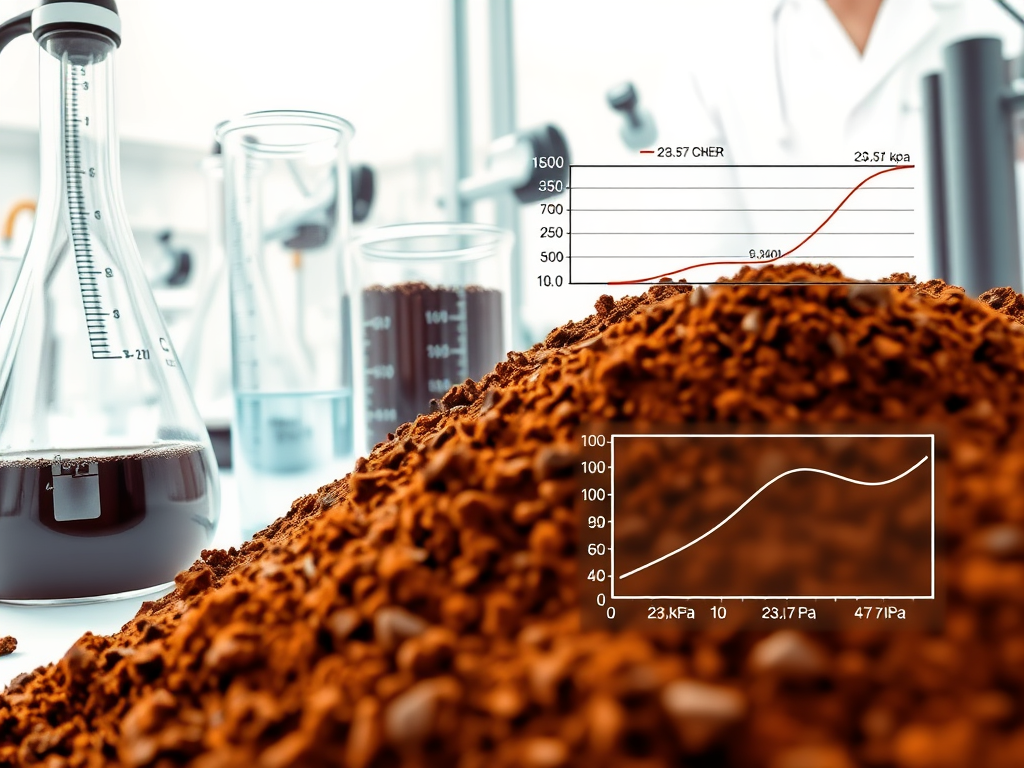
The most significant quantitative finding of the study was the substantial improvement in the soil’s mechanical strength. The cohesion of the soil more than doubled, increasing from 23.57 kPa to 47.02 kPa, and the internal friction angle saw a major boost, from 0.45° to 5.04°. This improvement was positively correlated with the biochar dosage. Additionally, the compression coefficient and permeability coefficient remained at low levels, which is desirable for geotechnical applications. The study also noted a change in the soil’s failure pattern, transitioning from a ductile, drum-like shape to a more brittle failure with a distinct shear surface, resembling sandy soil. This structural change was attributed to the biochar transforming the clay from a typical clay-like texture to a more granular one.
The researchers attributed these effects to two main mechanisms: soil modification and a desaturation effect. Biochar’s strong adsorption properties caused it to draw pore water out of the soil matrix, leading to desaturation. This desaturation exposed the rough surfaces of soil particles, increasing inter-particle friction and contributing to a higher internal friction angle. The desaturation also led to the precipitation of salt crystals from the pore water, which cemented the soil particles together, increasing cohesion and reducing compressibility. From a soil modification perspective, biochar’s porous structure and framework increased the overall porosityPorosity of biochar is a key factor in its effectiveness as a soil amendment and its ability to retain water and nutrients. Biochar’s porosity is influenced by feedstock type and pyrolysis temperature, and it plays a crucial role in microbial activity and overall soil health. Biochar More of the soil, which, depending on the dosage and particle size, influenced permeability and compressibility.
In conclusion, the research confirmed the feasibility of using biochar for the reinforcement of domestic contaminated soil. While the study established a solid foundation for this application, the authors stress that further research is needed to understand the synergistic mechanisms between soil reinforcement and the prevention of organic matter degradation, which could provide long-term carbon sequestration benefits.
Source: Guo, Y., Sang, S., Tan, L., & Zhang, R. (2025). Study on the regulation effect of biochar on the engineering properties of domestic sources contaminated soil. Journal of Taibah University for Science, 19(1), 2542674.




Leave a Reply