
Key Takeaways
- Pre-treating wet microalgae with pressurized heat removes unwanted moisture and pre-cleans the organic material before final conversion.
- A specialized catalyst coating biocharBiochar is a carbon-rich material created from biomass decomposition in low-oxygen conditions. It has important applications in environmental remediation, soil improvement, agriculture, carbon sequestration, energy storage, and sustainable materials, promoting efficiency and reducing waste in various contexts while addressing climate change challenges. More with a synthetic zeolite mineral produces high-value aromatic hydrocarbons with up to ninety-six percent selectivity.
- The new composite material drops undesirable oxygen and nitrogen pollutants in the resulting fuel from over eighty-two percent down to around three percent.
- The biochar layer prevents the catalyst from clogging with carbon deposits, keeping it stable for repeated manufacturing cycles.
- This technology enables the direct transformation of common microscopic algae into high-purity chemical ingredients for cleaner alternative fuels.
In a new paper published in the journal Biochar, scientists Jinye Hu, Yunpu Wang, Haiwei Jiang, Jiabo Wu, Ting Luo, Qi Wang, Yuhang Hu, Kaisong Hu, Wenguang Zhou, and Liangliang Fan investigated advanced methods to improve the quality of fuel derived from microscopic algae. While microalgae offer great promise as a third-generation renewable energy source due to their rapid growth cycles and high carbon dioxide absorption rates, the raw bio-oil produced from them typically suffers from significant drawbacks. High concentrations of oxygen and nitrogen molecules make the crude oil highly viscous, chemically unstable, and prone to creating severe atmospheric pollution when burned. To address these commercial barriers, the research group developed a dual-action preprocessing and refining strategy that strips away these problematic elements and yields high-purity aromatic hydrocarbons suitable for industrial applications.
The team began by applying a pressurized thermal treatment to the microalgae, operating at temperatures between one hundred sixty and two hundred twenty degrees Celsius. This initial processing stage acts as an efficient cleanup step, breaking down weak chemical bonds and lowering the overall moisture content without requiring energy-intensive pre-drying. By performing this preliminary deoxygenation and denitrogenation, the raw material increases its overall energy density and becomes much better suited for subsequent chemical conversion. The researchers discovered that treating the algae at exactly two hundred degrees Celsius established the perfect baseline balance for maximizing high-quality yields in the next phase of processing.
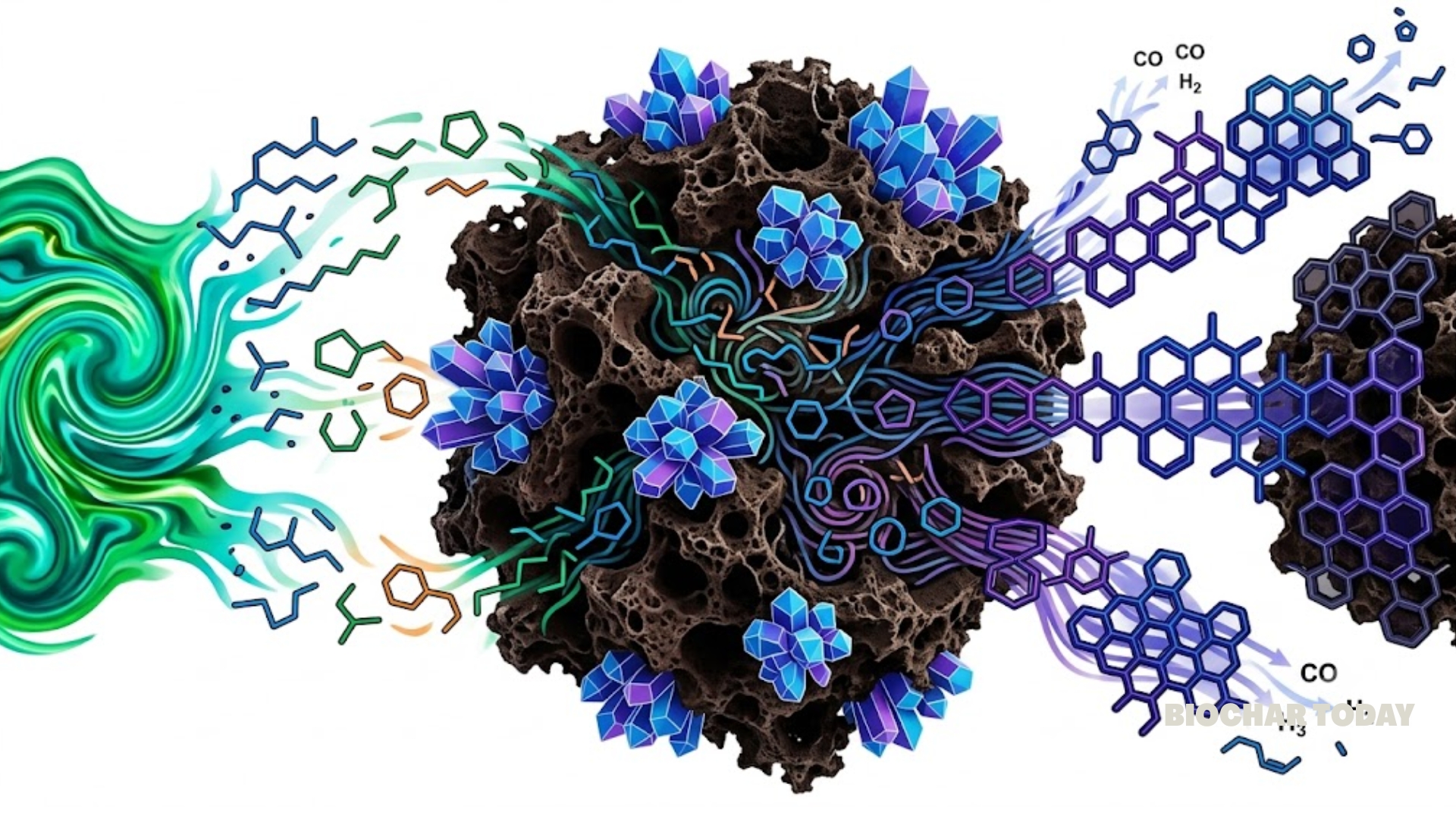
Following the thermal pretreatment, the vapors from the microalgae were directed through a custom-engineered composite catalyst consisting of a synthetic zeolite mineral layered directly onto a robust biochar support. Traditional zeolites are exceptionally efficient at stripping oxygen and nitrogen from organic vapors, but their tiny microscopic pores quickly become choked with heavy carbon residues, causing the catalyst to fail rapidly. By introducing a porous biochar base, the scientists created a defensive pre-cracking shield. The wider channels in the biochar catch the heavy, complex molecules first, safely breaking them down into smaller fragments before they ever reach the delicate inner structures of the zeolite.
This sophisticated structural arrangement yielded extraordinary results during the final conversion tests. Under optimal conditions, the composite catalyst achieved a remarkable ninety-six percent selectivity for valuable aromatic compounds. More specifically, the setup demonstrated an impressive eighty-three percent selectivity toward benzene, toluene, and xylene, which are vital building blocks for industrial chemicals and high-grade alternative fuels. Simultaneously, the catalyst successfully purged the vast majority of fuel impurities, slashing the combined volume of oxygenates and nitrogen heterocycles from a massive eighty-two percent under non-catalytic conditions down to a negligible three percent.
Beyond these initial performance metrics, the composite catalyst displayed remarkable durability and resistance to operational degradation. During extended testing spanning six consecutive recycling and regeneration runs, the biochar-supported catalyst maintained stable conversion rates and outpaced standard single-component zeolites. The unique architecture kept the accumulation of destructive carbon deposits exceptionally low, recording a minuscule coke yield of just one-third of a percent compared to the nearly two percent deposit rate seen on unsupported zeolites. This significant reduction in coking ensures that the material can remain active for long periods, bringing the process closer to economic viability for large-scale production facilities.
Ultimately, this research provides a comprehensive blueprint for transforming low-grade microalgae into premium chemical commodities. By systematically mapping out the reaction pathways of individual algal components like proteins, lipids, and carbohydrates, the authors successfully demonstrated how weak chemical bonds are sequentially broken down. The integration of a cheap, sustainable biochar support not only enhances the overall chemical purity of the final oil but also solves a long-standing catalyst durability problem, marking a major step forward for the future of green manufacturing.
Source: Hu, J., Wang, Y., Jiang, H., Wu, J., Luo, T., Wang, Q., Hu, Y., Hu, K., Zhou, W., & Fan, L. (2026). In-depth into the mechanism of aromatic production from catalytic pyrolysisPyrolysis is a thermochemical process that converts waste biomass into bio-char, bio-oil, and pyro-gas. It offers significant advantages in waste valorization, turning low-value materials into economically valuable resources. Its versatility allows for tailored products based on operational conditions, presenting itself as a cost-effective and efficient More of wet-torrefied microalgae with HZSM-5 coated biochar. Biochar, 8(91), 1-21.



Leave a Reply