
Key Takeaways
- Flooding rice fields lowers cadmium in crops but increases toxic mercury levels.
- Keeping soil dry stops mercury accumulation but causes plants to absorb more cadmium.
- Adding charcoalCharcoal is a black, brittle, and porous material produced by heating wood or other organic substances in a low-oxygen environment. It is primarily used as a fuel source for cooking and heating. More treated with iron and manganese locks both harmful metals safely in the soil.
- Smart water management paired with treated charcoal produces completely safe rice crops.
The research published in the journal BiocharBiochar is a carbon-rich material created from biomass decomposition in low-oxygen conditions. It has important applications in environmental remediation, soil improvement, agriculture, carbon sequestration, energy storage, and sustainable materials, promoting efficiency and reducing waste in various contexts while addressing climate change challenges. More by Tong Sun, Wenhao Yang, Yuebing Sun, Lin Wang, and Xuefeng Liang addresses a long-standing dilemma in global food safety regarding how to grow crops safely in soils contaminated with multiple heavy metals. Rice farmers face a critical environmental problem because conventional agricultural water management practices have entirely opposite effects on different chemical pollutants. For instance, keeping rice paddies continuously flooded effectively prevents plants from absorbing cadmium, but this oxygen-depleted environment stimulates specific soil bacteria that convert mercury into a highly dangerous organic form. Conversely, introducing aerobic irrigation methods successfully stops mercury transformation but inadvertently causes a dramatic spike in cadmium uptake by the rice roots, making traditional single-remediation approaches highly ineffective for co-contaminated fields.
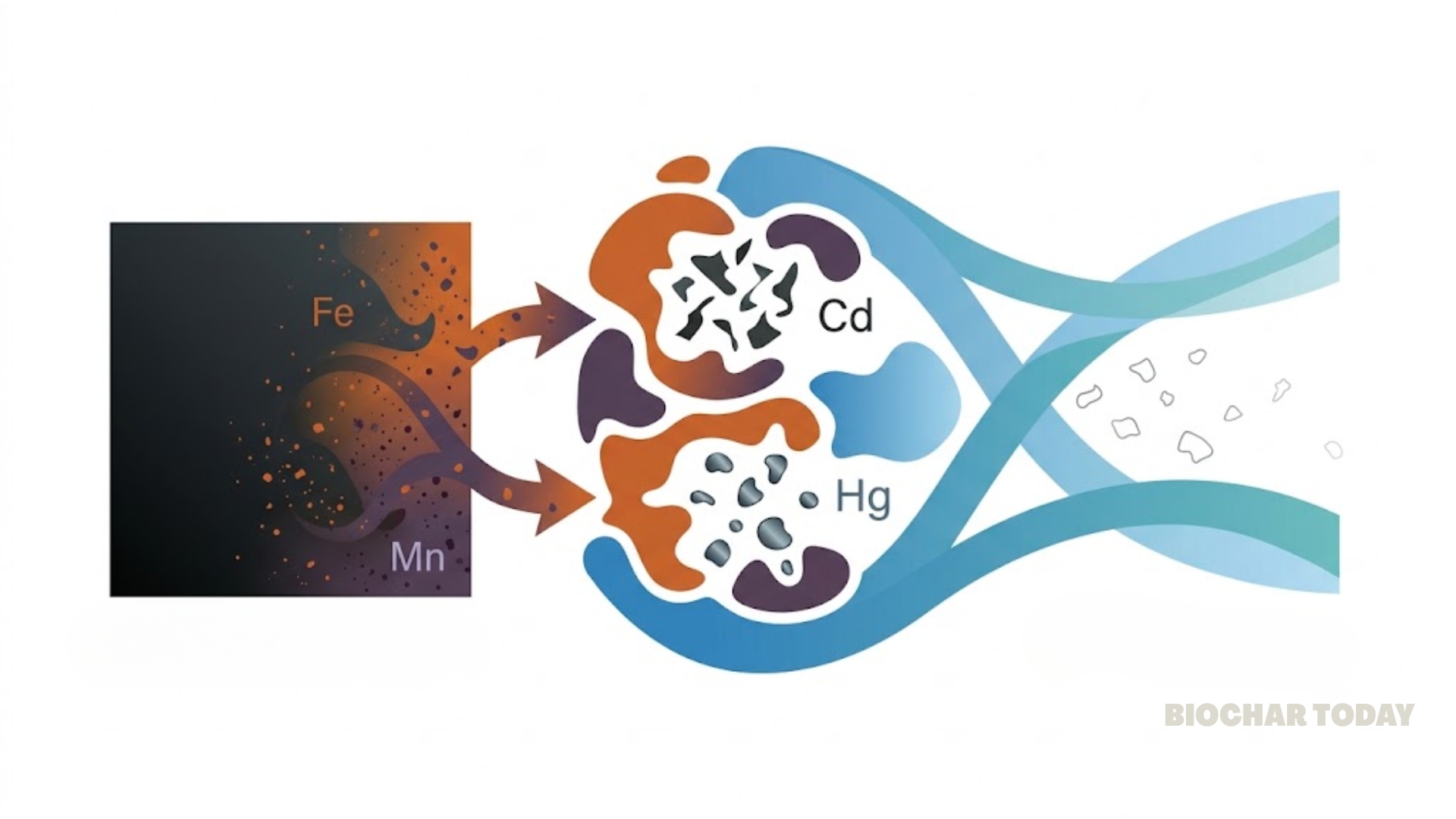
To overcome this chemical conflict, the scientific team developed an integrated strategy combining iron-manganese oxide modified biochar with precise water regimes to protect agricultural outputs. The modified biochar possesses an optimized porous structure and is heavily enriched with oxygen-containing functional groups, which dramatically enhance its chemical capacity to bind toxic elements through surface adsorption and precipitation. When paddy fields are kept under continuous flooding, the application of this specialized biochar works synergistically to lower cadmium availability to an absolute minimum while simultaneously suppressing the growth of anaerobic microbes responsible for mercury methylation. This combined treatment allowed the researchers to safely suppress the environmental risks, achieving a remarkably low grain cadmium concentration of only 0.05 milligrams per kilogram.
Under the alternative scenario of continuous aerobic irrigation, the integration of modified biochar successfully restricted the elevated cadmium uptake typically caused by drier soil conditions. At the same time, this aerobic environment naturally hindered the production of toxic organic mercury, and the iron-manganese biochar further immobilized the remaining inorganic mercury through chemical complexation and metal interactions. Through this specific combination of aerobic watering and modified biochar, the experiment achieved the lowest concentrations of total mercury at 0.02 milligrams per kilogram and methylmercury at 6.89 micrograms per kilogram in the harvested grains. This successfully demonstrates that tailoring specific soil amendments to distinct irrigation methods can completely neutralize metal-specific environmental risks during crop cultivation.
Beyond reducing grain toxicities, the study revealed significant positive impacts on the broader soil ecosystem, particularly regarding the structural stability of the soil bacterial community. High-throughput sequencing analysis demonstrated that the application of iron-manganese biochar increased the complexity and modularity of the microbial network, which helps the soil ecosystem resist environmental disturbances and reduces competitive stress among helpful microbes. Furthermore, the treatment enriched specific metal-resistant bacterial groups that possess a high tolerance to heavy metals and assist in pollutant adsorptionBiochar has a remarkable ability to attract and hold onto pollutants, like heavy metals and organic chemicals. This makes it a valuable tool for cleaning up contaminated soil and water. More. Although these controlled greenhouse experiments provide a strong practical framework for enhancing food safety in polluted ecosystems, the authors emphasize that multi-year field trials are still necessary to confirm long-term stability, economic viability, and scalability under natural weathering conditions.
Source: Sun, T., Yang, W., Sun, Y., Wang, L., & Liang, X. (2026). Synergistic effects of Fe-Mn modified biochar and water management on remediation of Cd and Hg co-contaminated soils. Biochar, 8(1), 121.





Leave a Reply