
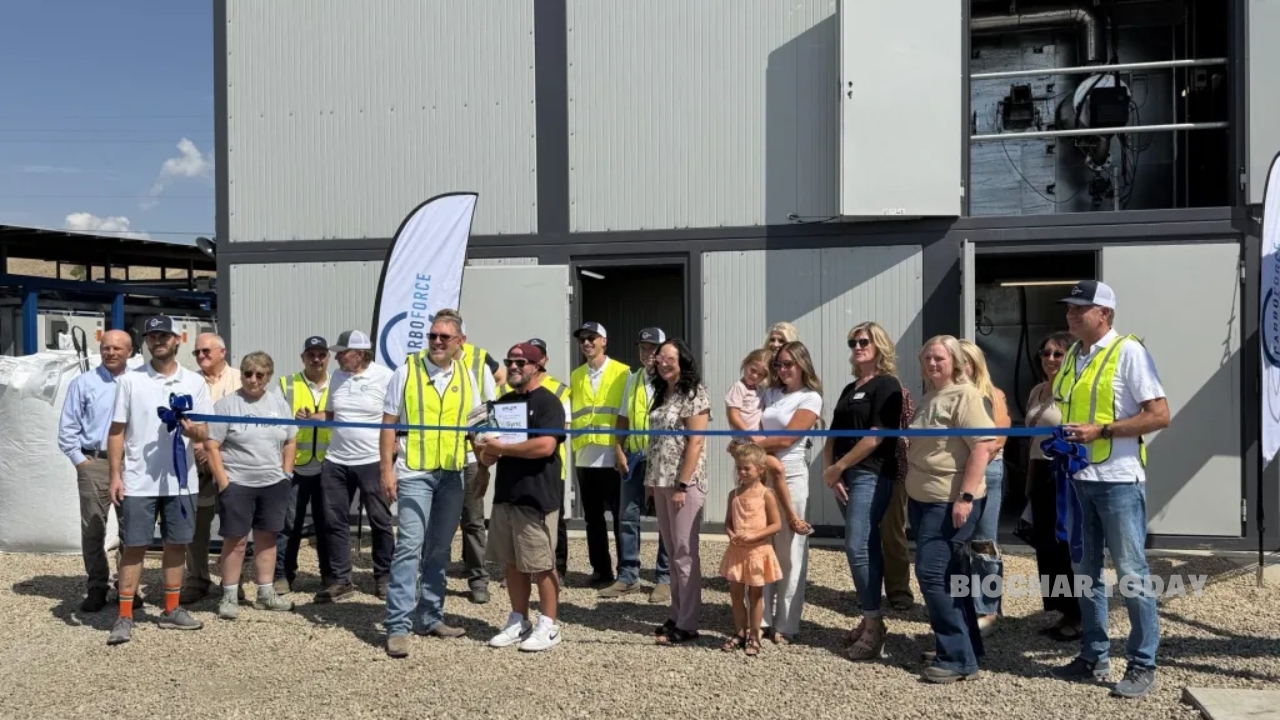
United States-based carbon technology provider CO2-Sync, in partnership with technology manufacturer Carbo-FORCE, has officially launched its CF-1000 commercial pyrolysisPyrolysis is a thermochemical process that converts waste biomass into bio-char, bio-oil, and pyro-gas. It offers significant advantages in waste valorization, turning low-value materials into economically valuable resources. Its versatility allows for tailored products based on operational conditions, presenting itself as a cost-effective and efficient More facility in Price, Utah. The Heber City-headquartered project developer held a ribbon-cutting ceremony to mark the operational debut of the project, which integrates biocharBiochar is a carbon-rich material created from biomass decomposition in low-oxygen conditions. It has important applications in environmental remediation, soil improvement, agriculture, carbon sequestration, energy storage, and sustainable materials, promoting efficiency and reducing waste in various contexts while addressing climate change challenges. More production directly with lower-carbon energy generation. By deploying industrial-scale thermal processing equipment in the Mountain West region, the project signals a growing momentum toward localized carbon management infrastructure and market-ready utility integrations.
Industrial biomassBiomass is a complex biological organic or non-organic solid product derived from living or recently living organism and available naturally. Various types of wastes such as animal manure, waste paper, sludge and many industrial wastes are also treated as biomass because like natural biomass these More operators in the regional energy sector face the persistent challenge of managing organic waste streams while addressing increasing pressures for industrial emissions reduction. Traditional disposal pathways for forestry residues and agricultural waste contribute to elevated carbon output and unutilized energy potential. Furthermore, regional energy supply chains require scalable deployment models that can generate both durable carbon removal co-products and consistent base-load clean power without relying on speculative technological frameworks.
To address these resource and environmental bottlenecks, the project partners deployed the Carbo-FORCE CF-1000 pyrolysis unit. The system utilizes continuous high-temperature thermal decomposition to process organic feedstocks into carbon-dense biochar while capturing volatile off-gases generated during production. These syngasSyngas, or synthesis gas, is a fuel gas mixture consisting primarily of hydrogen and carbon monoxide. It is produced during gasification and can be used as a fuel source or as a feedstock for producing other chemicals and fuels. More emissions are redirected to produce renewable heat and power, maximizing the thermodynamic efficiency of the facility and creating a closed-loop processing system.
The operational launch of the Price facility yields dual outputs: scalable biochar production for agricultural and industrial end-uses, along with a localized supply of clean energy linked to the regional grid network. The successful commissioning provides a proven, operational blueprint for commercial pyrolysis infrastructure in the region. Beyond immediate volume outputs, the project establishes a framework for combining permanent carbon sequestration pathways with industrial energy applications in the United States.



Leave a Reply