
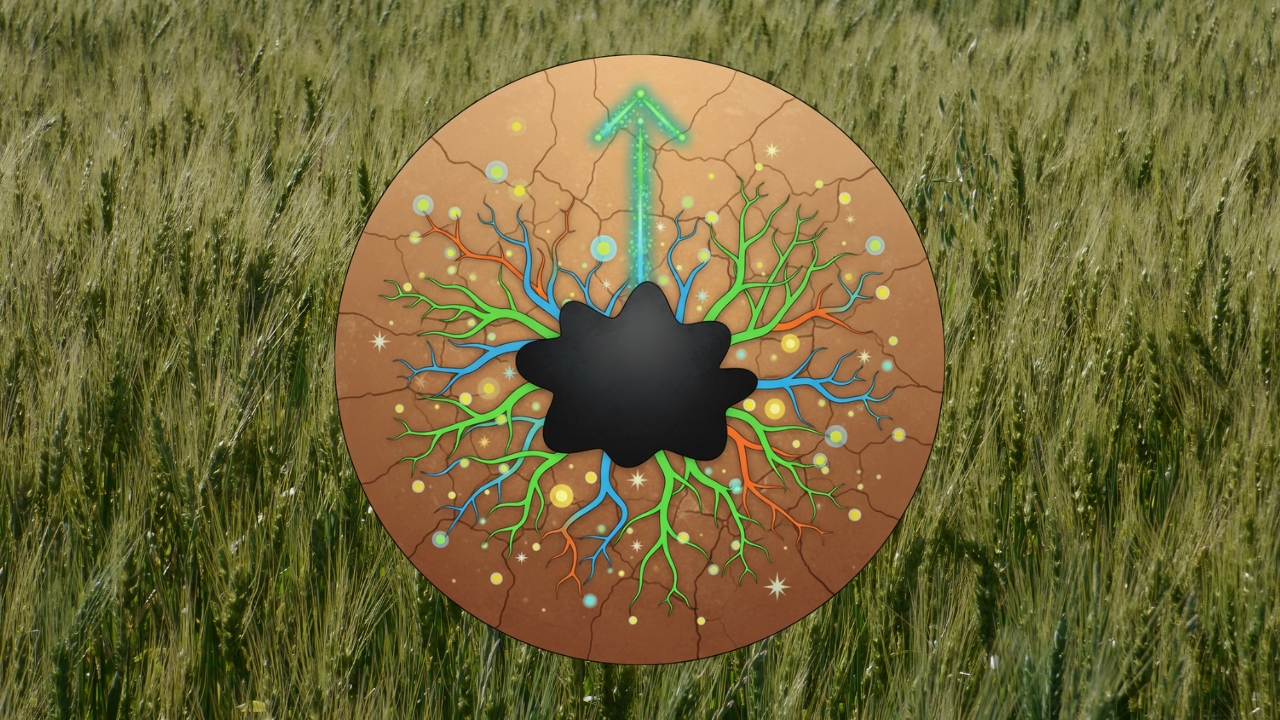
Key Takeaways
- Arid Soils Need Carbon: Desert soils, like those in Arizona, lack organic matter, making them poor environments for microbial life. Adding carbon-rich materials like crop residue or biocharBiochar is a carbon-rich material created from biomass decomposition in low-oxygen conditions. It has important applications in environmental remediation, soil improvement, agriculture, carbon sequestration, energy storage, and sustainable materials, promoting efficiency and reducing waste in various contexts while addressing climate change challenges. More is essential to improve soil health.
- Carbon Boosts Soil Life: Both crop residue and biochar additions cause a rapid and significant increase in microbial activity (measured by CO2 release), indicating that the soil’s microscopic community is “waking up” and actively working.
- Biochar Locks Carbon Away Better: While residue provides quick food for microbes, adding biochar with the residue helps slow down the rate at which carbon is released as CO2. This suggests biochar is better at creating long-term carbon storage in the soil, which is crucial for fighting climate change.
- Farming History Matters: Soils managed with cover crops showed the best natural water retention and microbial activity, reinforcing that sustainable practices (like crop rotation) work best in combination with soil amendments.
- Targeted Solutions for Arid Agriculture: These findings support the use of residue and biochar amendments as a combined strategy to enhance microbial health, boost soil fertility, and improve sustainability in arid, carbon-limited agricultural systems.
Soil, a complex and dynamic medium, is critical for agriculture and environmental sustainability, especially in arid regions like Arizona where soils often suffer from high alkalinity and low organic matter. The thesis, “Decoding Soil Health and Carbon Dynamics in Arid Environments,” by Dilshani Aswin of the University of Arizona’s Graduate Interdisciplinary Program in Applied Biosciences, explores how carbon-rich amendments affect soil health. This research, an internship report accepted as fulfilling the Professional Science Master’s requirement, focuses on a critical process called carbon mineralization, the microbial breakdown of organic carbon into carbon dioxide (CO2). Understanding this process is vital because it reflects soil health and nutrient cycling, particularly as soils globally store nearly double the carbon of the atmosphere.
Arid soils present unique challenges. They are typically carbon-deprived, meaning they lack the organic matter needed to support robust microbial life and efficient nutrient cycling. This scarcity makes them particularly susceptible to degradation. This study investigates the short-term impact of two key carbon-rich amendments: crop residue (wheat straw) and biochar (a stable, carbon-rich material from wood pyrolysisPyrolysis is a thermochemical process that converts waste biomass into bio-char, bio-oil, and pyro-gas. It offers significant advantages in waste valorization, turning low-value materials into economically valuable resources. Its versatility allows for tailored products based on operational conditions, presenting itself as a cost-effective and efficient More). These materials are proposed solutions to enhance soil carbon storage and promote sustainable agricultural practices in challenging climates. The research used a controlled mesocosm experiment over 28 days, mimicking field conditions to assess microbial activity through heterotrophic soil respiration (the CO2 release driven by microorganisms breaking down organic matter).
The experiment compared three soil treatment groups across three distinct agricultural fields at the Maricopa Agricultural Center (MAC): S (Soil only), SR (Soil with Residue), and SRB (Soil with Residue and Biochar). The fields themselves represented different land management histories: Rotation of Cover Crops and Cotton (RCC), Fallow for over five years (FFY), and Continuous Cotton Cultivation (CCC).
The results demonstrated a significant, positive response to both amendments. For all three soil types, the S (Soil only) treatment showed the lowest, most consistent respiration rates, typically under 0.1 mg CO2 per g of soil per day, reflecting the baseline, carbon-limited microbial community. In stark contrast, the SR and SRB treatments, with their added carbon sources, exhibited substantially higher initial respiration rates. This spike indicates a rapid, energetic response from the microbial community to the readily available labile carbon in the amendments. For instance, in the CCC soil, the mean respiration of the SR and SRB treatments (0.272 and 0.274 mg CO2 per g of soil per day, respectively) were over eight times greater than the S treatment (0.0315 mg CO2 per g of soil per day).
While both SR and SRB treatments initially enhanced microbial activity, the study looked at how the respiration rate changed over the 28-day period—a crucial indicator of long-term carbon stability. The data showed a linear, negative relationship between respiration and time across all treatment groups, meaning microbial activity naturally declined as the easily accessible carbon was consumed.
However, a closer look at the rate of this decline reveals the unique benefit of biochar. The analysis focused on the slope of the decline for the log-transformed respiration data in the SR and SRB treatments, which signifies the rate of carbon mineralization. Across all three soil types, the decline in the SRB treatment was consistently less steep than in the SR treatment.
This quantitative difference, despite the similar overall respiration levels, indicates that biochar, on average, contributed to 1.26 times (using mean slope decline from Appendix F) long-term carbon stabilization compared to residue alone, by slowing down the mineralization rate. This supports the hypothesis that biochar’s properties, such as its porous structure, help maintain microbial biomassBiomass is a complex biological organic or non-organic solid product derived from living or recently living organism and available naturally. Various types of wastes such as animal manure, waste paper, sludge and many industrial wastes are also treated as biomass because like natural biomass these More and stabilize soil organic carbon over time.
Source: Aswin, D. (2025). Decoding Soil Health and Carbon Dynamics in Arid Environments (Master’s thesis). The University of Arizona.





Leave a Reply