
Key Takeaways
- BiocharBiochar is a carbon-rich material created from biomass decomposition in low-oxygen conditions. It has important applications in environmental remediation, soil improvement, agriculture, carbon sequestration, energy storage, and sustainable materials, promoting efficiency and reducing waste in various contexts while addressing climate change challenges. More helps keep vital nutrients in the soil where plants can reach them instead of letting them wash away into deeper ground layers.
- Using this organic material allows crops to take up nitrogen more efficiently, reducing the need for excessive chemical fertilizers.
- Mixing biochar into agricultural fields improves the overall growth and height of wheat plants.
- The application of biochar leads to heavier grains and a more abundant harvest for farmers.
- Implementing this strategy protects local water sources from chemical pollution while maintaining strong food production.
Agricultural systems around the world face a continuous struggle with nutrient management, particularly in regions dominated by coarse-textured soils. A new study published in Scientific Reports by researchers Mauz ul Haq, Zaryab Khan, Aman Nawaz, and Abd Al Karim Jaafar explores a practical solution to this dilemma by assessing how wood-derived biochar interacts with varied chemical fertilizer rates to protect crop yields and environmental health. Cultivating staple crops like wheat requires significant inputs of nitrogen, yet much of this vital nutrient is frequently lost before the plants can consume it. This investigation confirms that incorporating a low concentration of biochar into vulnerable soils can successfully secure nitrogen within the root zone, reversing downward pollution trends and ensuring robust agricultural productivity.
The primary obstacle facing farmers in arid and semiarid territories stems from the negative electrical charges inherent to alkaline sandy loam soils. Because nitrate molecules also carry a negative charge, the native soil particles naturally repel them instead of holding them in place. When irrigation water or rainfall percolates downward through these loose, coarse soil profiles, it easily sweeps the unbound nitrates along with it. This rapid downward movement triggers severe nitrate leachingLeaching is the process where nutrients are dissolved and carried away from the soil by water. This can lead to nutrient depletion and environmental pollution. Biochar can help reduce leaching by improving nutrient retention in the soil. More, which leaves the upper crop roots starved of nutrients and concurrently threatens the purity of underlying groundwater supplies. Over-fertilizing fields to compensate for these losses only exacerbates environmental contamination, making physical and chemical modifications of the soil structure absolutely necessary.
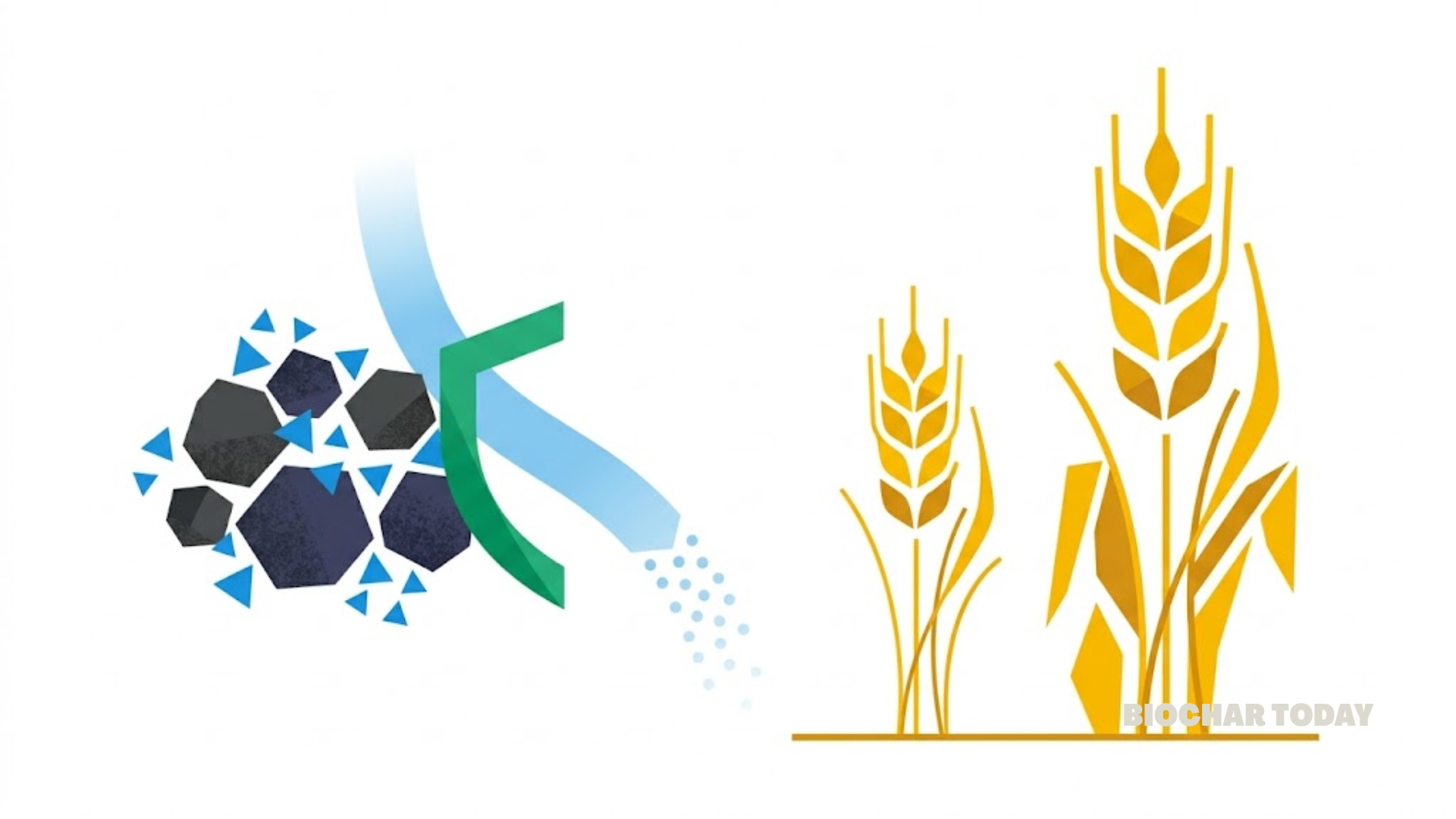
To counter this environmental and agronomic challenge, researchers utilized a hardwood biochar produced through slow pyrolysisPyrolysis is a thermochemical process that converts waste biomass into bio-char, bio-oil, and pyro-gas. It offers significant advantages in waste valorization, turning low-value materials into economically valuable resources. Its versatility allows for tailored products based on operational conditions, presenting itself as a cost-effective and efficient More at high temperatures. This highly porous material exhibits both high cation exchange capacity and unique anion exchange capacity, allowing it to act like a chemical sponge in the soil matrix. When mixed into sandy loam at a concentration of two percent by weight, the biochar physically entraps moving fluids within its microscopic pores while its active surface functional groups electrostatically bind to nitrogen compounds. This dual mechanism slows down the rate of nutrient mineralization and prevents irrigation water from flushing valuable chemical elements out of the upper soil boundaries.
The experimental findings demonstrate a substantial reduction in cumulative nitrate loss when biochar is deployed alongside standard fertilizer routines. In treatments where nitrogen was applied at a rate of seventy-five kilograms per hectare, the addition of the carbon-rich amendment slashed cumulative nitrate leaching by over twenty-seven percent compared to identical plots lacking biochar. At the maximum fertilizer application rate of one hundred and fifty kilograms per hectare, the presence of biochar still successfully lowered total nitrate losses by twenty percent. This stabilization of soil chemistry proved durable across the entire multi-month observation period, keeping harmful environmental discharges to an absolute minimum while maintaining ideal plant-available mineral nitrogen levels in the post-harvest soil.
Beyond its primary role in pollution mitigation, the biochar amendment altered key crop growth and yield dynamics. By preserving mineral nitrogen directly within the active rhizosphere, the treatment dramatically improved the capacity of the wheat root systems to absorb nourishment during critical early vegetative phases. Consequently, nitrogen use efficiency spiked to its highest recorded level of nearly thirty-one percent when the organic amendment was paired with lower fertilizer doses. The enhanced nutrient availability translated into obvious physical improvements, as the wheat plants grew taller, developed longer spikes, and produced heavier grains than their unamended counterparts. Ultimately, the combined application of two percent biochar and high nitrogen fertilizer generated the most abundant harvest, yielding nearly twenty-three grams of grain per pot.
Source: ul Haq, M., Khan, Z., Nawaz, A., & Jaafar, A. A. K. (2026). Evaluating biochar’s potential to reduce nitrate leaching and enhance wheat (Triticum aestivum L.) yield under different nitrogen management practices. Scientific Reports.





Leave a Reply