
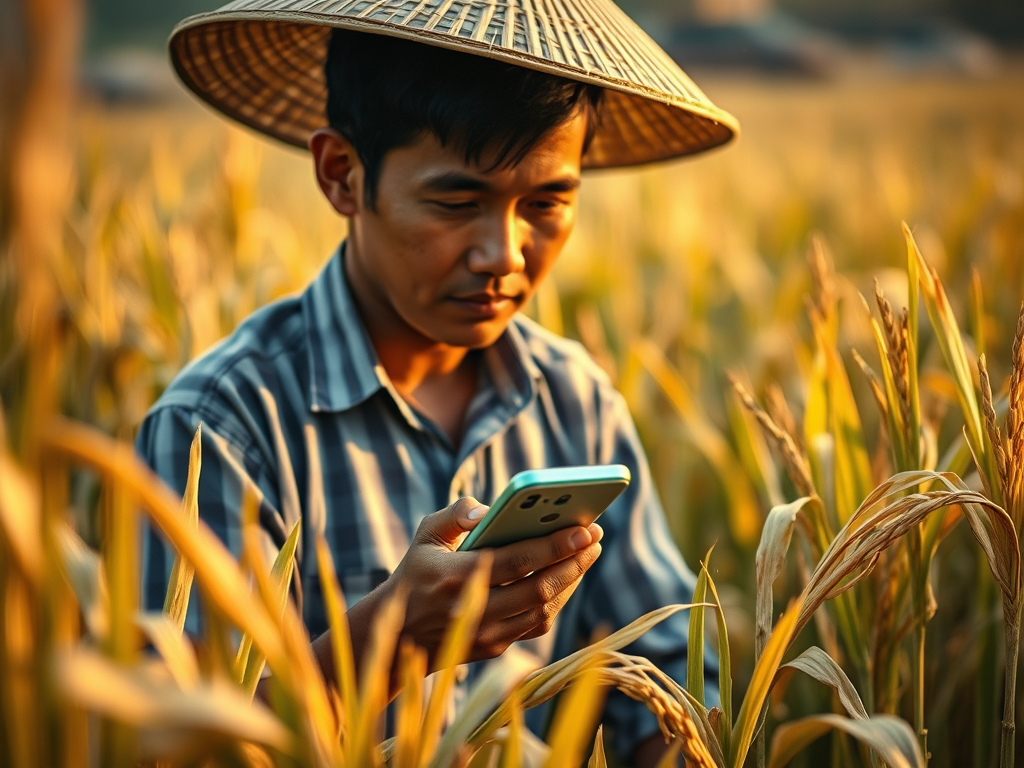
Global Transitions by Eain Dray Aung, Nophea Sasaki, Takuji W. Tsusaka, and Chaklam Silpasuwanchai investigates the crucial role of mobile agricultural technology in addressing prevalent environmental issues in farming, particularly the reduction of open-field burning and the promotion of sustainable waste management practices like biocharBiochar is a carbon-rich material created from biomass decomposition in low-oxygen conditions. It has important applications in environmental remediation, soil improvement, agriculture, carbon sequestration, energy storage, and sustainable materials, promoting efficiency and reducing waste in various contexts while addressing climate change challenges. More production. The research, focusing on 150 Participatory Guarantee System (PGS) farmers in Chachoengsao Province, Eastern Thailand, sheds light on the significant potential and existing barriers to adopting agri-tech solutions like the KaseChar mobile application.
Agricultural residue burning remains a critical environmental and public health concern across Asia, including Thailand. Practices such as the burning of rice farming (57%), sugarcane (47%), and maize (35%) residues contribute significantly to regional haze, poor air quality, and global climate change by releasing large quantities of black carbon and particulate matter. Rice straw, for instance, accounts for the most commonly produced agricultural waste in Chachoengsao Province, at 53.3%. Despite the well-known adverse effects, a notable 28% of farmers surveyed continue to use open-field burning as a primary method of waste disposal. This persistence is often due to limited accessible and affordable alternatives, with burning remaining a low-cost, labor-saving solution for clearing fields, especially where mechanization is scarce.
In response to these challenges, mobile applications have emerged as powerful tools for digital transformation in agriculture, offering solutions from weather forecasting to market access. The KaseChar app, a prototype digital marketplace, was specifically developed to support smallholder farmers in managing agricultural waste and improving sustainability through circular economy practices. Its core functionality allows farmers to list crop residues that can be converted into biochar—a practice known to enhance soil fertility, sequester carbon, and mitigate environmental impacts associated with open-field burning.
The study found a remarkably high level of digital readiness among the surveyed farmers, with 82% owning a smartphone and 97.3% having personal access to a device. Moreover, 76.7% of respondents reported spending 3–7 hours online daily, primarily on social media and entertainment. However, this digital access does not yet translate into widespread adoption of specialized agricultural waste management apps; only 0.7% had previously used such an application. Furthermore, sustainable waste utilization methods like biochar production and biogas generation were reported at minimal levels, both at just 1% adoption. This stark contrast highlights a significant gap between general smartphone use and the uptake of purpose-built agricultural tools aimed at sustainable practices.
Using the Technology Acceptance Model (TAM), the research evaluated farmers’ perceptions of KaseChar’s usefulness (PU), ease of use (PEOU), and behavioral intention (BI) to adopt the app. The results showed strong positive perceptions, with PU rated highly at a mean of 4.11, PEOU at 4.08, and BI at 4.03 (on a 5-point Likert scale). Farmers particularly recognized the app’s value in operational support (mean=4.21) and its potential for soil health improvement (mean=4.15), underscoring its role in streamlining logistics and promoting sustainable waste practices, especially through biochar. Key drivers of adoption included perceived productivity, efficiency, digital proficiency, and social influence. Waste management cost significantly influenced perceived usefulness (β=0.126, p=0.009), while internet usage was positively correlated with perceived ease of use (β=0.252, p=0.002). This suggests that farmers already investing in waste management are more motivated to adopt digital tools, and frequent internet users find the app easier to learn and navigate.
Despite high smartphone access and positive perceptions, barriers to adoption persist. The study identified digital literacy, labor intensity, and infrastructure gaps, particularly among older farmers, as significant limitations. Older farmers, for instance, were less likely to view KaseChar as beneficial, showing negative correlations with perceived efficiency and productivity (correlation coefficients of −0.119 and −0.156, respectively). This reflects generational differences in digital familiarity and challenges with inconsistent connectivity. KaseChar attempts to mitigate some of these barriers through features like voice input, simplified listing interfaces, and multilingual support, designed to be accessible even to users with limited digital literacy. The platform also facilitates direct connections between farmers and biochar producers, fostering localized, low-emission value chains.
In conclusion, while the KaseChar app demonstrates strong potential for enhancing agricultural waste management and promoting biochar production among Thai farmers, successful long-term adoption hinges on addressing the identified barriers. The study recommends targeted training programs, subsidies to offset costs, and improvements in digital infrastructure to facilitate wider uptake. Bridging this digital divide through well-designed, contextually relevant agri-tech solutions is vital for transforming agricultural waste into valuable resources, improving environmental health, and advancing sustainable farming practices in regions highly dependent on agriculture.
Source: Aung, E. D., Sasaki, N., Tsusaka, T. W., & Silpasuwanchai, C. (2025). Investigating Farmers’ Adoption of Mobile Agri-Tech: A TAM-Based Study of KaseChar in Eastern Thailand. Global Transitions.




Leave a Reply