
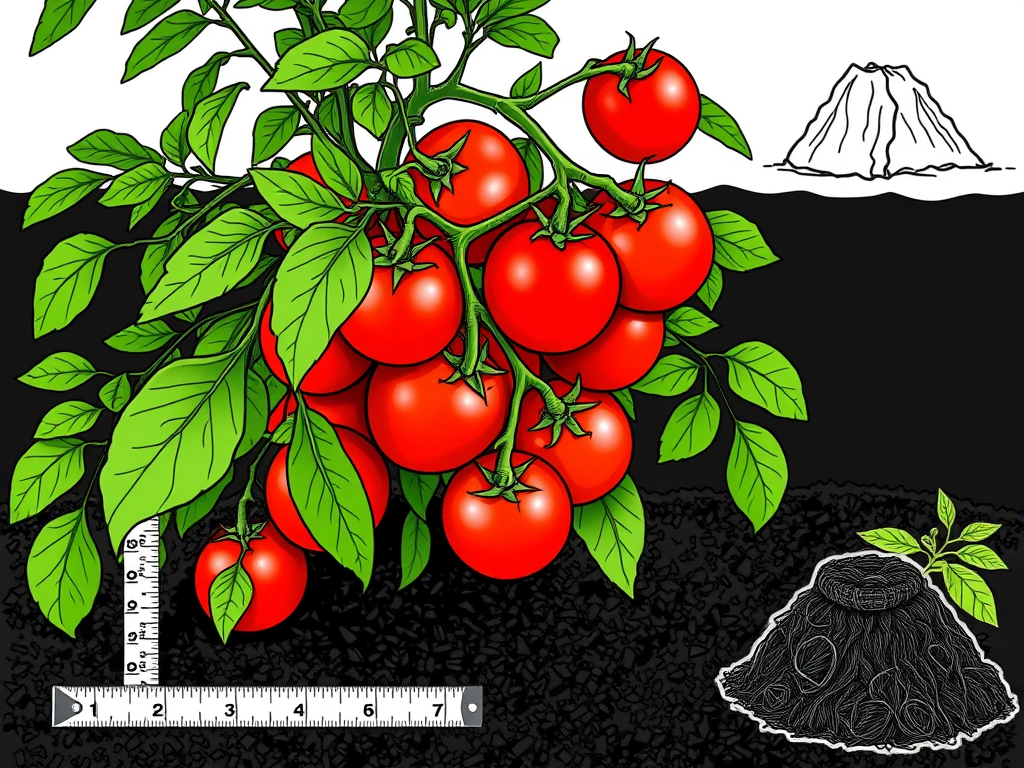
The humble tomato, a global dietary staple, faces significant post-harvest challenges due to its perishability. Addressing this, a recent study published in Scientific Reports by Aruna Olasekan Adekiya, Timothy Oyebamiji Ogunbode, Vincent Ishola Esan, Olajire Adedokun, Iyabo Victoria Olatubi, and Modupeola Hellen Ayegboyin, explores the remarkable impact of cow bone biocharBiochar is a carbon-rich material created from biomass decomposition in low-oxygen conditions. It has important applications in environmental remediation, soil improvement, agriculture, carbon sequestration, energy storage, and sustainable materials, promoting efficiency and reducing waste in various contexts while addressing climate change challenges. More on tomato cultivation. Their findings, published on July 10, 2025, reveal that biochar application not only dramatically increases yield but also significantly extends the shelf life of tomato fruits, offering a sustainable solution for farmers.
Conducted over 120 days, the experiment tested various levels of cow bone biochar (0, 10, 20, 30, and 40 t ha−1) and demonstrated a clear positive correlation between biochar application rate and improved soil properties, plant growth, yield, quality, and shelf life of tomatoes. Specifically, the highest application rate of 40 t ha−1 stood out for its exceptional benefits. This optimal rate of 40 t ha−1 cow bone biochar increased tomato yield by an astounding 294% compared to the control group. The study observed a consistent increase in growth and yield parameters as biochar levels rose from 0 to 40 t ha−1. This significant boost is primarily attributed to biochar’s ability to enhance soil chemical properties. The application of biochar led to increases in soil organic matter (SOM), nitrogen, phosphorus, potassium, calcium, and magnesium. For instance, at Site A, 40 t ha−1 biochar increased SOM by 130.2% and soil nitrogen by 33.3% compared to the control. This improvement in nutrient availability and retention, along with enhanced soil structure and water-holding capacity due to biochar’s porous nature, creates a more favorable environment for robust tomato growth and fruit development.
Beyond yield, the impact on fruit quality and post-harvest longevity is equally compelling. The 40 t ha−1 biochar application extended tomato shelf life by 70% compared to the control. This remarkable improvement is closely linked to the increased mineral content within the tomato fruits. The study found that the 40 t ha−1 biochar level boosted sodium, copper, iron, magnesium, calcium, and zinc contents in tomatoes by 60.71%, 142.93%, 68.13%, 328.4%, 68.75%, and 184.2%, respectively, relative to the control. Calcium, in particular, plays a crucial role in strengthening cell walls and maintaining fruit firmness, which directly translates to reduced water loss and extended shelf life. The improved water retention in the soil due to biochar also contributes to consistent fruit development, preventing issues like cracking and dehydration that can shorten shelf life.
Interestingly, while moisture content increased with biochar application, fat, carbohydrate, and ashAsh is the non-combustible inorganic residue that remains after organic matter, like wood or biomass, is completely burned. It consists mainly of minerals and is different from biochar, which is produced through incomplete combustion. Ash Ash is the residue that remains after the complete More content in the tomato fruits generally decreased. For example, at Site A, 40 t ha−1 biochar reduced fat content by 64.6% and carbohydrate content by 43.3% compared to the control. Conversely, protein content significantly increased, with the 40 t ha−1 rate leading to a 146.8% increase at Site A. This suggests a shift in the plant’s metabolic focus towards protein synthesis, supported by enhanced nitrogen availability from the biochar-amended soil.
Despite the substantial benefits, the researchers acknowledge the practical limitations of applying such high rates of biochar, noting that 40 t ha−1 is labor-intensive and costly for small-scale farmers. Excessive biochar could also potentially alter soil pHpH is a measure of how acidic or alkaline a substance is. A pH of 7 is neutral, while lower pH values indicate acidity and higher values indicate alkalinity. Biochars are normally alkaline and can influence soil pH, often increasing it, which can be beneficial More and microbial communities. To address these challenges, the study recommends tailoring application rates to specific soil and crop needs, with lower rates (e.g., 5−10 t ha−1) still offering significant long-term benefits. Combining biochar with other organic amendments, utilizing locally available biomassBiomass is a complex biological organic or non-organic solid product derived from living or recently living organism and available naturally. Various types of wastes such as animal manure, waste paper, sludge and many industrial wastes are also treated as biomass because like natural biomass these More, and exploring cooperative models for production are also suggested to enhance economic feasibility and promote sustainable adoption. Future research will focus on validating these findings in field conditions and assessing long-term ecological and economic impacts to ensure widespread sustainable adoption.
Source: Adekiya, A. O., Ogunbode, T. O., Esan, V. I., Adedokun, O., Olatubi, I. V., & Ayegboyin, M. H. (2025). Short term effects of biochar on soil chemical properties, growth, yield, quality, and shelf life of tomato. Scientific Reports, 15(1), 24965.



Leave a Reply