
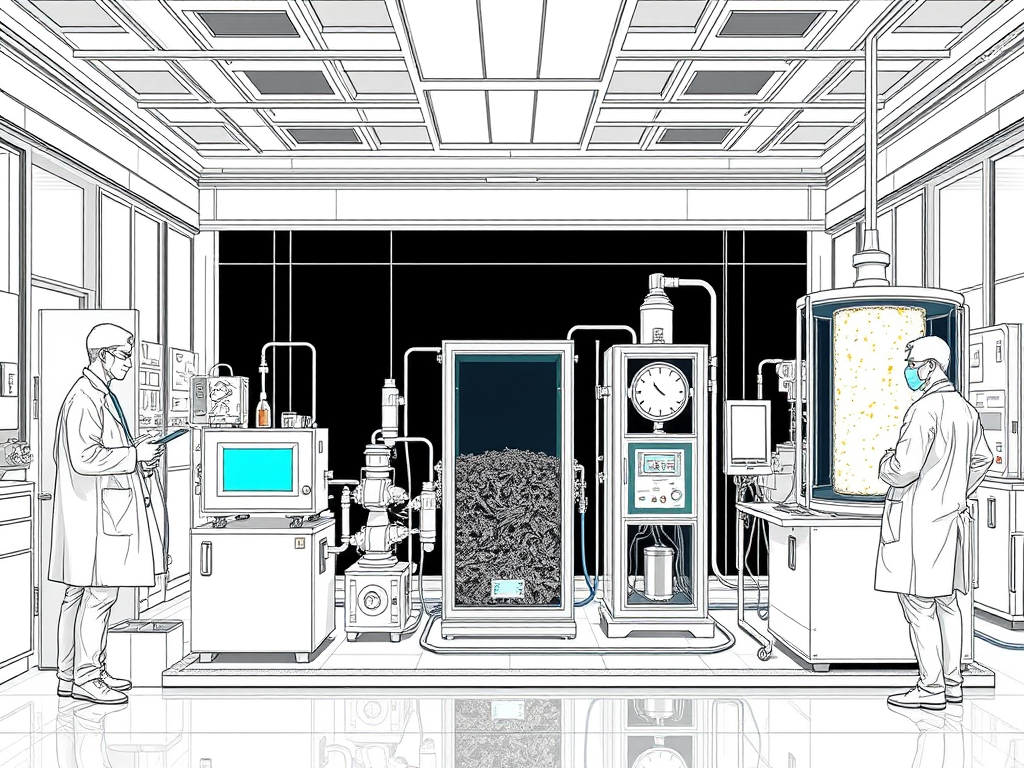
In a significant advancement for green hydrogen production, Nishithan C. Kani, Rohit Chauhan, and their colleagues have developed a biochar-assisted water electrolysis (BAWE) process that dramatically improves hydrogen generation efficiency while eliminating oxygen formation at the anode. This research, published in Cell Reports Physical Science, offers a promising pathway for sustainable and distributed hydrogen production.
Traditional water electrolysis faces limitations due to sluggish water oxidation reactions, requiring high overpotentials and operating at an equilibrium potential of 1.23 V. The BAWE process, however, utilizes carbon-based materials like agricultural waste-derived biocharBiochar is a carbon-rich material created from biomass decomposition in low-oxygen conditions. It has important applications in environmental remediation, soil improvement, agriculture, carbon sequestration, energy storage, and sustainable materials, promoting efficiency and reducing waste in various contexts while addressing climate change challenges. More as reducing agents, effectively lowering the equilibrium cell potential from 1.23 V to 0.21 V at standard conditions by avoiding direct water splitting. This allows for hydrogen production at total cell potentials under 1 V.
The team’s findings highlight several key benefits of the BAWE process. It achieves sub-volt hydrogen production, with an onset cell potential for H₂ generation below 0.2 V. This translates to a remarkable 6-fold increase in H₂ production compared to conventional water electrolysis. Using a single-junction solar cell, the BAWE system demonstrates a solar-to-hydrogen (STH) efficiency of 4.8% (circular process) and 35% (non-circular process, considering H₂ energy relative to H₂O without biochar).
The research delved into optimizing the biochar itself. The study found that properties such as an enhanced carbon-to-oxygen (C/O) ratio, increased crystallinity, and a more negative zeta potential significantly improve biochar oxidation kinetics at moderate temperatures. Smaller particle sizes and better mixing also prevent electrode caking, enhancing the stability of the biochar. Among the tested biochar samples derived from agricultural and animal wastes, biochar from cow manure (BC-5) exhibited the highest performance, yielding approximately 270 mA/gcat H₂ current. This superior performance is attributed to its optimal C/O ratio, high negative zeta potential, smaller particle size, and crystalline nature.
The study also investigated the impact of operating conditions. Increasing the anolyte temperature enhanced kinetics and mixing, leading to higher current densities. Argon sparging in the anolyte chamber improved mass transport and product gas collection, with optimal performance observed at 150 sccm (standard cubic centimeters per minute). Furthermore, smaller biochar particles with a higher pore diameter facilitated easier oxidation on the anode, boosting the hydrogen production rate.
The successful integration of a TOPCon silicon-bottom solar cell with the BAWE electrochemical cell for solar-driven hydrogen synthesis at 1 Sun irradiance further underscores the practical potential of this technology. This integrated system demonstrated an operating current of approximately 15 mA and an operating cell voltage of about 0.5 V. The findings suggest that biochar oxidation can serve as an effective anodic reaction to reduce the overall cell potential for various electrochemical processes, including CO₂ and N₂ reduction.
This innovative BAWE process not only addresses the energy intensity of hydrogen production but also offers a sustainable method for valorizing agricultural and animal waste.
Source: Kani, N. C., Chauhan, R., Olusegun, S. A., Sharan, I., Katiyar, A., House, D. W., Lee, S.-W., Jairamsingh, A., Bhawnani, R. R., Choi, D., Nielander, A. C., Jaramillo, T. F., Lee, H.-S., Oroskar, A., Srivastava, V. C., Sinha, S., Gauthier, J. A., & Singh, M. R. (2024). Sub-volt conversion of activated biochar and water for H₂ production near equilibrium via biochar-assisted water electrolysis. Cell Reports Physical Science, 5(6), 102013




Leave a Reply