
California-based technology firm Bioforcetech has secured a $310,000 Bridge Carbontech grant from Columbia University’s Carbontech Development Initiative (CDI), a program supported by the New York State Energy Research and Development Authority (NYSERDA). The funding is allocated to complete the engineering and commercial integration of the company’s proprietary carbon-negative building material, branded as OurCarbon. This specialized biocharBiochar is a carbon-rich material created from biomass decomposition in low-oxygen conditions. It has important applications in environmental remediation, soil improvement, agriculture, carbon sequestration, energy storage, and sustainable materials, promoting efficiency and reducing waste in various contexts while addressing climate change challenges. More product is derived directly from municipal biosolids and sewage sludge via an advanced thermochemical conversion process. The capital infusion will specifically fund the design and commercial manufacture of an automated dosing system, allowing conventional commercial concrete batch plants to seamlessly inject the biochar aggregate directly into their production lines.
The major challenge addressed by Bioforcetech involves the systemic bottleneck of scaling long-term carbon dioxide removal (CDR) storage pathways while simultaneously managing millions of tons of municipal sewage sludge under tightening environmental regulations. Municipal wastewater treatment plants in the United States face severe logistical strain due to escalating landfill tipping fees and strict regulatory bans on the land application of biosolids on agricultural fields due to widespread per- and polyfluoroalkyl substances (PFAS) contamination. While Bioforcetech has validated its thermochemical conversion process at a pilot scale, the primary industrial barrier remains the lack of standardized, automated injection infrastructure at commercial concrete facilities, preventing large-scale construction offtake and blockages within the localized circular supply chain.
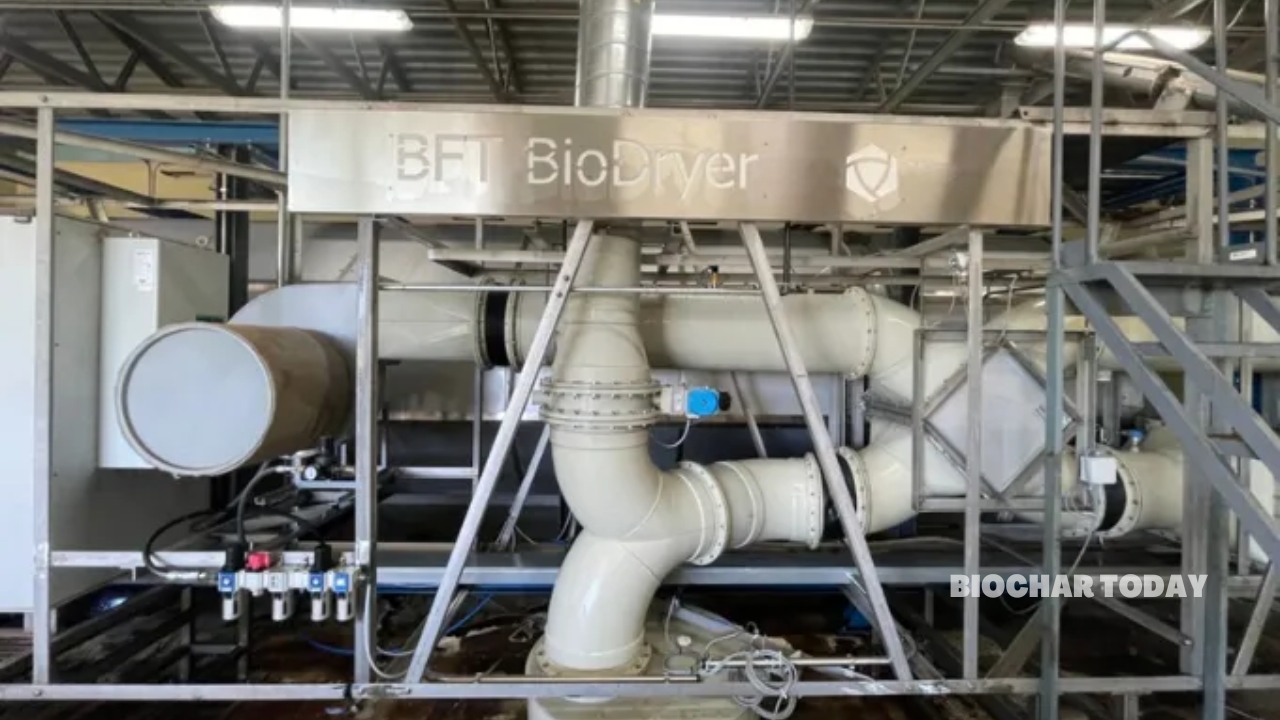
To circumvent these municipal waste and engineering constraints, Bioforcetech developed a closed-loop, two-stage treatment system deployed directly at regional wastewater treatment plants. The infrastructure utilizes the proprietary BFT BioDryer mechanism to rapidly extract moisture from raw biosolids, followed by the BFT SigmaOne high-temperature pyrolysisPyrolysis is a thermochemical process that converts waste biomass into bio-char, bio-oil, and pyro-gas. It offers significant advantages in waste valorization, turning low-value materials into economically valuable resources. Its versatility allows for tailored products based on operational conditions, presenting itself as a cost-effective and efficient More reactor, which processes the dewatered organic matter within a strictly controlled, low-oxygen thermal environment. This thermodynamic breakdown effectively converts volatile organic fractions into a highly stable, inert biochar matrix while permanently destroying complex chemical bonds. The resulting structural aggregate permanently sequesters embedded carbon inside cementitious materials, providing the building sector with a viable method to satisfy strict municipal mandates for lowering embodied carbon in regional infrastructure projects.
The operational and environmental outcomes of this technology validation establish a highly efficient dual-benefit framework for municipal waste management and long-term carbon sequestration. Rigorous third-party validation and testing overseen by engineering firm Brown and Caldwell confirmed that Bioforcetech’s high-temperature pyrolysis architecture achieves a 99.98% destruction efficiency for hazardous PFAS and “forever chemicals” embedded in the original sludge. By utilizing the CDI grant to deploy automated dosing equipment, the company successfully transitions from localized pilot pours to continuous industrial utilization within major metropolitan markets like New York City. The resulting concrete successfully locks away carbon dioxide for centuries, diverting hazardous municipal waste from landfills while transforming structural concrete into a verifiable, high-integrity carbon sink.




Leave a Reply