
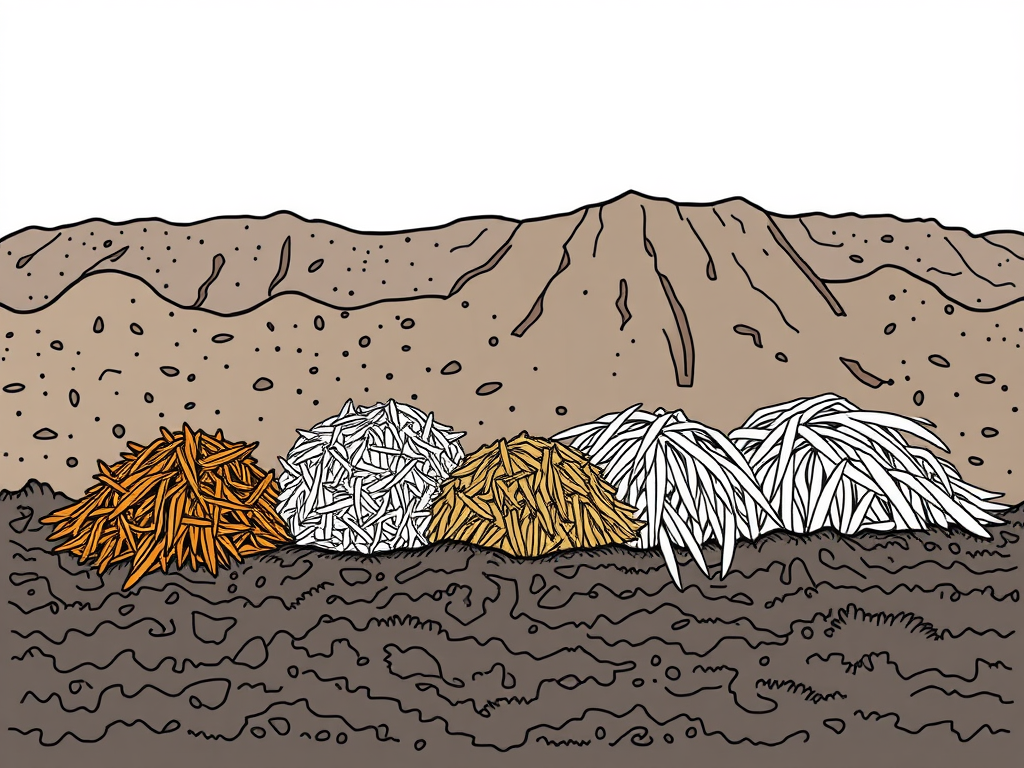
In a recent study published in Waste Disposal & Sustainable Energy, Jemima Akoto, Solomon Nunoo, and James Ransford Dankwah investigated the potential of agro-waste biocharBiochar is a carbon-rich material created from biomass decomposition in low-oxygen conditions. It has important applications in environmental remediation, soil improvement, agriculture, carbon sequestration, energy storage, and sustainable materials, promoting efficiency and reducing waste in various contexts while addressing climate change challenges. More as a backfill material for enhancing grounding systems. Their research sheds light on how different types of biochar perform in varying soil conditions, and importantly, the impact of environmental factors like rainfall on their long-term effectiveness.
Grounding systems are critical for electrical safety, dissipating fault currents into the earth. However, achieving low soil resistance, essential for effective grounding, can be challenging, especially in areas with high soil resistivity due to volcanic ashAsh is the non-combustible inorganic residue that remains after organic matter, like wood or biomass, is completely burned. It consists mainly of minerals and is different from biochar, which is produced through incomplete combustion. Ash Ash is the residue that remains after the complete More, gravel, or craggy terrain. Traditionally, physical methods like using multiple or deeper rods, or chemical treatments with materials like bentonite or sodium chloride, have been employed. While these methods can reduce soil resistance, they often come with limitations such as diminishing returns for physical methods and the temporal nature, cost, and corrosive properties of many chemical treatments. This has led researchers to explore greener alternatives like biochar.
Biochar has garnered attention for its ability to improve soil health, including water retention, nutrient exchange, and mechanical properties. Crucially for grounding systems, biochar also possesses traits that enhance electrical conductivity, such as high water absorption and retention, high mineral content, and a long residence timeResidence time refers to the duration that the biomass is heated during the pyrolysis process. The residence time can influence the properties of the biochar produced. More in soil—potentially hundreds of years. Previous studies have reported impressive reductions in soil resistivity and ground resistance with the use of biochar.
This study focused on biochar derived from coconut husk, sawdust, sugarcane bagasse, and rice husk. Researchers monitored soil resistivity and Resistance to Ground (RTG) values in two distinct soil types: a predominantly clayey soil (Site A) and a sandy soil (Site B) in Ghana. The findings revealed that these agro-waste biochar treatments significantly improved soil resistance and the zone of influence, with a P-value ≤ 0.05. The zone of influence, for instance, ranged less than 1 meter in clayey soil but was 2 meters or more in sandy soil.
The type of soil played a critical role in the effectiveness of the biochar. While biochar treatments (coconut husk, sugarcane bagasse, sawdust, and rice husk) effectively reduced RTG values in the clay soil, they were less effective in the sandy soil. This is attributed to the porous nature of sandy soil, which leads to easier leachingLeaching is the process where nutrients are dissolved and carried away from the soil by water. This can lead to nutrient depletion and environmental pollution. Biochar can help reduce leaching by improving nutrient retention in the soil. More of the applied biochar and dissolved ions, impacting its ability to conduct electricity.
A significant finding was the impact of rainfall and high moisture content. The study observed that these environmental factors contribute to the physical breakdown of biochar. This suggests a potential compromise to biochar’s long-term effectiveness, especially in areas with high rainfall or when applied to porous soils. The research also highlighted that “treatment, time, and mode of application of treatment played significant and interdependent roles in reducing soil resistivity”. These three factors collectively accounted for over 83% improvement of RTG values, with the treatment itself being the most dominant factor (54.7%), followed by the mode of application (38.6%), and time (6.7%).
To address the issue of biochar leaching and breakdown, the study explored the use of “green concrete” technology, where agro-waste biochar is incorporated into concrete. The results indicated that concretizing the biochar significantly improved its sustained performance in sandy soils by immobilizing the treatment and preventing it from being washed out. While leaching was less pronounced in clay soil, this approach could still be beneficial for long-term grounding system integrity in such environments.
In conclusion, agro-waste biochar presents a promising, greener alternative for enhancing grounding systems, demonstrating significant improvements in soil resistivity. However, its susceptibility to physical breakdown due to rainfall and leaching, particularly in sandy soils, underscores the need for careful consideration of soil type and innovative application methods, such as biochar-infused concrete, to ensure its long-term efficacy. Future research should also delve into other confounding variables, such as the carbonization method and the physical and chemical properties of the biochar, to further optimize its performance in grounding applications.
Source: Akoto, J., Nunoo, S., & Dankwah, J. R. (2025). Enhancing grounding systems: effects of agro-based biochar used as backfill materials. Waste Disposal & Sustainable Energy.



Leave a Reply