
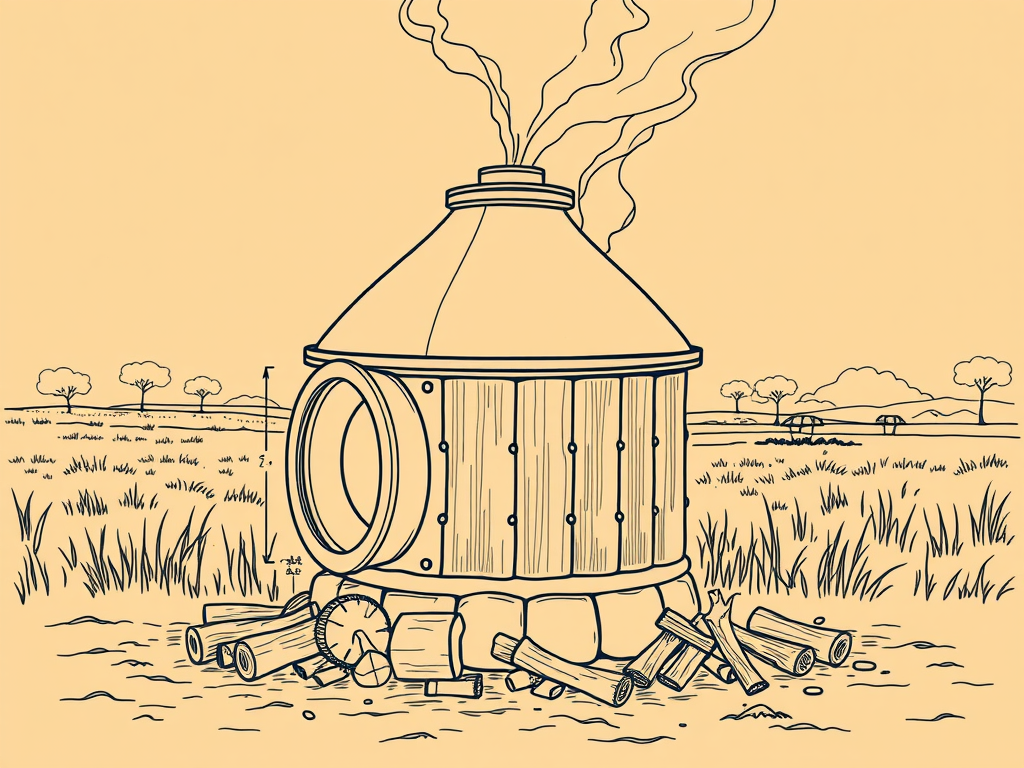
A study published in the Ayden International Journal of Environmental Sciences and Allied Research by Adebayo, Samuel Oluwagbemiga , details the development of an Indigenous BiocharBiochar is a carbon-rich material created from biomass decomposition in low-oxygen conditions. It has important applications in environmental remediation, soil improvement, agriculture, carbon sequestration, energy storage, and sustainable materials, promoting efficiency and reducing waste in various contexts while addressing climate change challenges. More Production Kiln (IBPK) in Nigeria. This kiln aims to facilitate the local production of biochar, a material that can improve soil fertility and help plants withstand drought.
The IBPK is designed to convert biomassBiomass is a complex biological organic or non-organic solid product derived from living or recently living organism and available naturally. Various types of wastes such as animal manure, waste paper, sludge and many industrial wastes are also treated as biomass because like natural biomass these More into a carbon-rich substance through thermal energy. The kiln features an Internal Retort Drum (IRD) and an outer drum. The IRD has dimensions of 350 mm in diameter and 600 mm in height, while the outer drum measures 500 mm in diameter and 800 mm in height.
In a trial experiment, the IBPK was used to process 55 kg of wood waste. The wood waste was placed inside the IRD, which was then positioned within the outer drum. The space between the drums was used to contain firewood, which was burned to generate the heat needed for biochar production. The kiln is designed with a chimney to release smoke. The carbonization process took 182 minutes, and the IBPK achieved a conversion efficiency of 71%. During the process, the average temperature inside the kiln was 269°C. The resulting biochar was analyzed, revealing the presence of several macro-elements: Nitrogen (2.95%), Phosphorus (21.79%), Potassium (4.95%), and Carbon (70.31%).
The total fabrication cost of the IBPK was N52,200:00. The researchers recommend the IBPK as a tool for farmers to produce biochar and for young people to start biochar production businesses.
Biochar is a carbon-rich substance similar to charcoalCharcoal is a black, brittle, and porous material produced by heating wood or other organic substances in a low-oxygen environment. It is primarily used as a fuel source for cooking and heating. More, found in soil as a result of organic matter decomposition. It can also be produced through the pyrolysisPyrolysis is a thermochemical process that converts waste biomass into bio-char, bio-oil, and pyro-gas. It offers significant advantages in waste valorization, turning low-value materials into economically valuable resources. Its versatility allows for tailored products based on operational conditions, presenting itself as a cost-effective and efficient More of organic materials like agricultural waste and plant matter, at temperatures ranging from 280°C to 500°C. Biochar contains various elements, including Carbon, Hydrogen, Oxygen, Nitrogen, Sulphur, and AshAsh is the non-combustible inorganic residue that remains after organic matter, like wood or biomass, is completely burned. It consists mainly of minerals and is different from biochar, which is produced through incomplete combustion. Ash Ash is the residue that remains after the complete More. It may also contain Potassium, Phosphorus, and other elements, depending on the source material. Primarily, biochar is used to enhance soil fertility and store carbon. It also has potential applications as livestock feed.
Biochar can be produced from various organic materials and under different conditions, resulting in biochar with unique properties. The selection of feedstockFeedstock refers to the raw organic material used to produce biochar. This can include a wide range of materials, such as wood chips, agricultural residues, and animal manure. More and production method depends on factors like material availability and intended use. Feedstock can include wood, paper, crop residues, manure, algae, green waste, nutshells, forest residue, poultry litter, and sewage sludge.
Studies have shown that biochar can improve soil moisture retention and carbon content. It can also be used for soil remediation, reducing carbon dioxide emissions, and adjusting soil pHpH is a measure of how acidic or alkaline a substance is. A pH of 7 is neutral, while lower pH values indicate acidity and higher values indicate alkalinity. Biochars are normally alkaline and can influence soil pH, often increasing it, which can be beneficial More. Overall, biochar offers a sustainable way to manage waste and improve soil health.
SOURCE ; Adebayo, S. O. (2025). ASSESSMENT OF MACRO-ELEMENT COMPOSITION IN LOCALLY PRODUCED BIOCHAR. Ayden International Journal of Environmental Sciences and Allied Research, 13(1).



Leave a Reply