
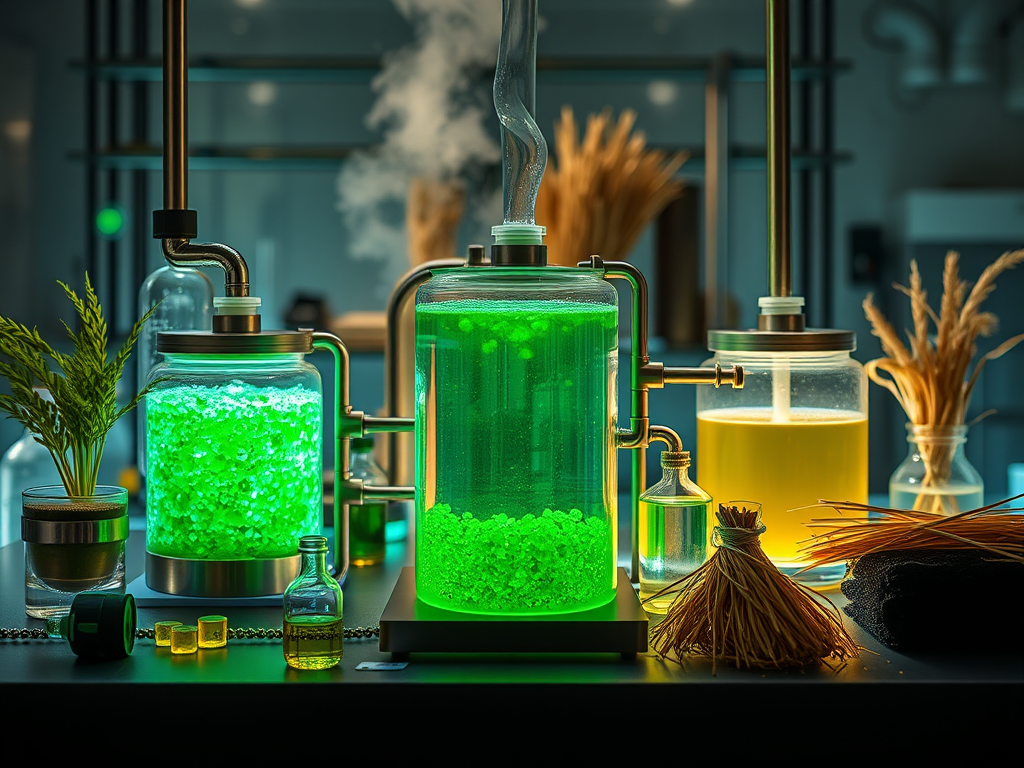
BiocharBiochar is a carbon-rich material created from biomass decomposition in low-oxygen conditions. It has important applications in environmental remediation, soil improvement, agriculture, carbon sequestration, energy storage, and sustainable materials, promoting efficiency and reducing waste in various contexts while addressing climate change challenges. More is a renewable, abundant resource that can be converted into biofuels and other materials for energy and environmental remediation. A recent study published in Biochar explores a process called hydrothermal conversion, which uses a combination of two types of biomassBiomass is a complex biological organic or non-organic solid product derived from living or recently living organism and available naturally. Various types of wastes such as animal manure, waste paper, sludge and many industrial wastes are also treated as biomass because like natural biomass these More: Chlorella pyrenoidosa (CP), a type of microalgae, and oilseed rape straw (OS). Researchers Jingmiao Zhang et al. discovered that by subjecting CP and OS to hydrothermal conversion, they could co-produce a range of valuable materials, including biofuels, bio-adsorbents, and biological nutrients, while improving resource utilization.
Biomass hydrothermal conversion is a process that has gained attention because it can handle a variety of raw materials, doesn’t require the feedstockFeedstock refers to the raw organic material used to produce biochar. This can include a wide range of materials, such as wood chips, agricultural residues, and animal manure. More to be dried, and uses relatively mild conditions. The process involves treating biomass with hot water under pressure to break it down into different products. In this study, CP and OS were hydrothermally treated at 230 °C for 6 hours. This process yielded several products: carbon dots (CDs), hydrochar (HC), bio-oil (OR), an aqueous product (AQ), and a volatile product (VO).
The study found that the type of feedstock significantly influences the final products. The CP hydrothermal process produced the highest yield of CDs at 16.3%, while the OS process generated the most hydrochar at 26.3%. When CP and OS were treated together, the co-hydrothermal process increased the production of hydrochar and volatile products through carbonization, decarboxylation, and dehydration reactions.
The products from this conversion process show great promise as biofuels. The higher heating values (HHVs) of the hydrochars and bio-oils were measured to determine their potential for energy use. Bio-oil derived from CP had an HHV of 38.5 MJ kg-1, which is slightly higher than the bio-oil from other microalgae species and shows its potential for use as a biofuel. The hydrochar from the co-hydrothermal treatment of CP and OS demonstrated a higher HHV than both the individual hydrochars, reaching 27.8 MJ kg-1. This suggests that co-hydrothermal conversion is particularly effective for producing solid biofuels with enhanced energy content. The study also noted that hydrochar from this process has a low sulfur content (0.4-1.3%), making it a cleaner alternative solid fuel that helps reduce SOx emissions.
In addition to biofuels, the study explored the use of carbon dots and hydrochar for environmental applications, specifically the removal of methylene blue (MB), a common dye pollutant. The carbon dots derived from CP demonstrated the highest performance, photodegrading over 42.3% of the MB in an aqueous solution. This was significantly higher than the degradation efficiency of CDs from OS (19.7%) and the co-treated CP/OS (29.5%). The strong photodegradation ability of the CP-derived CDs is attributed to their superior fluorescence properties and high quantum yield of 11.1%.
The hydrochar products also proved to be effective bio-adsorbents. Hydrochar from the OS process removed over 68.9% of the MB, with an adsorption capacity of up to 275.6 mg g-1. This capacity is higher than that of hydrochar from other biomass sources like mason pine and seaweed. Finally, the researchers investigated the potential of the aqueous product (AQ) as a biological nutrient for microalgae cultivation. The AQ from the CP hydrothermal process was the most suitable medium for growing Chlorella vulgaris, reaching a biomass productivity of 1.1 g L-1 after 8 days. In contrast, the microalgae could barely grow in the AQ from the OS process due to its low pHpH is a measure of how acidic or alkaline a substance is. A pH of 7 is neutral, while lower pH values indicate acidity and higher values indicate alkalinity. Biochars are normally alkaline and can influence soil pH, often increasing it, which can be beneficial More. This finding highlights a valuable method for recycling nutrients and addressing the problem of hydrothermal wastewater pollution.
This study demonstrates that hydrothermal conversion of biomass, particularly when combining different feedstocks like microalgae and agricultural waste, can be an efficient way to create multiple high-value products. The findings suggest that the CP hydrothermal conversion is better for producing carbon dots, liquid biofuels, and reusable aqueous products, while the OS process is superior for creating bio-adsorbents. The co-hydrothermal process of both biomasses is particularly effective for producing solid biofuels.
Source: Zhang, J., Zhang, B., Xia, A., Zhou, Q., Zhu, X., Huang, Y., Zhu, X., & Liao, Q. (2025). Production of carbon dots, biofuels, bio-adsorbents, and biological nutrients via hydrothermal conversion of Chlorella pyrenoidosa and oilseed rape straw. Biochar, 7(109).




Leave a Reply