
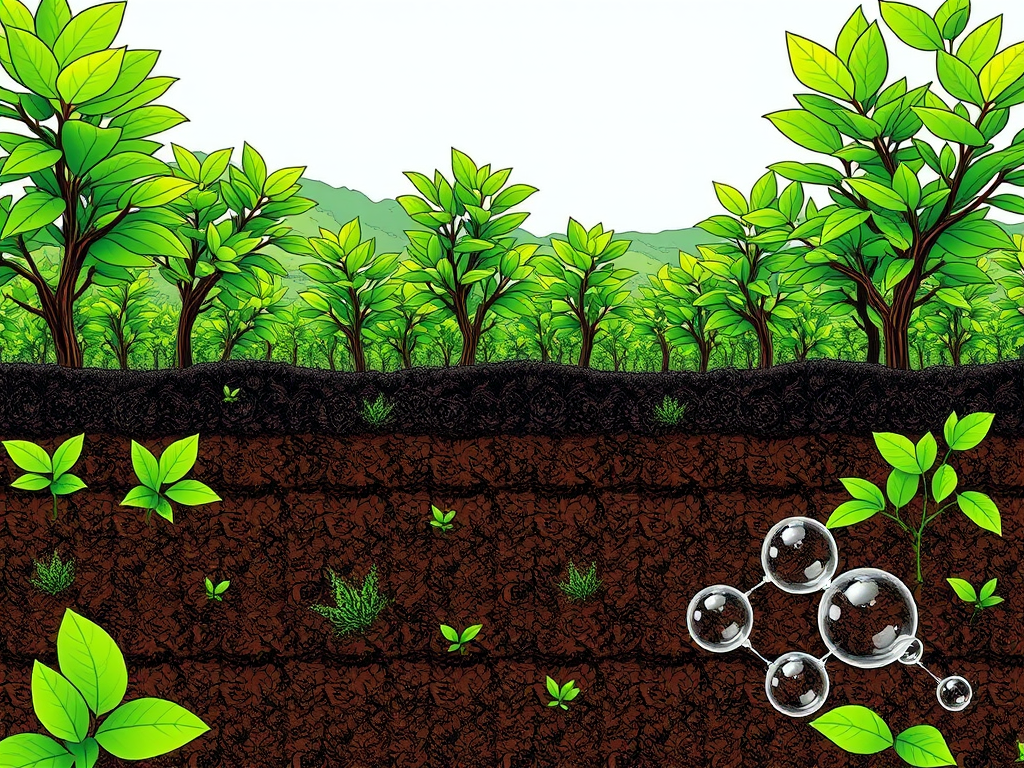
In a recent study published in Industrial Crops & Products, Shuli Wang and colleagues investigated the impact of water-retaining agents on greenhouse gas emissions from Camellia oleifera plantation soil. Camellia oleifera is an important woody oil crop cultivated in subtropical regions, where maintaining adequate soil moisture is crucial for high yields. The research focused on how polyacrylamide (PAM) and biochar-modified PAM affect soil water retention and the emission of nitrous oxide (N2O) and nitric oxide (NO)—two significant greenhouse gases.
The researchers found that both PAM and biochar-modified PAM altered soil moisture and physicochemical properties. Notably, the application of biochar-modified PAM led to a significant reduction in soil NO emissions. Specifically, NO emissions decreased by 15.90%, 18.54%, 16.01%, and 30.34% with increasing concentrations of the modified PAM. This reduction is attributed to the agent’s effect on the abundance of functional genes involved in nitrification and denitrification processes, mediated by an increase in soil pHpH is a measure of how acidic or alkaline a substance is. A pH of 7 is neutral, while lower pH values indicate acidity and higher values indicate alkalinity. Biochars are normally alkaline and can influence soil pH, often increasing it, which can be beneficial More.
The study highlights that using water-retaining agents, particularly biochar-modified PAM, can be a beneficial strategy for managing soil moisture and regulating greenhouse gas emissions in C. oleifera plantations. BiocharBiochar is a carbon-rich material created from biomass decomposition in low-oxygen conditions. It has important applications in environmental remediation, soil improvement, agriculture, carbon sequestration, energy storage, and sustainable materials, promoting efficiency and reducing waste in various contexts while addressing climate change challenges. More, produced from C. oleifera shells, enhances the water retention capacity of PAM. This modification not only improves the hydrophilicity and cohesiveness of PAM but also offers a cost-effective way to utilize agricultural waste.
While the findings are promising, the authors suggest that further research is needed to determine the optimal ratios and application methods of water-retaining agents. This will help maximize the benefits of these agents in both water conservation and greenhouse gas emission mitigation in agricultural practices.
SOURCE: Wang, S., Yu, Y., Zhang, X., Wang, H., Luo, L., Bai, J., Xu, X., Hu, D., & Zhang, L. (2025). Biochar modified water-retaining agent polyacrylamide reduced NO but not N2O emissions from Camellia oleifera plantation soil. Industrial Crops & Products, 227, 120838.





Leave a Reply