
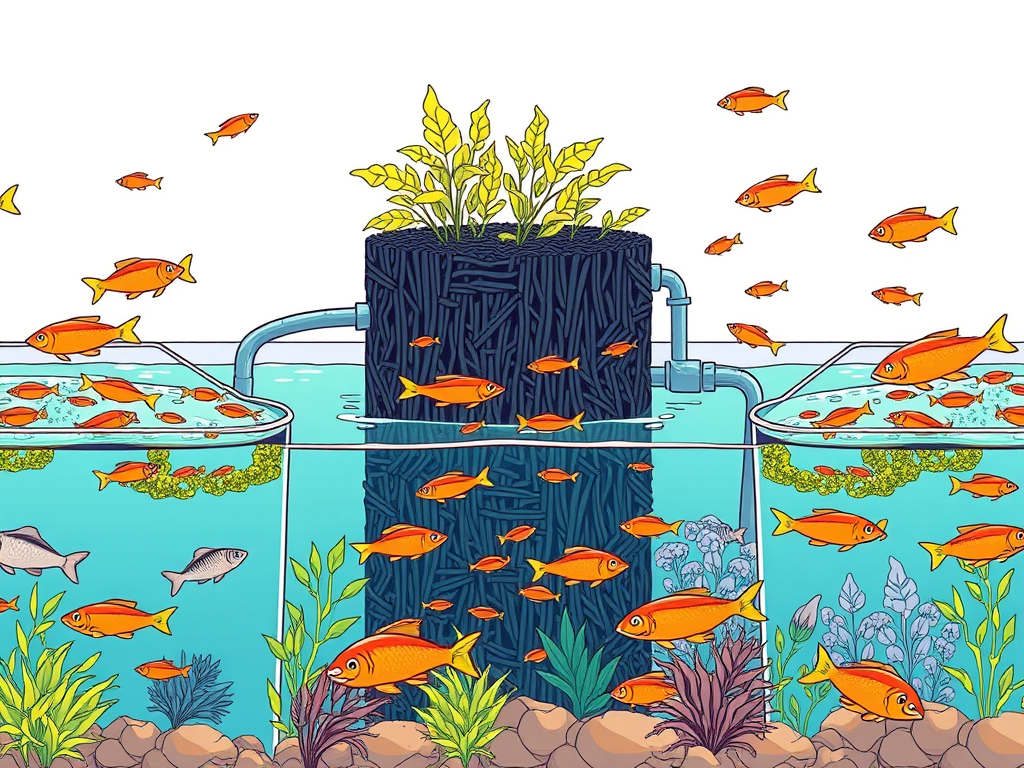
A recent study published in Resources, Environment and Sustainability by Marta Behjat and friends explores the environmental benefits of using biocharBiochar is a carbon-rich material created from biomass decomposition in low-oxygen conditions. It has important applications in environmental remediation, soil improvement, agriculture, carbon sequestration, energy storage, and sustainable materials, promoting efficiency and reducing waste in various contexts while addressing climate change challenges. More filters in recirculating aquaculture systems (RAS). The research indicates that biochar filters can effectively recover nutrients from fish wastewater and produce nutrient-enriched biochar for agricultural applications, potentially offering a more sustainable approach to fish farming.
Aquaculture is the fastest-growing food-producing sector globally. Recirculating aquaculture systems (RAS) are gaining popularity as a method to farm fish sustainably. However, traditional RAS involve the loss of valuable nutrients like nitrogen (N) and phosphorus (P). This study explores the use of biochar filters to capture these nutrients, turning potential pollutants into agricultural resources. Biochar has been recognized for its ability to improve soil quality and store carbon. This study investigates its additional use in RAS to recover nutrients from fish wastewater, creating a closed-loop system where the biochar becomes a nutrient-rich fertilizer.
The researchers conducted a life cycle assessment (LCA) to compare two RAS configurations: a conventional system using a biofilter and an innovative system using a biochar filter. The biochar system was further analyzed from two perspectives: one where biochar production is solely for the RAS, and another where biochar is already produced for agriculture and used in RAS as an intermediate step.
The LCA revealed that conventional RAS are most affected by the production of fish feed and electricity consumption. In contrast, the biochar filter system introduces additional impacts from forestry biomassBiomass is a complex biological organic or non-organic solid product derived from living or recently living organism and available naturally. Various types of wastes such as animal manure, waste paper, sludge and many industrial wastes are also treated as biomass because like natural biomass these More production and the construction of the pyrolysisPyrolysis is a thermochemical process that converts waste biomass into bio-char, bio-oil, and pyro-gas. It offers significant advantages in waste valorization, turning low-value materials into economically valuable resources. Its versatility allows for tailored products based on operational conditions, presenting itself as a cost-effective and efficient More plant needed to produce biochar. However, the biochar system also offers benefits like heat recovery and carbon sequestration, particularly notable in reducing global warming potential. The study found that biochar-based systems can achieve net-negative greenhouse gas emissions, sequestering 10 kg of CO2-eq per kg of fish, primarily due to the carbon stored in the biochar. This carbon remains stable in the soil, preventing its release into the atmosphere.
The authors acknowledge that the effectiveness of biochar in nutrient recovery and its behavior as a fertilizer require further validation. They emphasize the need for continued research to optimize the system and explore the potential of fish sludge valorization to further enhance the sustainability of RAS.
Source: Behjat, M., Svanström, M., Peters, G., & Wennberg, N. (2025). Life Cycle Assessment of recirculating aquaculture systems with innovative biochar filter for enhanced nutrient recirculation. Resources, Environment and Sustainability,





Leave a Reply