
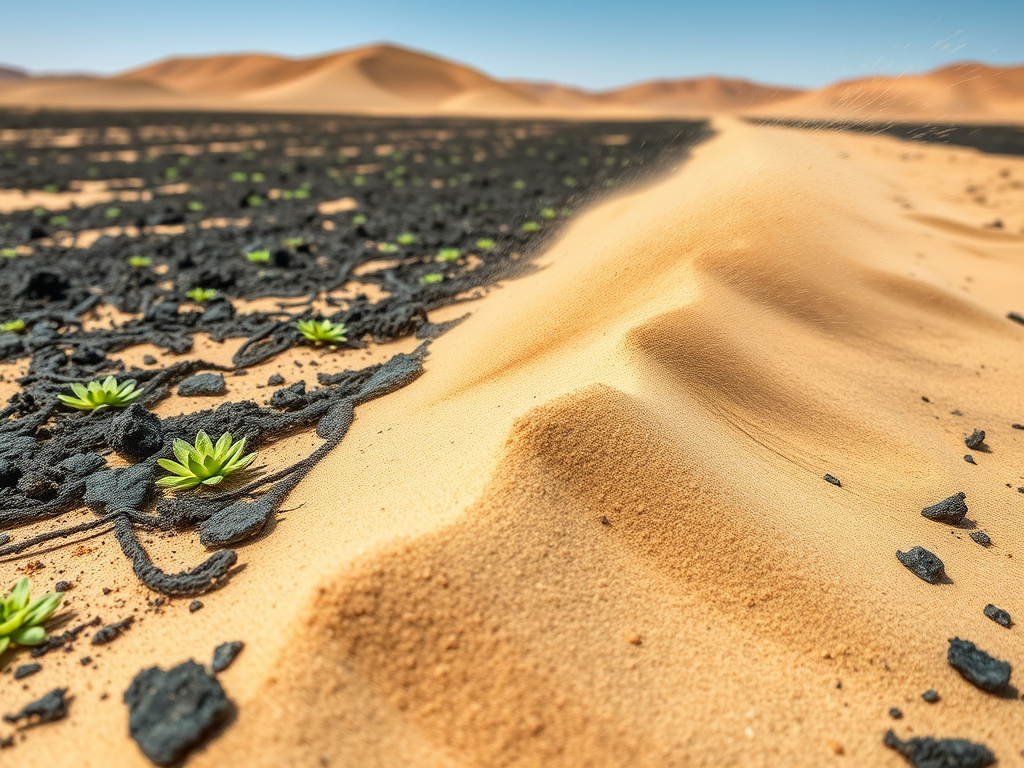
In a study published in Scientific Reports, Zhe Wang, Xueshi Liu, and colleagues explored how combining biocharBiochar is a carbon-rich material created from biomass decomposition in low-oxygen conditions. It has important applications in environmental remediation, soil improvement, agriculture, carbon sequestration, energy storage, and sustainable materials, promoting efficiency and reducing waste in various contexts while addressing climate change challenges. More with cyanobacteria crusts affects soil wind erosion in arid mining areas experiencing freeze-thaw cycles. The research highlights that while cyanobacteria crusts can reduce wind erosion, their effectiveness decreases under freeze-thaw conditions. The study reveals that the combined use of biochar and cyanobacteria offers a promising strategy for mitigating wind erosion, achieving up to a 64.73% reduction in erosion at a wind speed of 15 m/s.
Wind erosion poses a significant environmental threat, especially in arid and semi-arid regions like northern China. Mining activities in these areas exacerbate the problem by removing vegetation and disrupting the soil structure, making the soil more susceptible to wind erosion. This erosion can disperse pollutants into the environment, posing risks to human health.
Cyanobacteria crusts, which are formed by the interaction of various organisms like algae, lichens, and bacteria with soil particles, play a vital role in stabilizing soil and preventing wind erosion. These crusts secrete extracellular polysaccharide substances (EPS) that bind soil particles together. However, their natural recovery is slow and can be hindered by environmental factors and human activities. Biochar has emerged as a valuable soil amendmentA soil amendment is any material added to the soil to enhance its physical or chemical properties, improving its suitability for plant growth. Biochar is considered a soil amendment as it can improve soil structure, water retention, nutrient availability, and microbial activity. More. It improves soil properties such as water absorption and structure, and when combined with cyanobacteria, it enhances the stabilization of soil particles.
Arid and semi-arid regions often experience freeze-thaw cycles, which can degrade soil structure and reduce its resistance to wind erosion. These cycles particularly affect the topsoil layer where cyanobacteria crusts are present. While biochar has been shown to alleviate some negative impacts of freeze-thaw, its effect on the wind erosion resistance of cyanobacteria crusts in mining areas remained unclear.
The study conducted by Wang and colleagues aimed to address this gap by investigating the combined effect of biochar and cyanobacteria crusts on soil wind erosion under freeze-thaw conditions. The results showed that freeze-thaw cycles altered several soil physicochemical properties, including pHpH is a measure of how acidic or alkaline a substance is. A pH of 7 is neutral, while lower pH values indicate acidity and higher values indicate alkalinity. Biochars are normally alkaline and can influence soil pH, often increasing it, which can be beneficial More, bulk density, and clay percentage. Notably, the combination of biochar and cyanobacteria (CB group) proved most effective in reducing wind erosion, with the erosion reduction rate peaking at 64.73% at a wind speed of 15 m/s.
The enhanced erosion reduction is attributed to the improved aggregate stability and clay percentage in the soil. Biochar helps cyanobacteria withstand freeze-thaw damage, while also improving soil texture and aggregate stability. This combined effect makes the soil more resistant to wind erosion.
The study concludes that incorporating biochar with cyanobacteria crusts is a promising strategy for controlling wind erosion in areas with seasonal freeze-thaw conditions. This finding offers valuable insights for developing effective wind erosion control measures in vulnerable mining regions.
Source: Wang, Z., Liu, X., Sun, F., Jiang, Q., Shang, H., & Zheng, C. (2025). Effect of biochar and cyanobacteria crust incorporation on soil wind erosion in arid mining area under freeze-thaw action. Scientific Reports, 15(1), 16363.



Leave a Reply