
Key Takeaways
- BiocharBiochar is a carbon-rich material created from biomass decomposition in low-oxygen conditions. It has important applications in environmental remediation, soil improvement, agriculture, carbon sequestration, energy storage, and sustainable materials, promoting efficiency and reducing waste in various contexts while addressing climate change challenges. More enhances methane production by 8 to 47 percent across diverse organic waste substrates.
- Adding biochar reduces reactor start-up lag periods by up to 64 percent.
- Porous biochar surfaces act as protective microhabitats that prevent microbial washout.
- Alkaline minerals in biochar buffer acidity and prevent digester collapse under heavy organic loads.
- Biochar facilitates direct electron transfer between bacteria and methane-producing microbes.
The global accumulation of municipal sludge, agricultural residues, and food waste presents a growing environmental burden, with over 70 percent of organic waste still relegated to landfills or incineration. Anaerobic digestion offers a practical solution by using specialized microbial communities to convert organic matter into renewable methane gas. However, the process remains highly vulnerable to operational disruptions. Rapid organic overloading frequently causes volatile fatty acids to accumulate, dropping digester pHpH is a measure of how acidic or alkaline a substance is. A pH of 7 is neutral, while lower pH values indicate acidity and higher values indicate alkalinity. Biochars are normally alkaline and can influence soil pH, often increasing it, which can be beneficial More and suppressing methane generation. Additionally, high ammonia levels in livestock manure and food waste severely inhibit sensitive methane-producing microorganisms. Integrating biochar—a carbon-rich material produced from thermochemical waste conversion—has emerged as a robust strategy to stabilize digestion systems and maximize bioenergy recovery.
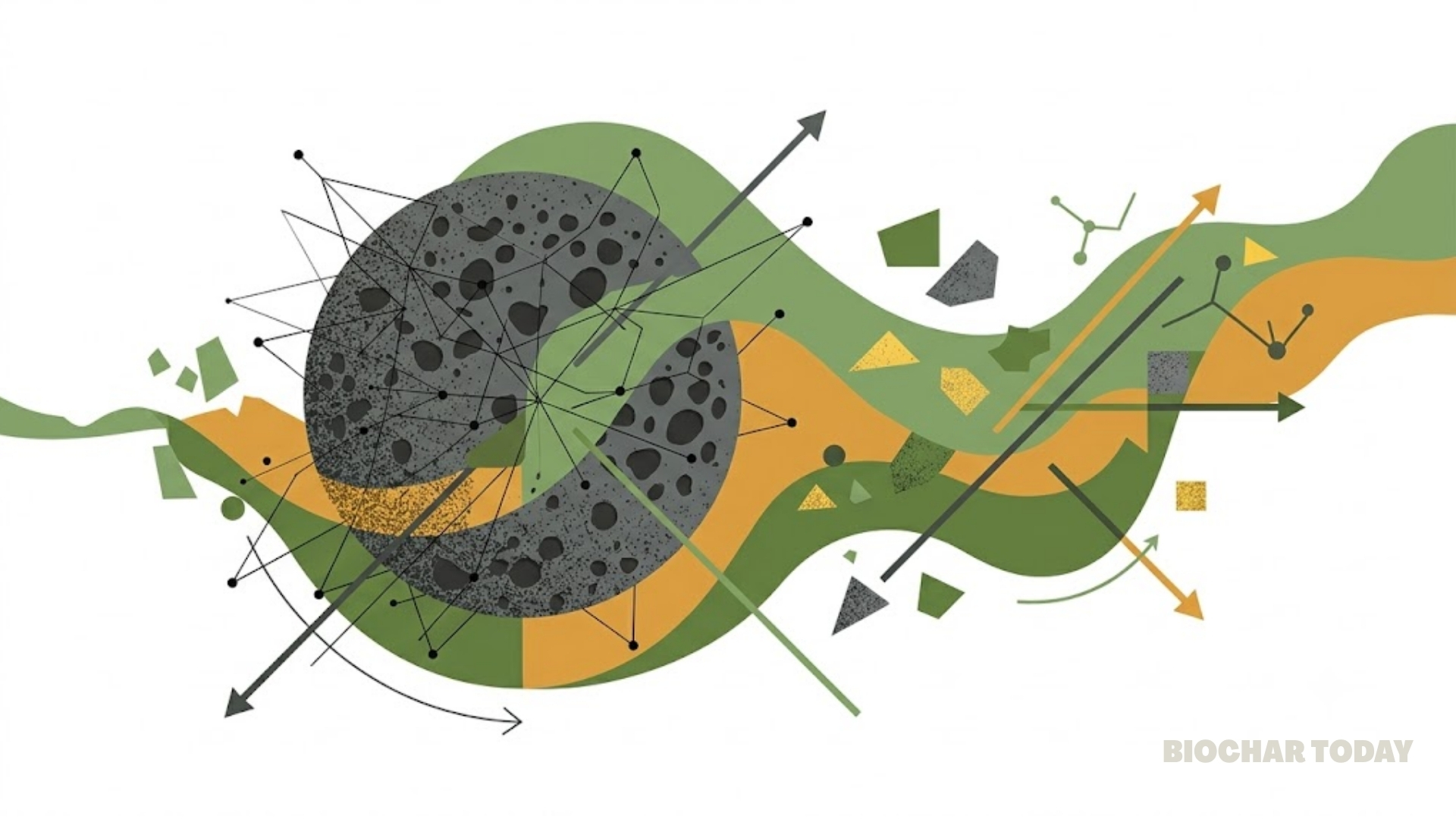
Biochar acts through multiple physical and chemical pathways to overcome metabolic bottlenecks during waste degradation. The primary benefit stems from its highly porous network, which provides structural anchoring sites for hydrolytic bacteria, fermentative microbes, and methane-producing archaea. These protective microhabitats safeguard microbes against environmental shocks while promoting dense biofilm growth. Chemically, biochar derived from high-temperature pyrolysisPyrolysis is a thermochemical process that converts waste biomass into bio-char, bio-oil, and pyro-gas. It offers significant advantages in waste valorization, turning low-value materials into economically valuable resources. Its versatility allows for tailored products based on operational conditions, presenting itself as a cost-effective and efficient More or mineral-rich feedstocks releases essential alkaline minerals, such as calcium, magnesium, and potassium, into the liquid digestate. This natural mineral release boosts system alkalinity, neutralizing excess acidity without requiring expensive chemical additives. Furthermore, acidic surface functional groups on biochar bind excess ammonium ions through cation exchange, effectively insulating sensitive microbial populations from toxic ammonia spikes.
Beyond physical protection and buffering, biochar fundamentally optimizes microbial metabolic interactions. Conventional digestion relies on slow, indirect electron transfer via diffusing hydrogen gas or formate molecules, which stalls whenever intermediate acids build up. Conductive biochar bridges this gap by establishing direct interspecies electron transfer pathways. Graphitized carbon networks and surface redox-active groups allow syntrophic bacteria to transfer electrons directly to partner methanogens, accelerating the conversion of volatile fatty acids into methane. Consequently, biochar-amended systems exhibit dramatic improvements in processing efficiency, raising methane yields by nearly 47 percent for food waste and up to 36 percent for high-nitrogen chicken manure. In complex co-digestion systems, biochar reduces start-up lag phases by 27 to 64 percent, accelerating the transition to steady biogas production.
Despite these clear performance gains, scaling biochar applications requires overcoming key material and engineering constraints. Unmodified biochars display significant physical heterogeneity depending on raw feedstockFeedstock refers to the raw organic material used to produce biochar. This can include a wide range of materials, such as wood chips, agricultural residues, and animal manure. More choices and processing temperatures. Low-temperature biochars retain helpful oxygen functional groups but can release residual soluble organic compounds that briefly stress microbial communities. Conversely, high-temperature biochars offer superior electrical conductivity but lose essential surface exchange capacity. Additionally, recovering fine biochar powders from leftover digestate remains an operational challenge. Future commercial deployment will depend on establishing standardized, digester-grade biochar specifications, validating long-term continuous operations, and ensuring comprehensive environmental safety across the entire waste valorization chain.
Source: Shi, Y., Luo, Y., Zhu, T., & Zang, K. (2026). Application and mechanisms of biochar in anaerobic digestion: Towards process resilience and waste valorization. Toxics, 14(9), Article 764.


![Eucalyptus Wood Waste-Derived Biochar Achieves a Ninety-Eight Percent Removal Efficiency for Benzo[ghi]perylene in Vehicle-Wash Wastewater](https://biochartoday.com/wp-content/uploads/2026/10/SCIENCE-BLOGS-2026-2026-10-19T160523.703.jpg)


Leave a Reply