
By Yao Fu, Peter Cleall, and Fei Jin in Renewable Energy The global agricultural sector generates an enormous amount of residue annually—think sugarcane bagasse, rice stalks, corn stalks, and wood waste. In 2021 alone, the Food and Agriculture Organization (FAO) reported 1208 million tons of corn produced globally, with a significant 205.87 million tons being burned. This practice releases substantial greenhouse gases, including 14.14 kilotons of N2O and 545.36 kilotons of CH4 into the atmosphere. Such figures underscore the urgent need for sustainable waste management solutions to achieve global net-zero targets. One promising avenue is the production of biocharBiochar is a carbon-rich material created from biomass decomposition in low-oxygen conditions. It has important applications in environmental remediation, soil improvement, agriculture, carbon sequestration, energy storage, and sustainable materials, promoting efficiency and reducing waste in various contexts while addressing climate change challenges. More from these agricultural residues, a process that promotes carbon neutrality and efficient waste utilization.
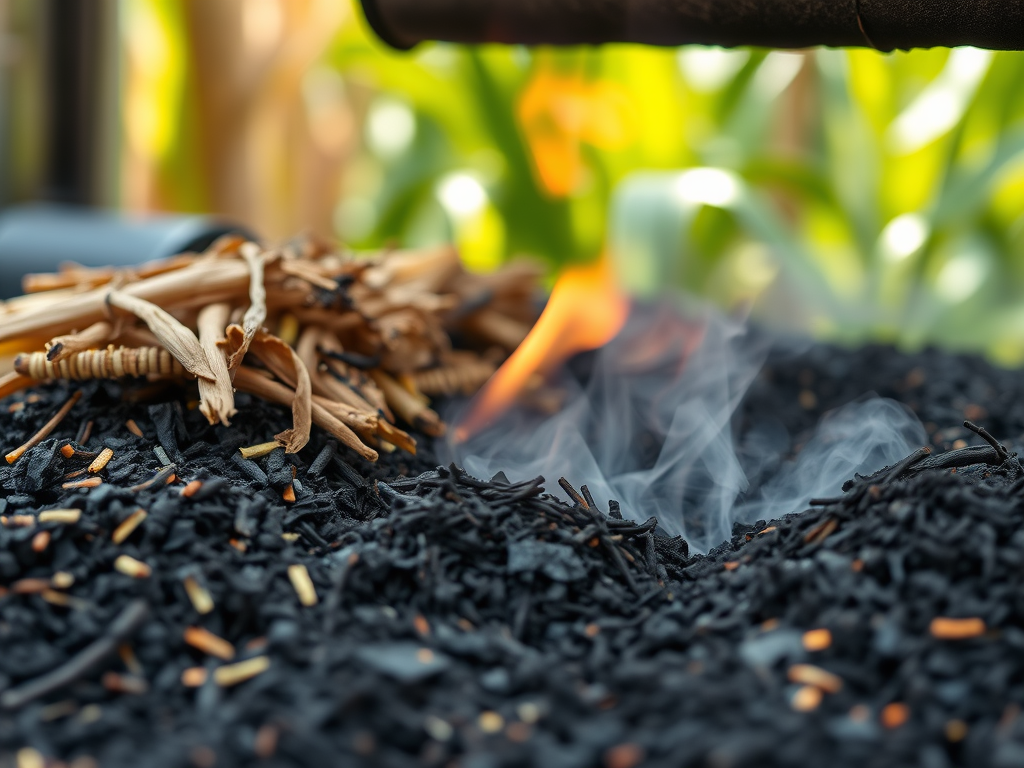
Biochar created through pyrolysisPyrolysis is a thermochemical process that converts waste biomass into bio-char, bio-oil, and pyro-gas. It offers significant advantages in waste valorization, turning low-value materials into economically valuable resources. Its versatility allows for tailored products based on operational conditions, presenting itself as a cost-effective and efficient More, a process that heats biomassBiomass is a complex biological organic or non-organic solid product derived from living or recently living organism and available naturally. Various types of wastes such as animal manure, waste paper, sludge and many industrial wastes are also treated as biomass because like natural biomass these More in an oxygen-limited environment above 250∘C results in a material rich in carbon (C) and characterized by high porosityPorosity of biochar is a key factor in its effectiveness as a soil amendment and its ability to retain water and nutrients. Biochar’s porosity is influenced by feedstock type and pyrolysis temperature, and it plays a crucial role in microbial activity and overall soil health. Biochar More. Beyond carbon, biochar primarily consists of hydrogen (H), oxygen (O), and nitrogen (N), along with smaller amounts of phosphorus (P) and potassium (K). The elemental composition of biochar is crucial as it dictates its physical and chemical properties, such as aromaticity, cation exchange capacity (CEC), electrical conductivity (EC), and alkalinity. These properties, in turn, influence biochar’s effectiveness in diverse environmental applications, including carbon sequestration, soil quality improvement, and wastewater treatment. For instance, biochar’s carbon backbone and aromatic structures are highly effective at adsorbing soil and water pollutants. High oxygen content enhances water retention and nutrient holding capacity, while N, P, and K directly impact soil nutrient levels and microbial activity. Given these varied applications, understanding and optimizing biochar’s elemental composition is of paramount importance.
However, the elemental composition of biochar can vary significantly depending on the biomass source and pyrolysis conditionsThe conditions under which pyrolysis takes place, such as temperature, heating rate, and residence time, can significantly affect the properties of the biochar produced. More. Even different parts of the same plant can yield biochar with distinct properties. Factors like highest heating temperature (HHT), residence timeResidence time refers to the duration that the biomass is heated during the pyrolysis process. The residence time can influence the properties of the biochar produced. More (RT), and heating rate (HR) all play a role. Generally, higher HHT leads to increased carbon content and ashAsh is the non-combustible inorganic residue that remains after organic matter, like wood or biomass, is completely burned. It consists mainly of minerals and is different from biochar, which is produced through incomplete combustion. Ash Ash is the residue that remains after the complete More, as volatile materials are lost, while H, O, and N content decrease. The inherent differences in agricultural residues themselves, such as their lignocellulosic structure, also significantly influence biochar properties.
Given the complexity of these interactions, predicting and optimizing biochar’s elemental composition has been a significant challenge through traditional experimental methods. This is where machine learning (ML) steps in. ML, a branch of artificial intelligence, excels at uncovering complex relationships and patterns within multidimensional data. A recent study published in Renewable Energy by Yao Fu, Peter Cleall, and Fei Jin leverages Gradient Boosting Regression (GBR) models to predict the content of C, H, O, N, P, and K in biochar derived from agricultural residues.
The researchers compiled a comprehensive dataset following PRISMA guidelines, gathering information on feedstockFeedstock refers to the raw organic material used to produce biochar. This can include a wide range of materials, such as wood chips, agricultural residues, and animal manure. More properties and pyrolysis parameters from 38 published studies, resulting in 332 data instances. A novel “Feature-oriented Imputation” method was developed, using K-Nearest Neighbors (KNN) or Random Forest (RF) imputers to fill in missing data based on the characteristics of each feature type. This approach ensured data completeness and model robustness.
The GBR models achieved excellent accuracy rates for predicting biochar elemental composition: carbon (R2=0.9088, RMSE 4.0614), hydrogen (R2=0.9068, RMSE =0.4180), oxygen (R2=0.9172, RMSE 2.6475), nitrogen (R2=0.8950, RMSE =0.3416), phosphorus (R2=0.9699, RMSE 0.0244), and potassium (R2=0.9464, RMSE =0.3842). These high R2 values and low RMSE indicate the model’s strong predictive capabilities and its ability to generalize well to new data.
A crucial finding from the study’s feature importance analysis is that feedstock properties generally have a more substantial impact on the elemental composition of biochar than pyrolysis parameters. Specifically, feedstock characteristics contributed 77.9% to carbon prediction, 67.0% to hydrogen, 52.4% to oxygen, 95.2% to nitrogen, 99.1% to phosphorus, and 97.0% to potassium content. This is particularly true for N, P, and K, as these elements are directly derived from the biomass and remain relatively stable during pyrolysis. However, HHT emerged as the most influential parameter for hydrogen and oxygen content, contributing 67% and 41.29% respectively, as higher temperatures lead to the release of volatile compounds and a reduction in H and O.
The study also identified optimal pyrolysis parameters to maximize specific elemental contents. For instance, to maximize biochar carbon content, an HHT between 600∘C and 1000∘C with a residence timeThis refers to the amount of time that the biomass is heated during the pyrolysis process. The residence time can influence the characteristics of the biochar, such as its porosity and surface area. More (RT) between 30 and 90 minutes is recommended. For maximizing hydrogen and oxygen, lower HHT (between 150∘C and 300∘C) and shorter RT (less than 40 minutes) with heating rates below 15∘C/min are favorable. These insights offer a robust framework for tailoring biochar prototypes for various applications, reducing the need for extensive laboratory trials, and promoting more efficient resource utilization in agricultural waste management.
Source: Fu, Y., Cleall, P., & Jin, F. (2026). Optimising biochar from agricultural residues: Predicting elemental composition with machine learning. Renewable Energy, 256, 124071.




Leave a Reply