
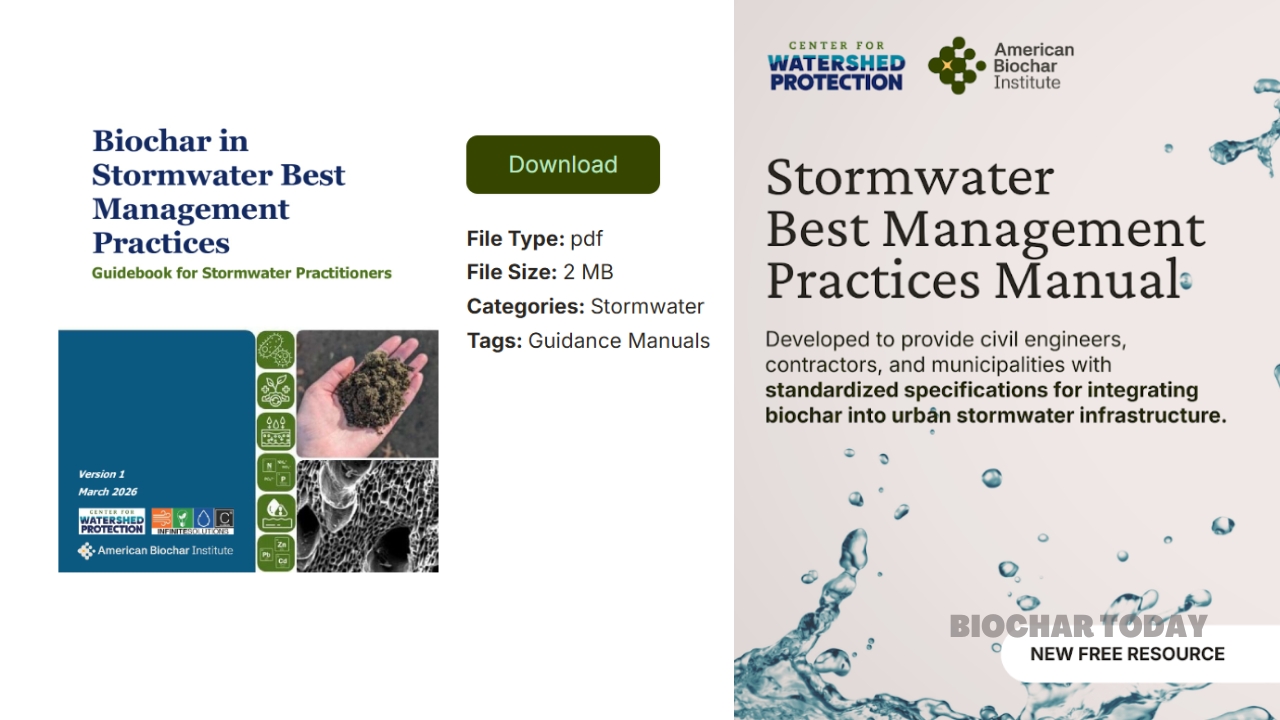
The American BiocharBiochar is a carbon-rich material created from biomass decomposition in low-oxygen conditions. It has important applications in environmental remediation, soil improvement, agriculture, carbon sequestration, energy storage, and sustainable materials, promoting efficiency and reducing waste in various contexts while addressing climate change challenges. More Institute, in partnership with the Center for Watershed Protection and Infinite Solutions, has officially released a technical manual titled “Biochar in Stormwater Best Management Practices: A Guidebook for Stormwater Practitioners.” This newly published industry resource compiles data from an intensive academic literature review and in-depth interviews with field experts to provide standardized deployment frameworks. The publication includes formal material specifications, predictive pollutant removal matrices, and eight operational fact sheets designed to integrate carbonized biomassBiomass is a complex biological organic or non-organic solid product derived from living or recently living organism and available naturally. Various types of wastes such as animal manure, waste paper, sludge and many industrial wastes are also treated as biomass because like natural biomass these More into municipal engineering, regulatory frameworks, and civil infrastructure projects.
A persistent challenge in urban stormwater management within the United States is the structural failure of traditional organic media, such as compost, in Best Management Practices (BMPs). Conventional organic components frequently leach excess nutrients like phosphorus into local water systems, thereby generating secondary water quality degradation and accelerating eutrophication downstream. Additionally, engineering practitioners struggle with unpredictable filtration rates due to unstandardized material particle sizes, which often lead to severe system clogging, structural compaction, and the premature death of vegetation necessary for maintaining green infrastructure performance and public acceptance.
To resolve these technical vulnerabilities, the Guidebook establishes a strict engineering protocol that mandates rinsing and screening biochar to remove fine particles before deployment, paired with custom particle size distributions tailored to specific BMP types. The operational framework identifies biochar as a highly effective medium for removing heavy metals, suspended solids, nitrogen, and complex organic compounds such as per- and polyfluoroalkyl substances (PFAS), while eliminating the risk of nutrient leachingLeaching is the process where nutrients are dissolved and carried away from the soil by water. This can lead to nutrient depletion and environmental pollution. Biochar can help reduce leaching by improving nutrient retention in the soil. More because it does not act as a source of phosphorus. Furthermore, the protocol standardizes quality control by requiring laboratory validation under the American National Standards Institute (ANSI) S668 guidelines to ensure the media is free of chemical impurities.
The long-term outcomes of implementing these standardized specifications include the optimization of vegetated green infrastructure BMPs, where the optimized media simultaneously drives contaminant removal and increases hydraulic infiltration into underlying soils. By stabilizing the root-zone hydrology, the framework successfully supports robust plant health, which is essential for sustaining long-term mechanical filtration and securing public approval for urban civil works. Ultimately, this comprehensive technical guidance bridges the historical gap between isolated pilot projects and scalable municipal deployment, providing civil engineers, watershed managers, and environmental regulators with a verified, predictable tool for urban water remediation.



Leave a Reply