
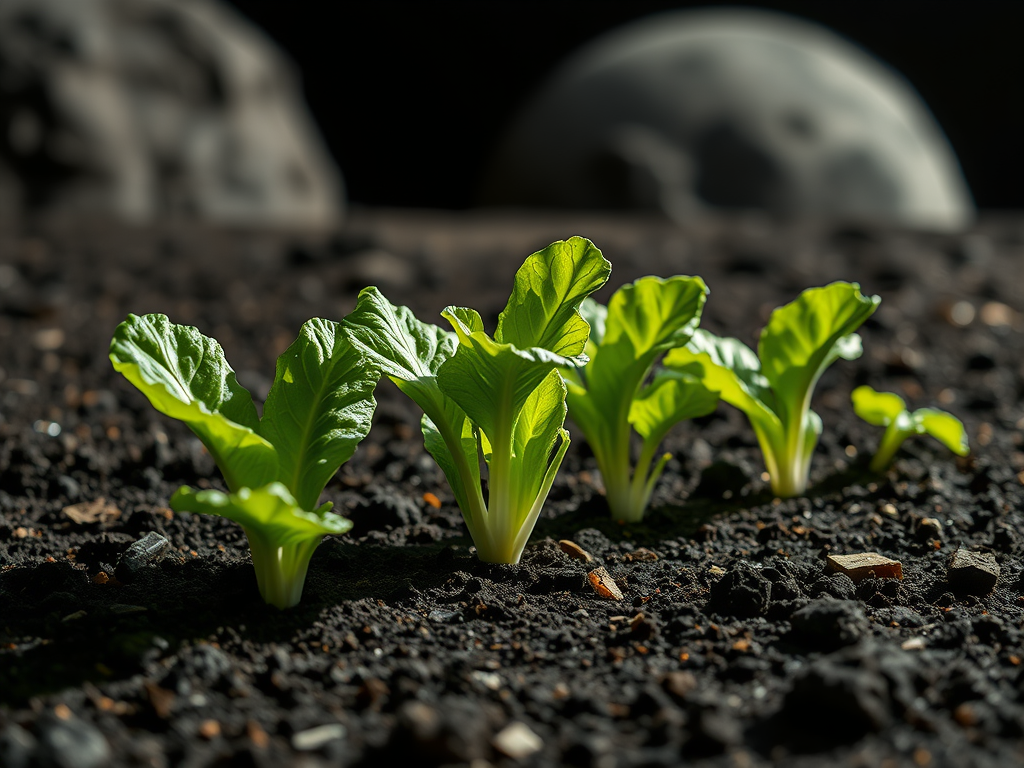
In an article in the journal iScience, researchers Chuang Mei, Gengxin Xie, Ya Han, and Miaomiao Peng explored a potential solution for growing food in space: using biocharBiochar is a carbon-rich material created from biomass decomposition in low-oxygen conditions. It has important applications in environmental remediation, soil improvement, agriculture, carbon sequestration, energy storage, and sustainable materials, promoting efficiency and reducing waste in various contexts while addressing climate change challenges. More to improve lunar soil for crop cultivation. Future long-term human missions to the moon will require bioregenerative life support systems (BLSSs) to produce food on-site, reducing the need for resupply from Earth. However, lunar soil, or regolith, has poor water-holding capacity and lacks organic matter, making it unsuitable for growing plants on its own. The researchers investigated whether biochar could enhance simulated lunar soil to support plant growth.
The study focused on using pig manure (PM) biochar to amend a simulated lunar soil known as CQU-1. The researchers chose pig manure because of its physiological similarity to human feces, which would be a primary source of organic waste in a lunar BLSS. They tested different concentrations of biochar, from 0.5% to 10%, and a control group without any amendment. The results were promising. Biochar treatment increased the organic matter content and the availability of nitrogen (N), phosphorus (P), and potassium (K) in the soil. The pHpH is a measure of how acidic or alkaline a substance is. A pH of 7 is neutral, while lower pH values indicate acidity and higher values indicate alkalinity. Biochars are normally alkaline and can influence soil pH, often increasing it, which can be beneficial More of the simulated lunar soil increased with the addition of biochar, which could enhance the availability of other nutrients. At a 3% concentration, biochar increased the electrical conductivity (EC) of the soil by 83.04%, while a 3% concentration of its feedstockFeedstock refers to the raw organic material used to produce biochar. This can include a wide range of materials, such as wood chips, agricultural residues, and animal manure. More only increased EC by 33.36%. Soil EC is a key indicator of soluble salts that plants can absorb.
The researchers also found that biochar significantly improved the physical properties of the simulated lunar soil. As the amount of biochar increased, the bulk density (BD) of the soil decreased. When the biochar addition rate was 10%, the BD decreased by 18.05%. The soil’s total porosityPorosity of biochar is a key factor in its effectiveness as a soil amendment and its ability to retain water and nutrients. Biochar’s porosity is influenced by feedstock type and pyrolysis temperature, and it plays a crucial role in microbial activity and overall soil health. Biochar More and air porosity also increased with higher biochar concentrations. These physical changes are critical for improving root growth and nutrient uptake.
Most importantly, the biochar amendment had a direct positive impact on lettuce seedling growth. Lettuce was selected as a potential BLSS crop due to its short life cycle and nutritional value. In the control group with no amendments, lettuce growth was significantly inhibited, with reduced germination and shortened root length. However, adding biochar greatly improved both seed germination and root growth. At the optimal concentration of 3%, the biochar-treated soil increased the seedlings’ fresh weight by 25.39% and dry weight by 20.98% compared to the control group. The study found that concentrations greater than 5% had a negative impact on seedling growth, indicating that there is a precise balance for successful cultivation. The researchers concluded that biochar is a more effective amendment than its raw feedstock for improving simulated lunar soil.
The study’s findings provide a strong theoretical basis for future lunar missions, as the physicochemical properties of simulated lunar soil are chemically similar to real lunar soil collected during the Apollo missions. The ability to pyrolyze on-site waste into a valuable soil amendmentA soil amendment is any material added to the soil to enhance its physical or chemical properties, improving its suitability for plant growth. Biochar is considered a soil amendment as it can improve soil structure, water retention, nutrient availability, and microbial activity. More, rather than transporting supplies from Earth, offers a sustainable and self-sufficient approach to long-term space exploration. This research marks a significant step toward making space agriculture a reality.
Source: Mei, C., Xie, G., Han, Y., & Peng, M. (2025). Biochar improves lettuce seedling growth by influencing the nutrient content of simulated lunar soil. iScience, 28(11), 113327.



Leave a Reply