
This is the tenth in a new series of Biochar Expert Profiles, where we celebrate those who have dedicated their passion, expertise, and innovation to advancing the field of biocharBiochar is a carbon-rich material created from biomass decomposition in low-oxygen conditions. It has important applications in environmental remediation, soil improvement, agriculture, carbon sequestration, energy storage, and sustainable materials, promoting efficiency and reducing waste in various contexts while addressing climate change challenges. More. These experts come from all walks of life: renowned scientists whose groundbreaking research has redefined possibilities, emerging researchers whose fresh perspectives are shaping the future, industry leaders who are growing the market through new technologies and business models, and unsung heroes who work tirelessly to enrich soils with biochar. Whether it’s their pioneering techniques, insightful discoveries, or unwavering dedication, these individuals are the heart and soul of the biochar revolution. By highlighting their contributions and sharing their knowledge, this series aims to inspire the biochar community at large.
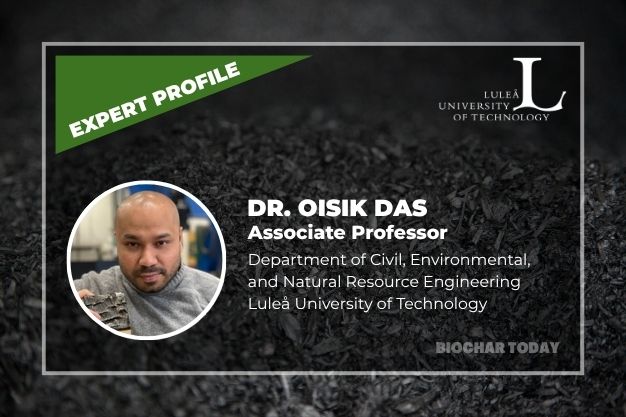
Welcome to yet another Biochar Today’s expert interview session! Today, we have the distinct pleasure of introducing Dr. Oisik Das, who works at Luleå University of Technology in Sweden. Dr. Oisik is not just a researcher; he’s a passionate explorer of the science all around us, driven by a belief that every effect has a cause, and he’s dedicated to unraveling a few of them. With a rich academic background spanning from Washington State University to the University of Auckland and KTH Royal Institute of Technology, Dr. Oisik has carved out a unique niche in the world of materials science, particularly at the intersection of fire, biochar, and biocomposites. He was among the very first to explore adding biochar to composites back in 2014 during his PhD and extensively investigated the fire behavior of composites having sustainable fire-retardants. He has published over 150 peer-reviewed articles, authored many book chapters, and an entire academic book. He has over 12 years of teaching experience across Sweden, New Zealand, India, and Singapore. Dr. Oisik is also an Associate Editor in Sustainable Process Engineering for Frontiers in Chemical Engineering, Energy Exploration & Exploitation, and a new journal called BiocharX as well as an Editorial board member for Composites Part C (Elsevier), Polymer Testing (Elsevier),Macromolecular Materials and Engineering (Wiley), Material Circular Economy (Springer), and Polymers (MDPI).
Join with me into Dr. Oisik ‘s insights on biochar’s revolutionary potential, its surprising interactions in fire-safe composites, and the cutting-edge research poised to transform industries. Get ready to discover how this “B” for biochar enthusiast is shaping the future of sustainable engineering. Enjoy the conversation!!!
Shanthi Prabha : Dr. Oisik, you pioneered adding biochar to composites. What was the spark behind that idea, and what were the biggest initial challenges in developing such composites?
Dr. Oisik Das: Thank you, Shanthi Prabha, for inviting me to this interview. It is a privilege! I have taken the liberty to invite two of my fantastic colleagues, Elif Kaynak and Dong Wang, who are also working on various applications of biochar at Luleå University of Technology (LTU) in Sweden. The following is a photo (Fig. 1) of three of us.

Fig. 1. The “B” is for biochar! (L-R: Dong Wang, Oisik Das, and Elif Kaynak)
Yes, coming to your question, I always had the illusion that I was the ‘pioneer’ in biochar-added polymer composites, but the group of Gulnare Ahmetli from Selcuk University in Turkey was the first to publish about biochar-added composites in 2013. I have been crying in a corner ever since!!!
Having focussed a little too much on parties during my master’s at Washington State University (WSU), I was determined to submerge myself completely in research when I started my PhD at the University of Auckland (UoA). The ‘spark’ was caused solely by Auckland university- its dedicated professors (e.g., Debes Bhattacharyya, Simon Bickerton, Piaras Kelly, etc.), staff (Callum Turnbull, Steven Crowley, etc.), and friends (Nam Kyeun Kim, Imelda Piri, Mohammad Rajaei, etc.). These aforementioned people supported me immensely and allowed me to be an independent thinker. Having investigated thermo-chemical reactors and pyrolysisPyrolysis is a thermochemical process that converts waste biomass into bio-char, bio-oil, and pyro-gas. It offers significant advantages in waste valorization, turning low-value materials into economically valuable resources. Its versatility allows for tailored products based on operational conditions, presenting itself as a cost-effective and efficient More reactions previously at WSU, I realised that most of the resulting products (i.e., bio-oil and non-condensable gases) require additional processing to be usable. However, biochar could be used as soon as it comes out of a reactor. At UoA, I was placed at the Centre for Advanced Composites Materials (currently called the Centre for Advanced Materials Manufacturing and Design), where researchers investigated and developed various properties and types of polymeric materials. With my prior experience in producing biochar and current placement in a composites laboratory, the worlds of biochar and polymer got married. This was the inception of the idea to add biochar to polymeric composites.
Yes, it took me quite a while to finally understand the nitty gritty of adding biochar in composites. Initially, I was adding pine wood-derived biochar to polypropylene, and I was processing it by compression moulding/hot pressing. However, the surface finish of these composites was terrible. After numerous iterations, I was able to improve the surface finish and disperse the biochar particles uniformly within the resin.
SP: Given your expertise, what’s the most surprising fire-retardant interaction you’ve observed with biochar in composites, especially concerning the biochar’s own inherent fire properties?
OD: I do not think that biochar can be termed as a fire retardant. When made at high thermo-chemical conversion temperatures (ca. > 500 – 600 ℃), the carbon structure of biochar is aromatic, which is thermally stable, and this property is expressed when biochar is added to polymers. Biochar simply acts as a thermal ‘shield’ that hinders mass and heat transfer between the unburnt polymer and the outside ‘hot’ environment. Thus, the fire-safe behaviour that we see in biochar-composites, compared to the corresponding neat polymer, is solely due to the additive nature and completely depends on the amount of biochar in the composite system.
Fire retardants (FRs) such as ammonium polyphosphate, magnesium/aluminium hydroxide, etc., are very effective in imparting fire-safety in polymers, but they significantly lower the mechanical properties, mainly the tensile strength. While doing my postdoc at KTH Royal Institute of Technology in Stockholm, my ex-supervisor and current friend, Mickael Hedenqvist, and I found that it was possible to dope several types of fire retardants (FRs) into the porous structure of biochar. This FR-doped biochar, when added to composites, enabled the retention of tensile strength of the composite while allowing the FRs to enhance the fire performance compared to when only biochar is added. Hence, the most surprising aspect is that biochar can be doped with conventional FRs and used to develop concurrently fire-safe and mechanically strong composites.
SP: How is biochar poised to revolutionize sustainable concrete with a low carbon footprint, and what are the primary structural engineering challenges in achieving this?
OD: There is an urgent need to lower the carbon footprint of concrete, and Sweden is one of the leaders in the world for sustainable development. Funnily enough, I received many grants from agencies, such as Brandforsk, FORMAS, and SBUF, to perform research on biochar-concrete despite having no academic background in concrete. Fortunately, my PhD student, Dong Wang, has a mountain of knowledge on concrete, who has found out numerous, and frankly revolutionary, aspects about the effects of biochar in concrete. Some of the advantages of adding biochar to concrete are obviously lowering the cement content, thus reducing carbon emissions, but also enhancing internal curing, lowering shrinkage, and improving late-age mechanical strength.
There are two major issues with adding biochar to concrete. Firstly, biochar does not have the pozzolanic potential of traditional supplementary cementitious materials, which limits its contribution to concrete performance. Secondly, biochar significantly reduces workability due to the highly absorptive or ‘thirsty’ nature of biochar. When added to the concrete mix, biochar absorbs a lot of water, making the mix stiff and flow less; therefore, carefully thinking about this nature of biochar is essential for the practical applications. However, Dong Wang again came to the rescue and developed a new method to add biochar in concrete without compromising the workability. Watch out for our publication in the near future to know the secret 😊.
SP: Beyond the lab, what are the critical safety insights you’ve uncovered regarding biochar’s self-ignition and dust explosion risks during production, storage, and transport?
OD: The research on self-ignition and dust explosion behaviour of biochar is almost non-existent. Most of the current research is focused on biomassBiomass is a complex biological organic or non-organic solid product derived from living or recently living organism and available naturally. Various types of wastes such as animal manure, waste paper, sludge and many industrial wastes are also treated as biomass because like natural biomass these More. That’s why we i.e., Elif Kaynak and I from LTU, are working with two talented scientists at Research Institutes of Sweden (RISE), namely Chen Huang and Sixten Dahlbom, to understand the self-ignition and dust explosion behaviour during production, transport, and storage of biochar. We hope to get some research grants in the near future to explore the aforementioned. As of now, the only ‘easy’ way to reduce the self-ignition and dust explosion possibility of biochar is pelletising it, i.e., densification.
SP: If resources were unlimited, what’s your “moonshot” biochar application or research direction that could solve a major global challenge or revolutionize an industry?
OD: It is very difficult to get a consistent quality of biochar between different batches, even when they are made from the same type of feedstockFeedstock refers to the raw organic material used to produce biochar. This can include a wide range of materials, such as wood chips, agricultural residues, and animal manure. More or pyrolysis reactor and with the same thermo-chemical reaction conditions. This random nature of biochar’s physico-chemical properties undermines its consistency and reproducibility in high-value applications, such as energy storage/conversion and environmental remediation. If money, time, and/or resources were unlimited, I would dedicate myself to solving this problem, i.e., create consistent quality of biochar across various batches of production through standardisation in biomass pre-treatment, pyrolysis reaction conditions, post-treatment, and characterisation methods for specific applications. For this, I would like to collaborate with the rising stars in the Indian biochar research arena, namely Vigneshwaran Shanmugam and Singaravelu Vivekanandhan.
SP: From your extensive publications, including Nature Reviews, what single research finding or breakthrough in your biochar work are you most proud of, and why?
OD: While doing my PhD at Auckland University, I determined the individual mechanical properties of the constituents i.e., biochar, wood, and polypropylene using nanoindentation and used theoretical models (i.e., rule of mixtures, Halpin–Tsai–Nielsen, and Verbeek) to predict the bulk mechanical property of the composite, which matched well with the experimental values. This can enable effective engineering and optimise the design conditions of biochar-composites. The results were published in the Composites Part B: Engineering journal, and I am most proud of this article. However, throughout the article, I spelt ‘constituent’ as ‘consituent’ ☹.
SP: As an editor for prestigious journals, what’s the most common oversight in submitted biochar research, and what’s your top advice for emerging researchers?
OD: I am yet to be an editor of any journal, but I serve as an associate editor and editorial board member of many journals. The biggest issue I observe is that most researchers just randomly add biochars to polymers, concrete, and other materials just for the sake of it, without comprehending the precise properties of biochar that are important for specific applications. My advice to young biochar researchers is to be a slow and consistent thinker and try to figure out the inherent properties of biochar that are advantageous for the intended application. They should remember that “unlike humans, not all biochars are created equal.”
SP: How do you effectively bridge the gap between cutting-edge biochar research and its real-world industrial or public adoption, emphasizing the role of communication?
OD: This is done through interviews like the one I am doing currently, popular science articles, magazine articles, and social media (e.g., LinkedIn). Also, it is important to reach as many people as possible, and thus, I am giving the only academic course in biochar, called “The Basics of Biochar”, which is available online through LTU’s Canvas system, and anyone from any part of the world can take it.
SP: What’s the most overlooked organic waste feedstock for biochar production, and what unique properties could it offer for specific applications like material enhancement?
OD: It is difficult to pinpoint such a feedstock as it depends on the local availability where the biochar is intended to be produced. A feedstock that is abundant in one place may not be available in another place. In order to reduce carbon emissions and costs, long-distance transportation of biomass feedstock should be avoided. Hence, we should look into our own backyard (no pun intended) for the most abundant and unused biomass feedstock, which is not competing with land for food production (i.e., ideally should be waste).
SP:For your students, what’s the fundamental concept of biochar you ensure as a professor they should grasp by the end of your course, and why is it so crucial for future engineers?
OD: The most important thing is to understand the thermal decomposition pathways of mainly cellulose and lignin, which lead to biochar formation. The knowledge of thermo-chemical conversion reactions will allow future engineers to tailor them to suit the needs of specific applications. I teach this in my “The basics of biochar” course 😊.
SP: What emerging trend or novel research direction in biochar excites you most, and what significant promise does it hold for future materials science or engineering?
OD: I think the use of biochar to replace cement in concrete is gaining traction worldwide. Numerous studies are being undertaken to understand the various effects of biochar in concrete. However, the mix designs need to be altered based on the porosityPorosity of biochar is a key factor in its effectiveness as a soil amendment and its ability to retain water and nutrients. Biochar’s porosity is influenced by feedstock type and pyrolysis temperature, and it plays a crucial role in microbial activity and overall soil health. Biochar More, density, and water absorption capacity of biochar. Another potential application is the replacement of carbon black with biochar in styrene-butadiene rubber.
SP: For our readers eager to explore your extensive contributions to biochar research and its applications, where is the best place to find an overview of your publications and projects online?
OD: Yes, it is Google Scholar: https://scholar.google.com/citations?user=2huRKFMAAAAJ&hl=en&oi=ao




Leave a Reply