
The global biocharBiochar is a carbon-rich material created from biomass decomposition in low-oxygen conditions. It has important applications in environmental remediation, soil improvement, agriculture, carbon sequestration, energy storage, and sustainable materials, promoting efficiency and reducing waste in various contexts while addressing climate change challenges. More sector has long struggled with a specific data gap: the “last mile” of feedstockFeedstock refers to the raw organic material used to produce biochar. This can include a wide range of materials, such as wood chips, agricultural residues, and animal manure. More availability. While we know macro-level agricultural statistics, pinning down the precise location, density, and seasonality of residues at a resolution high enough to justify capital expenditure (CapEx) for pyrolysisPyrolysis is a thermochemical process that converts waste biomass into bio-char, bio-oil, and pyro-gas. It offers significant advantages in waste valorization, turning low-value materials into economically valuable resources. Its versatility allows for tailored products based on operational conditions, presenting itself as a cost-effective and efficient More plants has been a challenge, particularly in the fragmented agricultural landscapes of Southeast Asia.
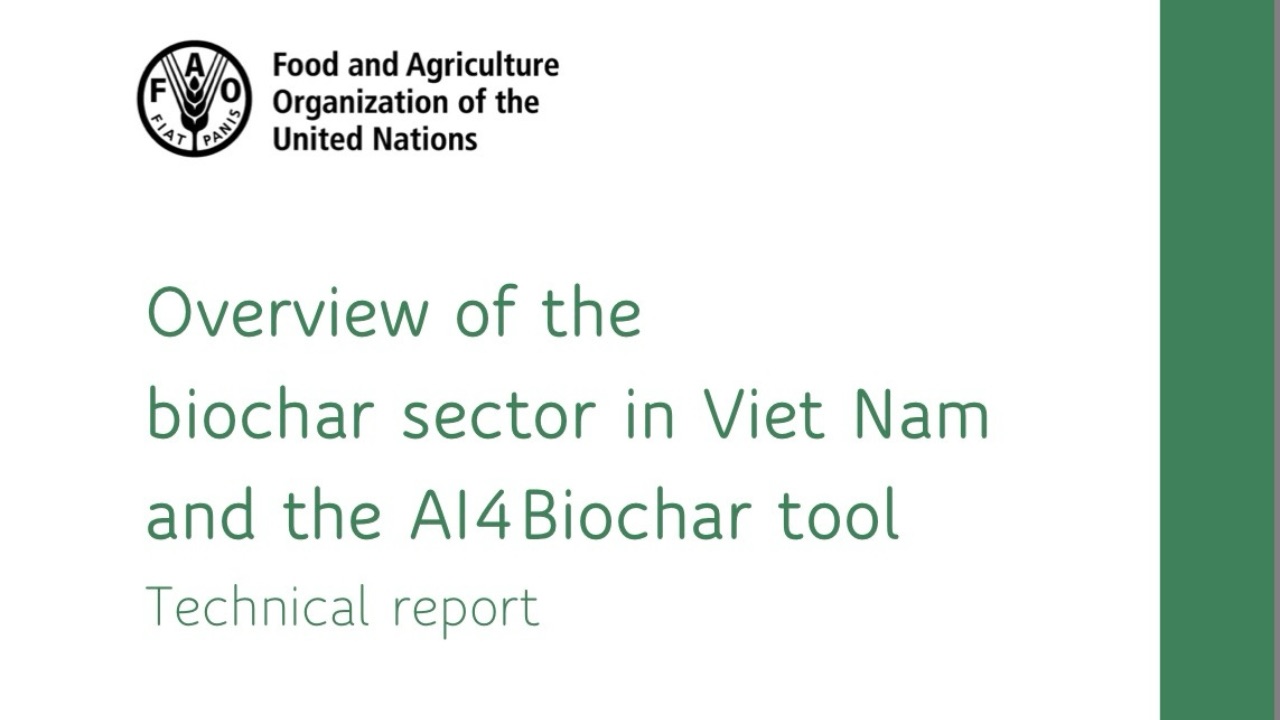
A recent technical report released by the Food and Agriculture Organization (FAO), titled “Overview of the biochar sector in Viet Nam and the AI4Biochar tool,” offers a significant step forward in closing this gap. For investors, equipment manufacturers, and project developers eyeing the Asian market, this document serves as both a market signal and a feasibility roadmap. It details the deployment of machine learning to map feedstock in the Mekong Delta and provides a sobering yet optimistic assessment of Vietnam’s readiness to transition from a cottage industry to an industrial biochar hub.
The Vietnam Context: High Volume, Low Maturity
Vietnam presents a classic paradox in the biochar space: it possesses massive feedstock potential but suffers from low market maturity. The country generates approximately 156.8 million tonnes of agricultural residues annually. This biomassBiomass is a complex biological organic or non-organic solid product derived from living or recently living organism and available naturally. Various types of wastes such as animal manure, waste paper, sludge and many industrial wastes are also treated as biomass because like natural biomass these More is dominated by rice husks (9 million tonnes) and straw (50 million tonnes), primarily in the Mekong and Red River Deltas, with significant contributions from coffee husks in the Central Highlands and coconut residues in the coastal regions.
Despite this abundance, the sector remains underdeveloped. The ratio of biochar production scale to potential market scale is estimated at a mere 5.2%. Currently, the market is characterized by extreme price volatility—biochar products range from 500 VND/kg to 12,000 VND/kg (approx. $0.02 to $0.47 USD). This wide variance indicates a lack of product standardization and a fragmented supply chain where biochar is often a byproduct of artisanal charcoalCharcoal is a black, brittle, and porous material produced by heating wood or other organic substances in a low-oxygen environment. It is primarily used as a fuel source for cooking and heating. More production or small-scale rice husk drying rather than the output of dedicated, high-tech pyrolysis facilities.
For equipment manufacturers, this signals a specific opportunity. The current infrastructure relies heavily on traditional earth kilns or simple drum systems with poor emission controls. However, the report highlights a shift toward “improved kilns” and pilot projects utilizing continuous pyrolysis reactors (rotary or fixed bed) capable of syngasSyngas, or synthesis gas, is a fuel gas mixture consisting primarily of hydrogen and carbon monoxide. It is produced during gasification and can be used as a fuel source or as a feedstock for producing other chemicals and fuels. More capture. The market is primed for mid-sized, semi-automated systems that can handle high-silica feedstocks (like rice husk) while offering the emission controls necessary to meet increasingly strict environmental regulations.
AI4Biochar: De-risking Site Selection
The core innovation detailed in the report is the AI4Biochar tool, a geospatial solution developed to de-risk the logistical side of biochar production. In a landscape defined by smallholder farms—often measuring less than one hectare—aggregating enough biomass to feed a continuous pyrolysis unit is a logistical nightmare.
The AI4Biochar tool utilizes Sentinel-2 satellite imagery processed through a U-Net deep learning architecture. This allows for the automated, precise delineation of crop field boundaries. By overlaying these boundaries with crop intensity maps (e.g., distinguishing between double and triple cropping cycles for rice), the tool calculates sustainable residue removal rates at the plot level.
This is a critical advancement for project finance. Instead of relying on regional averages, a developer can now assess the specific residue yield of a catchment area. In the pilot application within the Tri Ton district of An Giang province, the tool identified over 28,000 specific rice plots. It estimated a total residue production of 901,540 tonnes for the reference year (2020), broken down into 85% straw and 15% husk.
For investors, the tool provides the data necessary to optimize facility location. The pilot study operated on the assumption of co-locating pyrolysis units with existing rice mills. This “hub-and-spoke” model minimizes transportation costs—the single biggest opex killer in biochar projects. The analysis showed an average transport distance of 12.5 km from field to mill in the district, a viable radius for raw biomass logistics.
The Carbon Case: Flipping the Emissions Script
The environmental analysis of the Tri Ton district serves as a microcosm for the broader Vietnamese opportunity. The baseline scenario—current practices—is environmentally disastrous. The open burning of rice straw and the inefficient combustion of husks in the district generate approximately 89,000 tonnes of CO2eq annually.
The implementation of a biochar system flips this metric aggressively. The “Target Scenario” modeled in the report—which assumes a transition to biochar production with soil incorporation—projects a net removal of over 860,000 tonnes of CO2eq per year. This represents a swing of nearly 1 million tonnes of CO2eq for a single district.
Per hectare, the shift is from an emission source of +1.8 tCO2eq/year to a carbon sink of -17.7 tCO2eq/year. For carbon market participants, these numbers are compelling. They suggest that Vietnam’s agricultural sector could generate high-quality, permanent carbon removal credits (CDRs) at a volume that justifies the verification and validation costs associated with major registries like Puro.earth or Verra.
Beyond Carbon: The Public Health and Economic Drivers
While international investors focus on carbon credits, the domestic drivers for the Vietnamese government are likely to be air quality and local economics. The report provides granular data on non-GHG pollutants, which are often the immediate trigger for regulatory change.
The transition to biochar in the Tri Ton pilot area is projected to reduce Carbon Monoxide (CO) emissions by 95% and Nitrogen Oxides (NOx) by 86%. Crucially, it would eliminate 100% of the Sulphur Oxides (SOx) and Particulate Matter (PM) associated with open residue burning. Given that open burning is a leading cause of respiratory illness in the Mekong Delta, this health dividend provides the Ministry of Agriculture and Environment (MAE) with strong political cover to enforce bans on burning and incentivize biochar production.
Economically, the implications are equally stark. The analysis suggests that a fully realized biochar value chain in the Tri Ton district could generate revenues exceeding $23 million USD annually (assuming a market price of $450/tonne for biochar). While this price point is optimistic for agricultural-grade biochar and likely factors in premium markets or carbon revenues, the economic contribution is estimated at roughly 14.8% of the district’s local GDP. Furthermore, the model projects the creation of nearly 1,500 permanent jobs in logistics and plant operations, offering a vital employment buffer for rural communities.
The Policy Gap and Institutional Needs
Despite the technological feasibility and economic promise, the report is transparent about the policy hurdles. Vietnam currently lacks a cohesive national biochar strategy. Responsibilities are fractured across the Ministry of Agriculture and Environment (MAE), Ministry of Industry and Trade (MOIT), and others.
For the sector to scale, the “cottage industry” mindset must be abandoned in favor of industrial planning. The report recommends several key policy interventions:
- Standardization. The establishment of national standards for biochar quality to stabilize prices and build buyer confidence.
- Financial Mechanisms. The integration of biochar into green credit programs and the national carbon market framework.
- Inter-ministerial Coordination. A task force to align the agricultural benefits (MAE) with the energy potential (MOIT) and fiscal incentives (Ministry of Finance).
Strategic Implications for Industry Stakeholders
For Equipment Manufacturers
The Vietnamese market is moving past the experimentation phase. There is imminent demand for localized, robust pyrolysis systems that can handle high volumes of rice husk and straw. Systems that offer energy co-generation (drying rice using syngas heat) will have a distinct competitive advantage. Manufacturers should look to partner with local rice milling conglomerates to integrate pyrolysis units directly into existing processing lines.
For Investors and Project Developers
The AI4Biochar tool demonstrates that feedstock risk can be quantified and managed. The Tri Ton case study proves the carbon removal potential is massive. The primary risk remains regulatory and operational execution. Investors should prioritize projects that have secured long-term offtake agreements for the physical biochar (perhaps in the coffee or high-value crop sectors) to hedge against carbon market volatility. The “hub” model at rice mills offers the most secure entry point regarding feedstock security.
For Buyers
Expect Vietnam to emerge as a significant source of biochar credits and physical product in the coming decade. However, due diligence regarding production methodology is essential. With price variances so high, buyers must verify that the biochar is produced via modern pyrolysis that ensures carbon stability (H:C ratios) and meets international safety standards regarding PAHs and heavy metals, particularly given the legacy of artisanal production.
The FAO’s report on Vietnam is a validation of a data-driven approach to industry scaling. By combining advanced AI for feedstock mapping with rigorous lifecycle assessment (LCA), the path from “potential” to “profitability” becomes clearer. Vietnam holds the biomass, the labor force, and the environmental imperative to become a global biochar leader. The missing pieces are capital, technology transfer, and cohesive policy—gaps that international industry players are well-positioned to help fill.



Leave a Reply