
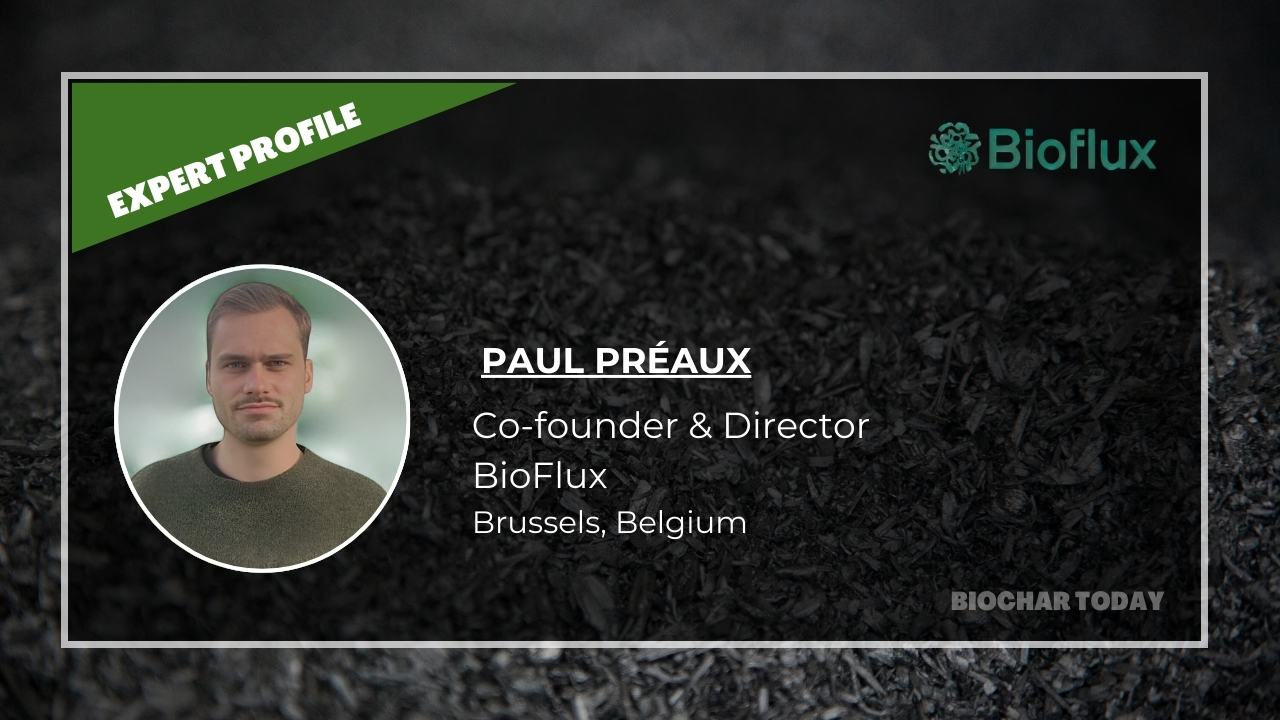
Paul Préaux is Co-Founder and CEO of BioFlux, where he leads international work on biocharBiochar is a carbon-rich material created from biomass decomposition in low-oxygen conditions. It has important applications in environmental remediation, soil improvement, agriculture, carbon sequestration, energy storage, and sustainable materials, promoting efficiency and reducing waste in various contexts while addressing climate change challenges. More production, feedstockFeedstock refers to the raw organic material used to produce biochar. This can include a wide range of materials, such as wood chips, agricultural residues, and animal manure. More assessment, pyrolysisPyrolysis is a thermochemical process that converts waste biomass into bio-char, bio-oil, and pyro-gas. It offers significant advantages in waste valorization, turning low-value materials into economically valuable resources. Its versatility allows for tailored products based on operational conditions, presenting itself as a cost-effective and efficient More technologies, and carbon removal certification. With a background in urban management, governance, and development, his work focuses on the technical and market aspects of biochar deployment, including project feasibility, technology selection, and carbon credit generation across agricultural and industrial value chains.
He has contributed to biochar initiatives across Europe, Africa, and Asia, supporting project development, due diligence, and certification processes for biochar facilities and applications. His experience includes evaluating biomassBiomass is a complex biological organic or non-organic solid product derived from living or recently living organism and available naturally. Various types of wastes such as animal manure, waste paper, sludge and many industrial wastes are also treated as biomass because like natural biomass these More supply chains, assessing biochar applications, and guiding projects from early feasibility through implementation and market integration, with a focus on high-integrity carbon removal and sustainable resource use.
In this expert session, Paul will share practical insights on biochar systems, deployment challenges, and emerging opportunities in the global biochar landscape.
Shanthi Prabha: You work at the intersection of engineering, carbon certification, and real-world deployment. Where do biochar projects most often struggle when moving from concept to an operational facility?
Paul Préaux: Most projects struggle because they underestimate the complexity of what they are building. A biochar project is not just a piece of pyrolysis equipment. It is a layered system that combines engineering, feedstock logistics, permitting, certification, biomass sourcing, product commercialization, energy integration, and long-term carbon accounting. Each of these layers has its own risks and constraints, and they all interact with one another.
Many developers assume that once the technology is selected, the rest will fall into place and the business case will quickly become bankable. In reality, financial modeling must be iterative. Early models are often built on optimistic assumptions. As permitting timelines, equipment validation, factory acceptance testing, grid integration, and regulatory approvals unfold, the model must be continuously adjusted. Treating the financial model as static is one of the most common mistakes.
Timelines are also severely underestimated. Due diligence on equipment suppliers, permitting procedures, government authorizations, site preparation, and delivery delays frequently push projects far beyond initial expectations. Ultimately, a project is only as strong as its ecosystem of partners. Strong equipment providers, reliable feedstock suppliers, credible certification pathways, commercial offtakers, and long-term financing partners determine whether a project simply gets built — or survives for 20 to 30 years.
SP: BioFlux supports projects from early feasibility through certification. What tends to be underestimated at the earliest stages of biochar project design?
PP: At the earliest stages, alignment with standards and methodologies is often underestimated. Projects are sometimes designed based on what is technically feasible today, rather than what will remain compliant tomorrow. Methodology constraints — feedstock eligibility, energy utilization rules, carbon stability thresholds, traceability requirements — should shape design from the beginning. Retrofitting compliance later is costly and risky.
Certification partner selection is another area where developers often misjudge the landscape. Some pursue what appears to be the easiest pathway, rather than considering which credits are most resilient and credible in the market. Not all carbon credits are valued equally. Long-term bankability depends on selecting frameworks aligned with evolving buyer expectations.
There is also a tendency to view biochar purely as a carbon product. That is a mistake. Biochar is a physical material that must be integrated into real value chains. Soil markets, fertilizer blending, industrial applications, energy recovery — these physical pathways determine commercial resilience. As scrutiny increases across carbon markets, traceability becomes essential. Projects must ensure that they can track and verify where biochar goes, how it is used, and that it is not misapplied. Designing projects for future regulatory expectations — not just current voluntary standards — is increasingly critical.
SP:You’ve worked with agricultural residues, manure, sludge, and industrial by-products. How does feedstock reality shape technology choice more than many developers expect?
PP: Feedstock determines everything, far more than many developers anticipate. There is no one-size-fits-all pyrolysis technology. Rice husks with high silica content create abrasion and can damage reactor components. Manure and sludge are high-moisture feedstocks requiring robust drying systems and corrosion-resistant design. Certain industrial residues may impact emissions control systems or affect final biochar quality.
Feedstock characteristics influence:
- Biochar yield
- Energy yield
- Carbon credit volumes
- Maintenance frequency
- Operational hours
- Compliance with emissions standards
Technology suppliers may claim broad compatibility, but real validation is essential. Before procurement, feedstocks should be tested. Factory acceptance tests should be conducted. References must be verified. Operational hours should be compared against promised performance.
At BioFlux, engineering validation and reference verification are central to technology selection. We do not rely solely on supplier claims. We examine real performance data, operational stability, integration capacity, and how systems perform under comparable conditions. Technology choice must also reflect the experience level of the project team. Advanced systems require advanced operational capacity. A team without industrial experience may struggle with complex maintenance regimes, which in turn affects uptime and financial performance. Feedstock is not just an input — it shapes the entire economic and technical architecture of the project.
SP:A lot of discussion in the sector focuses on carbon credits. From your experience, what makes a biochar project viable even before carbon revenue is considered?
PP: The team is fundamental. Biochar has sometimes been described as “black gold,” and that narrative attracts many new entrants. However, potential alone does not build viable projects. Manufacturing, logistics, digitization, commercialization, and maintenance must all be understood deeply by the project team. A project must know where its production will go. Who will buy the biochar? Under what specifications? At what volume? Carbon buyers should be engaged before operations begin, not after.
We are conservative in financial modeling. While some credits may achieve prices of $130 to $150 per ton in certain contexts, building a business case on peak market pricing is risky. We model conservatively to ensure resilience against market fluctuations. A structurally sound project is one that remains viable even under lower carbon price scenarios. Carbon revenue should strengthen the business — not be the only pillar holding it up.
SP:You’ve supported certification under different carbon frameworks. Where do developers most often misjudge the demands of high-integrity MRV and documentation?
PP: Developers oftern underestimate the rigor of baseline definition and ongoing documentation requirements. High-integrity MRV requires:
- A defensible counterfactual scenario
- Transparent operational emissions accounting
- Continuous data collection systems
- Full traceability of feedstock and product flows
In insetting contexts, both removals and emission reductions must be accounted for against a credible baseline. It is not sufficient to claim stored carbon; companies must demonstrate how operations differ from what would have occurred otherwise. Professional insetting standards emphasize defensible baselines, transparency, and ongoing monitoring. MRV must be embedded into operational design from day one. Retrofitting monitoring systems after deployment is costly and often incomplete.
SP:Large corporates are exploring biochar for Scope 3 insetting. What operational realities become clear once companies try to integrate biochar into existing supply chains?
PP: When corporates move from strategy to implementation, complexity quickly becomes visible.
First, many companies lack granular visibility into their supply shed. They may understand their general sourcing regions but not the exact aggregation points or how farms are structured. Without this visibility, designing an effective insetting program is difficult. At farm level, program design becomes critical. Artisanal pathways require clustering, structured monitoring, and data collection systems that remain affordable and relevant to farmers. Agricultural co-benefits must often be monitored alongside carbon outcomes.
Baseline emissions must be clearly defined. What emissions would occur without intervention? How are operational emissions quantified? How are removals and reductions separated and reported? The deeper companies go into insetting development, the clearer it becomes that operational integration, baseline definition, and MRV design are not administrative exercises — they are structural components of the program.
SP: You’ve worked across Europe, Africa, and Asia. How do project risks differ between emerging markets and more mature industrial contexts?
PP: Emerging markets often offer lower CAPEX and OPEX environments. Equipment and labor may be more affordable. However, operational risk increases. Access to spare parts may be limited. Experienced engineers may be scarce. Some international suppliers may hesitate to provide long-term after-sales support. Governance structures and quality oversight may vary.
Integrity risks in carbon markets may also be more pronounced where oversight is weaker and manual processes dominate.
In mature markets such as Europe or North America, regulatory compliance is stricter. Equipment must meet emissions standards and certification requirements such as CE compliance. Energy integration is often mandatory. CAPEX is higher, and margins can be tighter. In these contexts, projects must innovate through energy valorization, higher-value applications, and efficient integration. Different geographies present different risks — but both require thoughtful structuring.
SP: There are now many technology providers on the market. What criteria matter most when selecting pyrolysis technology for a specific context?Manufacturing quality and proven references are foundational.
PP: The most important questions are:
- Where is the system operational?
- With which feedstock?
- For how many verified operational hours?
- Under what emissions standards?
Beyond hardware quality, after-sales support and spare parts availability are critical. A technically strong system without reliable servicing capacity is a long-term risk. Engineering validation ensures that systems are benchmarked against high-performance standards, even if cost constraints require adaptation. Technology selection must reflect feedstock, regulatory environment, operator capacity, and long-term serviceability — not just upfront cost.
SP: Biochar is often discussed as both a soil amendment and a carbon removal pathway. How do you approach aligning agronomic performance with carbon accounting requirements?
PP: The starting point is agronomic validation. Biochar must demonstrate positive impacts on soil health, yield, and nutrient management within specific contexts. Application strategies must be tested and understood. At the same time, methodology requirements must shape mixing ratios and product design. In certain cases, fertilizer blending ratios can be structured to reduce downstream monitoring complexity. In others, application-site deployment increases MRV intensity and program design requirements. There is a balance between agronomic performance and monitoring obligations. With proper design, these can operate in synergy rather than conflict.
SP: From due diligence to feasibility studies, you often assess projects before investment. What signals tell you a project is structurally sound versus overly optimistic?
PP: Overly optimistic projects tend to:
- Overpromise delivery timelines
- Overestimate operational hours
- Overstate feedstock availability
- Build financial models on aggressive carbon prices
In due diligence, we compare projected performance with historical delivery data. We verify retired credits on registries. We assess feedstock sourcing plans in detail. We challenge assumptions. Our role is not to shrink projects or inflate them. It is to calibrate them realistically. Investors want confidence, not ambition alone. Projects that are transparent about risk, conservative in pricing, and realistic in projections are structurally sound.
Readers interested in Paul’s work in advancing biochar projects and real-world deployment can connect with him on LinkedIn: https://www.linkedin.com/in/paul-pr%C3%A9aux-5a7362101
Explore more about BioFlux: https://www.bioflux.earth/; https://www.linkedin.com/company/bioflux-eu/





Leave a Reply