

Why I am writing this
An article in Down To Earth about Brazil’s Jequitinhonha Valley made me stop and think for a long time. I read it once quickly, then again slowly. I trained for years to read a landscape as data like infiltration rates, recharge, species indices. But I also learned to read one the other way, by sitting alone listening to nature with nothing to measure. That quiet attention taught me that a landscape is not a set of variables. It is closer to a relationship. BiocharBiochar is a carbon-rich material created from biomass decomposition in low-oxygen conditions. It has important applications in environmental remediation, soil improvement, agriculture, carbon sequestration, energy storage, and sustainable materials, promoting efficiency and reducing waste in various contexts while addressing climate change challenges. More was where those two ways of knowing met for me—as a careful carbon science, and also as a care for the soil beneath our feet, the water that keeps our cells turgid, and the air that fills our lungs; and, yes, for the whole of nature that keeps our beat, breath, blood, brain, bliss, brilliance, and buoyancy balanced.
So when I see biochar’s name attached to a story of drying springs, it does not stay at arm’s length. It feels personal—not because I believe biochar is beyond criticism, but because I have spent years trying to understand both its possibilities and its limitations. This opinion piece is therefore more than a usual editorial for me. I do not intend to point fingers or place blame. But as an environmental scientist, and as a biochar researcher who has worked closely with the science behind this material, I cannot quite hold myself back from saying something when a technology I care deeply about becomes part of a story of environmental harm. I have tried to write this plainly—for people who work with biochar, but also for those who make decisions about industries, land, water and policy. The aim is not to dismiss the technology, nor to defend it unquestioningly, but to look carefully at what the evidence shows, what our existing standards already require, and where we need to do better.
Perhaps that is also part of the responsibility of working in this field: to remain curious, to question what needs questioning, and to speak when something deserves closer attention. If biochar is to play a meaningful role in environmental and climate solutions, then we must also be willing to examine where its use can go wrong—and to learn from those moments.
The valley before the plantations
The Upper Jequitinhonha, in Minas Gerais, is a landscape of high, flat plateaus called chapadas, each 10,000 to 40,000 hectares, cut by deep valleys (grotas) where families have farmed for generations. The plateaus sit on deep, well-drained red Latosol soils and native Cerrado savanna. Rain soaks in, moves slowly underground, and re-emerges lower down as veredas: palm-fringed spring systems that feed streams and rivers. Soil scientists describe veredas as highly sensitive, with low capacity to recover once disturbed. In plain terms, the plateau works like a sponge and the valleys are where it slowly wrings out. Everything downstream, from wells to fields to river flow, depends on that sponge staying intact.

How the monoculture arrived, and who brought it
Eucalyptus is not native to Brazil. It came to the Upper Jequitinhonha through public policy. From the mid-1970s, government incentives during the military regime were designed to turn the region into a raw-material supplier for the steel industry, using the chapadas for large-scale eucalyptus to make charcoalCharcoal is a black, brittle, and porous material produced by heating wood or other organic substances in a low-oxygen environment. It is primarily used as a fuel source for cooking and heating. More (Calixto & Ribeiro, 2007; Silva et al., 2022). Acesita, now Aperam BioEnergia, built its operation on this model. Today Aperam manages roughly 150,000 hectares, about two-thirds under eucalyptus, producing over 420,000 tonnes of charcoal a year for “green steel.” Public money helped: Brazil’s development bank BNDES disbursed over R$34 million to the company in 2016-17, and Banco Votorantim a further R$2.58 million in 2016-18. In 2025 the company sought a €250 million IFC loan to expand plantation area by about 20%, including some 42,600 hectares of new land.
The intention, then, was industrial supply, not restoration, and not water security.

Was it the right tree for the land?
No, and the standard forestry guidance itself explains why. FAO’s regional expert consultation on eucalyptus concluded that most problems can be minimised through careful design, but also that where rainfall is 400-1,200 mm, the water balance must be planned carefully, and where water is scarce, tree numbers must be cut to match supply. The Jequitinhonha is semi-arid and sits in that band. Nobody planned the water balance for 100,000 hectares of it.
Eucalyptus is fast-growing and very productive. That productivity means high year-round water use. It replaced a native Cerrado that evolved for this climate, this soil, and this wet-and-dry rhythm. A tree chosen for yield per hectare was placed on land whose most valuable product was water.

What the evidence shows
- Groundwater and vegetation. The Global Forest Coalition and CAV investigation, reported by Down To Earth, found that the regional water table dropped 4.5 metres between 1974 and 2019. On the Chapada das Veredas plateau, native vegetation fell from 86.1% cover in 1973 to 24.6% in 2018. Local research cited in the same report found that about 50% of annual rainfall recharges groundwater under native Cerrado, against only about 29% under eucalyptus. Put simply, the land now returns far less of its rain to the ground.
- Rivers and springs. A 2019 survey in the municipality of Turmalina found that 89% of local springs had already dried up. The Fanado River’s dry-season flow fell from over 300 cubic metres per second in the 1980s to under 1, with no unusual change in rainfall to explain it. Earlier hydrological research (2005), cited by Le Monde Diplomatique Brasil, found that replacing native pasture with eucalyptus monoculture cuts river flow by 44%, and that semi-arid catchments with very low baseflow (under 10%) can dry up entirely.
- Land and water together. The peer-reviewed study Metamorfose da chapada (Silva et al., 2022) found that eucalyptus monocultures altered water dynamics, dried water sources, and created water insecurity, a “double expropriation” of land and of water for farming communities.
- Jobs and chemicals. The GFC / CAV report puts employment at about 0.02 jobs per hectare, one job per 50 hectares, against roughly five jobs per hectare in family farming. It also documents use of glyphosate and sulfluramid, and community concern over kiln air pollution and rising cancer treatment costs.
None of this is a mystery. It is a known threshold effect: in semi-arid catchments with low baseflow, replacing native vegetation with a high-transpiration crop removes the water that keeps springs alive. By the mid-1990s, springs and streams were already drying in the Alto Jequitinhonha. This is a four-decade-old conflict, not a new discovery.

The people who live there
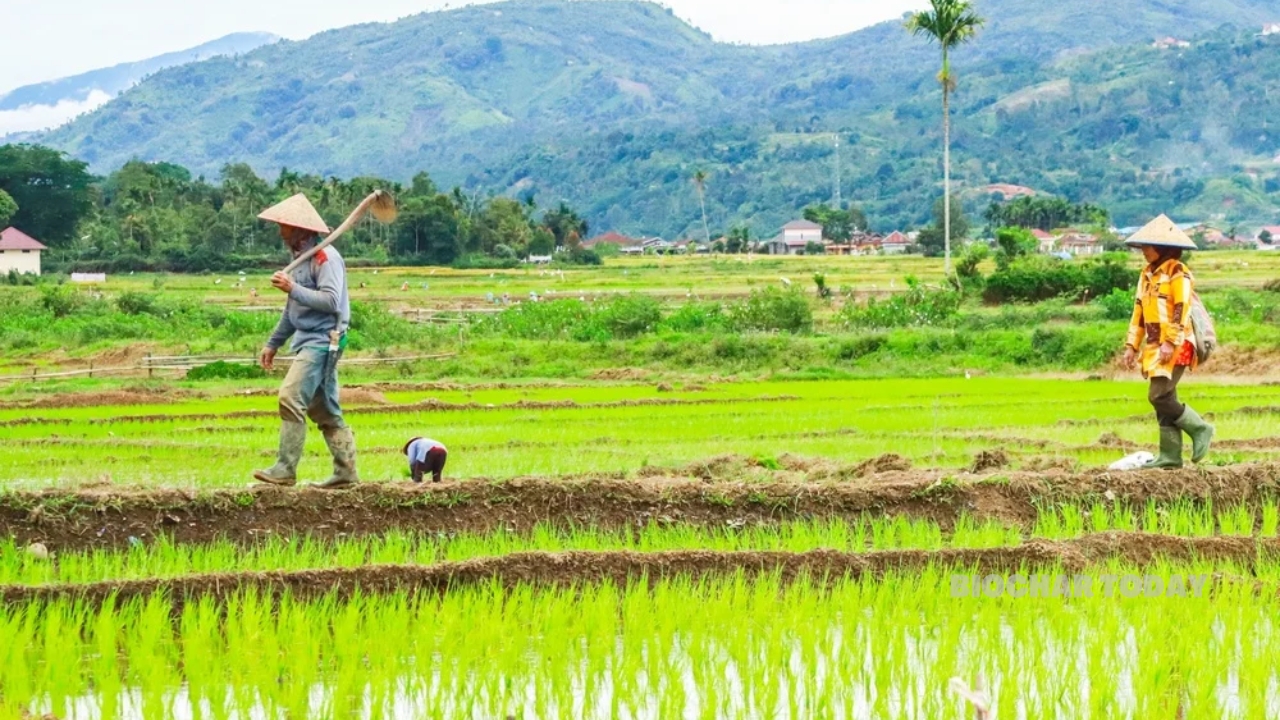
Traditional and Quilombola communities lost access to the chapadas: shared land for grazing, fishing, and gathering fruits such as pequi. Communities describe watching land taken and veredas restricted, then watching water scarcity follow. The GFC / CAV report calls for an immediate halt to plantation expansion, restoration of veredas and Cerrado, and compensation for affected families. Indigenous and Quilombola groups are also campaigning, through a bill in the Minas Gerais assembly (No. 5609/2026), to have the Jequitinhonha River recognised as a legal subject with rights.
A valley under double pressure
The same watershed now faces a lithium rush. Mining applications in the Jequitinhonha and Mucuri basins rose 562% between 2022 and 2024. Independent reporting from around Sigma Lithium’s operations documents dust, respiratory illness, a stream that dried up for the first time in 2025, and concern over 130 catalogued springs. Both industries are financed in part with public development money, and both are sold under a “green transition” banner: green steel on one side, battery metals on the other.

A landscape that has already lost half its recharge capacity is now being asked to absorb a second extractive industry. This is not resilience. It is stacked risk.
Where biochar comes in
The charcoal fines left over from Aperam’s kilns (moinha) are now marketed as biochar for carbon removal credits. Reported figures include close to 100,000 credits and about €6.4 million in projected annual revenue. Biochar’s climate case rests on locking away carbon that would otherwise return to the atmosphere. But the trees here were not waste. They were grown on purpose, on converted land, at a documented cost to water.

What our standards already say about feedstock
Verra VM0044. Eligible feedstockFeedstock refers to the raw organic material used to produce biochar. This can include a wide range of materials, such as wood chips, agricultural residues, and animal manure. More must be waste biomassBiomass is a complex biological organic or non-organic solid product derived from living or recently living organism and available naturally. Various types of wastes such as animal manure, waste paper, sludge and many industrial wastes are also treated as biomass because like natural biomass these More that would otherwise decay or be burned without energy use. Purpose-grown feedstock is excluded, because it can compete with food security and drive land-use change. Jequitinhonha-type feedstock would not qualify.
Puro.earth Biochar Methodology (2025). Land-clearing biomass does not include clearing for agriculture or plantations. Non-food crops are limited to specified land types, such as degraded or marginal land. Forest biomass must support regeneration, carbon stocks and soil quality. Again, this feedstock would not qualify.
European Biochar Certificate / World Biochar Certificate. The positive list includes woody biomass from short-rotation plantations (Ag-03) and energy crops, with no land-use-change or ecosystem-integrity test attached. This is a gap: plantation feedstock can pass on paper.
IBI Standards and ISO 17225. These focus on biochar properties and fuel classification. They set no rules on how or where feedstock was grown, so they are silent on this question.
ISO 14001:2015. This is not a feedstock rule. It is an environmental management system standard, with continual improvement and third-party audits, and it is a tool that could be used to enforce feedstock rules.
The pattern is clear. The strictest frameworks already exclude this. The gap sits in the standards written mainly to test chemistry and contaminants, which never expected a plantation charcoal stream to enter the biochar market. I believe that is oversight, not intent. But an oversight that stays open after cases like this becomes a choice.
Why this cannot be defended
Anyone claiming this pathway as biochar carbon removal has to pass three simple tests. It fails all three.
- The waste test. Was the biomass genuinely surplus, something that would otherwise rot or burn? No. It was grown for charcoal, and the plantation exists because of the charcoal.
- The land test. Did producing it avoid converting natural ecosystems or productive land? No. Native Cerrado cover fell from 86.1% to 24.6% on the plateau.
- The water test. Did producing it leave local water and communities no worse off? No. Water tables, springs and river flow fell, and peer-reviewed work links this to the monoculture.
A carbon credit that cannot pass any of these is not carbon removal. It is a label on a land-use decision made fifty years ago, kept alive by new revenue.
Fairness matters, so let me be precise. Eucalyptus is not inherently evil, and forestry is not the enemy. FAO’s own review notes that many problems arise from careless siting and policy rather than from the genus. But that is exactly the point: siting and scale were the failures here, and no offset can repair them.
There is also precedent for prevention. Around 2001, the Brazilian state of Espírito Santo passed a law banning new eucalyptus plantations until an agroecological mapping determined where they could and could not be planted. Ethiopia’s national review of about 506,000 hectares of eucalyptus reaches the same lesson from another angle: choose species and sites carefully before planting, not after the springs fail.
The purity and purpose of biochar
Biochar was conceived, researched and championed as a tool for restoration, waste valorisation and climate resilience. Its core idea is circularity: take biomass that would otherwise rot or be burned in the open, releasing its carbon straight back to the air, and turn it into a stable material that builds soil and holds carbon for a long time.
Three purposes give biochar its integrity:- Closing nutrient loops. Turning waste into something that feeds soil; Valorising waste. Easing landfill burdens and open burning of crop residue; Improving soil and water health. Better water retention, microbial habitat and nutrient use. This is the exact opposite of what an aggressive monoculture does to a landscape.
Biochar’s credibility was earned over decades of patient measurement of how carbon behaves in char, how long it lasts in soil, and what it does for living systems. That credibility is the industry’s most valuable asset. It is also its most fragile one.
Toward true sustainability: principles for biomass and biochar
If biochar is to grow with integrity, every decision on biomass should follow three principles.
Prioritise true wastes. Feedstock should be genuinely residual: crop husks, stalks and shells, wood-processing residues, invasive-species clearing that helps native restoration, and organic municipal waste. If the biomass exists only because char is wanted, it is not waste.
Ecological beneficence. Any plantation considered for biomass or carbon removal must leave the environment and society better off. That means native, mixed-species systems on degraded land that protect water and restore soil, not systems that drain them.
Social and community safeguards. Sourcing must respect land rights, food security and community access to water as conditions, not as annexes at the back of a sustainability report.
A call to action
To certification bodies and registries
- Close the plantation gap. Purpose-grown, short-rotation feedstock must pass the same land-use-change and ecosystem tests that Verra and Puro apply.
- Audit upstream of the kiln. A carbon claim must cover the whole estate that fed it, not just the pyrolysisPyrolysis is a thermochemical process that converts waste biomass into bio-char, bio-oil, and pyro-gas. It offers significant advantages in waste valorization, turning low-value materials into economically valuable resources. Its versatility allows for tailored products based on operational conditions, presenting itself as a cost-effective and efficient More unit.
- Treat charcoal-industry co-products as a red flag requiring full supply-chain disclosure, not an automatically eligible pathway.
To project developers and industrialists
- Require, for every biochar project, a full life-cycle assessment and, where land conversion is involved, an environmental impact assessment, both updated every year for the life of the project.
- Adopt ISO 14001 environmental management certification as a baseline, not an extra.
- Publish results openly. This story took decades to surface because nobody outside an NGO investigation was looking closely.
To financiers and buyers
- Demand independent hydrological and biodiversity baselines before funding plantation expansion or purchasing credits linked to it.
- Ask three questions before any purchase: Is it waste? Did it convert land? Did it cost water?
To biochar practitioners and lovers of this field
- Say it out loud. If we do not defend our own field’s integrity, others will define it for us.
To communities and governments
- Give affected communities real legal standing and a voice before concessions are signed, not consultation after the fact.
- Follow Espírito Santo’s example: map first, plant later.
A word to those who lead industries and write policy
This section is for you: the executives who sign off financing, the officials who grant licences, the buyers who purchase credits. I do not write it in anger. I write it because you are the people best placed to change what happens next, and because I think most of you, if asked plainly, would not defend what is in this paper. So let me ask a few plain questions. I do not need answers on paper. I only ask that you hold them for a moment.
- When the expansion plan was approved, who asked what it would do to the springs? Was there a person in the room whose job was to speak for the water?
- When “green steel” or “carbon removal” went into the sustainability report, did anyone check whether a river a few kilometres away had gone intermittent?
- If a credit is worth millions, is it worth the well a family no longer has? If you think it is, say so aloud, and say it to them.
- If your own children’s drinking water depended on that plateau, would you accept the assessment that was done?
- Ten years from now, when this is studied by someone like me, what will your signature on the approval say about what you valued?
Every large decision looks reasonable at the desk where it is made. The water table does not sit at that desk. It falls a little each year, quietly, over decades, until it has fallen for two generations. By then, the people who approved the plan have retired and the people who bear it have nowhere to go. You have real power here, and this is not a reason to feel only blame. It is a reason to feel responsibility. A financing condition, a licence clause, a purchasing rule: each of these can prevent the next valley from going the same way. Use them.
Biochar should be made with pure intentions. That means the intention has to be visible in the sourcing, the accounting and the outcomes, not only in the brochure. If it would not survive a visit from the people who live downstream, it should not carry the name.
Biochar earned its reputation through patient science: how carbon behaves in char, how long it lasts in soil, what it does for water and life in the ground. That reputation is precious, and it is fragile. A spring does not care what a project is called. It flows or it doesn’t.
We can feed the kiln with genuine waste, and grow biochar the honest way. What we cannot do is greenwash a spring back to life. The standards to prevent the next Jequitinhonha already exist in part. What is needed now is the will to close the remaining gaps, and the courage to say no.
References
Down To Earth, Eucalyptus monoculture plantation in Brazil’s Jequitinhonha Valley linked to water table drop (reporting the Global Forest Coalition / CAV investigation).
Silva, E. P. F. et al. (2022). Metamorfose da chapada: monocultura de eucalipto e tomadas de terras e águas no Alto Jequitinhonha. Campo-Território (UFMG).
Calixto, J. S. & Ribeiro, A. E. M. (2007). Três olhares sobre o reflorestamento. Organizações Rurais & Agroindustriais.
Soil and landscape baseline of the Upper Jequitinhonha chapadas, Redalyc (soil science paper).
Le Monde Diplomatique Brasil, Vale do Jequitinhonha: dilemas e lutas de camponeses impactados pela monocultura do eucalipto.
IDEC / Fair Finance research on BNDES and Banco Votorantim financing of Aperam BioEnergia.
Cultural Survival and Mongabay reporting on lithium mining in the Jequitinhonha Valley.
Belachew & Minale (2025), Socioeconomic and Environmental Impacts of Eucalyptus Plantations in Ethiopia, The Scientific World Journal.
FAO Regional Expert Consultation on Eucalyptus (Bangkok, 1993).
World Rainforest Movement, reports on eucalyptus in Brazil, including the Espírito Santo law.
Environmental Paper Network (2025), on the Suzano protests and financing
Verra VM0044; Puro.earth Biochar Methodology (Edition 2025); European Biochar Certificate / World Biochar Certificate positive list; ISO 17225; ISO 14001:2


Leave a Reply