
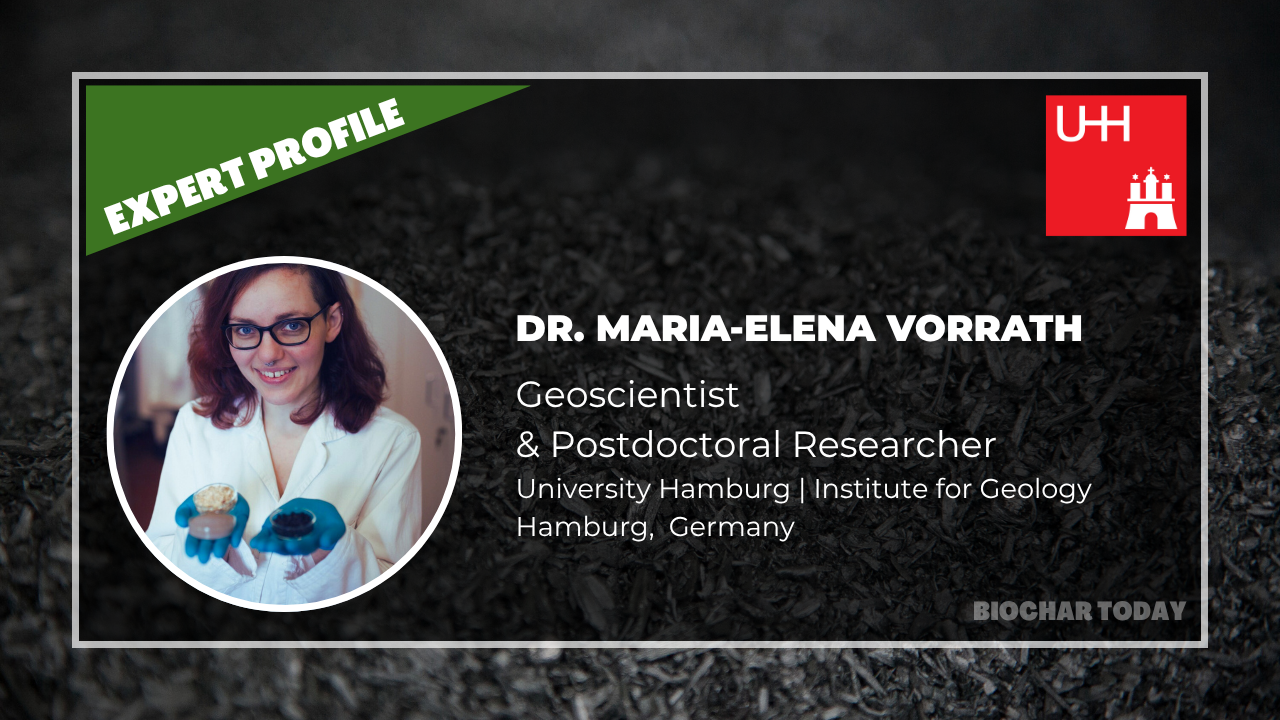
It is a pleasure to introduce Dr. Maria-Elena Vorrath , a Geoscientist with established expertise in carbon dioxide removal (CDR) strategies, particularly the integration of enhanced rock weathering (ERW) and biocharBiochar is a carbon-rich material created from biomass decomposition in low-oxygen conditions. It has important applications in environmental remediation, soil improvement, agriculture, carbon sequestration, energy storage, and sustainable materials, promoting efficiency and reducing waste in various contexts while addressing climate change challenges. More. Dr. Vorrath is currently a Postdoctoral Researcher at the University Hamburg, where she investigates the synergetic effects of enhanced rock weathering and pyrogenic carbon to improve terrestrial carbon sequestration in agricultural systems. This work includes leading multiple laboratory studies assessing the carbon removal potential of soil amendments, which explores co-deployment and co-pyrolysis to develop “rock-enhanced biochar.”
Dr. Vorrath is also the Principal Investigator for the Rockchar project, where she develops affordable, environmentally friendly carbon sequestration by combining biochar with industrial waste materials like steel slag and concrete. Furthermore, her Superchar project, is focused on creating a slow-release phosphorus and potassium fertilizer from pyrolyzed sewage sludge to address environmental and food security challenges. Beyond her academic research, Dr. Vorrath serves as a Scientific Advisor and Consultant for various CDR stakeholders leveraging her foundation in biogeochemistry and interdisciplinary project management to drive sustainable, real-world solutions.
I am delighted to have her bring her depth of knowledge on Biochar based CDR to our discussion today.
Shanthi Prabha: Dr. Vorrath, you have a fascinating background, starting in musicology and audio engineering before pivoting to geosciences and climate action—and now you’re an expert in Rockchar and Superchar, with various future projects. Was there a specific moment—perhaps a particularly compelling piece of charcoal—that made you say, Forget the music charts, I’m topping the CDR charts and putting the ‘char’ in circular economy?
Maria-Elena Vorrath: Haha, music and biochar have more in common than you think:
- The first microphones were built by pressing coal dust in a can together with two electrodes. The vibration of the voice causes the coal dust to move and change its resistance, which is then converted into an electric current – the audio signal.
- There is no music on a dead planet, therefore, I thought I should contribute my part as an expert on the global carbon cycle and bring at least some carbon back into the ground.
There was indeed a specific moment that started a long journey to find a work that has a climate-positive footprint. As a PhD student in climate and polar science, I participated in a ship expedition to Antarctica. Surrounded by icebergs, my colleague from Oceanography told me: “The warm water comes earlier every year and it leaves later every year.” I realised how strong this huge Antarctic ice sheet is reacting to our inaction and that the early stage of the climate crisis has already had an irreversible and destructive impact on humanity: the rise of sea level over the next hundreds and thousands of years cannot be reversed, and billions of people will lose their homes and lives. No guarantee exists that mitigating the climate crisis can prevent the destruction of other tipping elements in the climate system, but not even trying seems unethical to me. I also prefer to retire in a world with a temperature of +3.0°C rather than +3.1°C, because every tenth of a degree counts.
In brief, I began researching enhanced rock weathering, one of the long-term thermostats of Earth’s climate, in 2021. I then combined it with biochar in soil in 2022, as part of my current research project, PyMiCCS.
SP: Your work heavily emphasizes the synergistic combination of biochar and Enhanced Rock Weathering (ERW). Could you elaborate on the specific effects you have observed in the Rockchar project that maximize CO2 sequestration and the stability of the soil organic carbon (SOC) pool per area? Can you please explain a bit more about Rockchar for our readers?
MV: We combined rock powder and biochar in two ways: as a simple co-deployment and as a mineral-enriched biochar where biomassBiomass is a complex biological organic or non-organic solid product derived from living or recently living organism and available naturally. Various types of wastes such as animal manure, waste paper, sludge and many industrial wastes are also treated as biomass because like natural biomass these More and rock powder were pyrolyzed together. Based on the first experiment we recently published, we were unable to measure any increased CO2 sequestration clearly. This is also because we found that distinguishing the weathering signal from the rock and the leachingLeaching is the process where nutrients are dissolved and carried away from the soil by water. This can lead to nutrient depletion and environmental pollution. Biochar can help reduce leaching by improving nutrient retention in the soil. More of biochar was impossible without our methods. However, we noted that all biochar improved soil hydrology, which is essential for rock weathering to occur and for CO2 sequestration. Additionally, the materials have different properties: one ton of rock can sequester only 367 kg of CO2, but it has a low volume (approximately 0.8 m³) and provides mineral nutrients. In contrast, one ton of our biochar sequesters around 3,120 kg of CO2, carries organic nutrients, and has a large volume (approximately 3 m³). To increase soil fertility, it makes sense to apply both materials to the field.
Soil organic carbon was not the focus of our study. There are examples of SOC loss as a consequence of pHpH is a measure of how acidic or alkaline a substance is. A pH of 7 is neutral, while lower pH values indicate acidity and higher values indicate alkalinity. Biochars are normally alkaline and can influence soil pH, often increasing it, which can be beneficial More increase and higher microbial activity, but also examples where the formation of secondary minerals from weathering supports the increase and stabilization of SOC. Well, there is still a lot to do.
SP: The Rockchar project utilizes co-pyrolysis of biomass with industrial byproducts like steel slag and concrete. What is the most significant hurdle in upscaling these waste streams as biochar amendments in a way that is both safe for agricultural use and economically viable for a truly circular economy?
MV: It supposes we need more field trials and use cases to demonstrate the economic feasibility based on the agronomic benefits of these materials. When those products are sold as fertilizer, they must meet the safety requirements of each national fertilizer regulation. Therefore, harm rather occurs due to improper handling (e.g., applying too much material at once) than from the materials themselves. Most important is that the agronomic use of steel slag and concrete may not incentivize or support the continuation of the usual steel and concrete production, as these industries must decarbonize and decrease in the future to meet climate goals.
My experiments with Rockchar will run until the end of 2025, providing valuable long-term data. Hopefully, you can read the outcome sometime next year.
SP: The core idea of Superchar is to use pyrolyzed sewage sludge and chicken manure. What primary research challenge—beyond fundamental waste management—were you aiming to solve with this specific combination of phosphorus-rich and potassium-rich feedstocks?
MV: The primary challenge is indeed that phosphorus is bound to the geological cycle, which means that recovering the worldwide exhausted mineral mines takes many millions of years. Consequently, we need to recover and recycle as much plastic as possible, which will also prevent negative side effects such as eutrophication and harmful algae blooms. With up to 7% P in sewage sludge, this material is like gold that we have to mine for our future food security.
SP: Nutrient availability is a known challenge with certain biochar feedstocks. Could you explain the Superchar mechanism that enhances the recovery and slow-release of phosphorus, and how you ensure this effectiveness is consistent when deployed as a fertilizer?
MV: Indeed, it is really frustrating that less than 1% of P in pyrolyzed sewage sludge is soluble in water. I was inspired by two studies from Buss et al., who increased the P-recovery by more than 200 times just by adding potassium acetate. They found that pyrolysisPyrolysis is a thermochemical process that converts waste biomass into bio-char, bio-oil, and pyro-gas. It offers significant advantages in waste valorization, turning low-value materials into economically valuable resources. Its versatility allows for tailored products based on operational conditions, presenting itself as a cost-effective and efficient More enables the formation of water-soluble potassium phosphates. As I am a big fan of low-level technology that allows equal opportunities when it comes to large-scale carbon sequestration, I found that chicken manure could be a good source of potassium. Luckily, poultry is the most popular and numerous livestock in the global south, where problems with sewage sludge management occur and P-releasing biochar could increase food security on nutrient-depleted, highly weathered (sub-)tropical soils. Solving several issues with one solution (while also sequestering CO2) sounded attractive to me.
SP: The safe use of sewage sludge requires careful consideration of contaminants. How does the pyrolysis process and the resulting material in the Superchar project mitigate the risks associated with trace contaminants like heavy metals, viruses, and pharmaceuticals?
MV: A significant advantage is that viruses and pharmaceuticals are destroyed during pyrolysis; however, trace metals are concentrated and not eliminated. Due to this issue, a thorough assessment of sewage sludge-derived biochar is necessary before its use in the environment. I imagine that sewage sludge from low-industrial and rural areas might be less contaminated, while these areas might profit from the production and use of Artisan Superchars.
SP: You recently conducted a field expedition to test Superchar with the Mosan team. What is the single most critical factor that changes when translating a promising biochar or co-pyrolysis result from a controlled lab environment to a real-world field application?
MV: The most essential factor is creativity. If you are unable to adjust from clean laboratory conditions with small samples, precision scales, and a clean reactor with controlled pyrolysis to a dusty, hot pyrolysis plant in Guatemala, you are lost. You must be ready to shovel shit in a barrel and roll it over the floor to mix your feedstocks, distribute it for drying in the sun and mill your Superchar with a hand mill. Other critical factors are speaking Spanish(!), being pragmatic, having an adventurous mind and being able to tolerate frustration, having craft skills (or learn them) and a good deodorant. These are not the common skills of academics but developing prototypes of Superchar requires hands-on action.
SP: Biochar is often promoted for its green energy co-benefits from pyrolysis. What is the current potential for commercial biochar operations to use this generated heat and gas to truly establish a maximum circular economy in their localized operations?
MV: It highly depends on the technological level of the pyrolysis plant, if it is either a Kontiki or a Pyrek. In my view the key part is the infrastructure to a) maintain stable biomass access and b) to distribute heat and energy to places where needed. More and more pyrolysis plants are combined with industries that use the excess heat. If these industries also produce a feedstockFeedstock refers to the raw organic material used to produce biochar. This can include a wide range of materials, such as wood chips, agricultural residues, and animal manure. More (like cocoa shells) it is even better.
SP: As a CDR Consultant, you advise stakeholders on navigating the CDR universe. What are your 1-2 most important pieces of advice for project developers looking to integrate biochar and ERW for optimal co-benefits in diverse agricultural settings?
MV: So far, we cannot distinguish between cation release from rock weathering and from biochar, which makes MRV and correct CDR accounting for ERW impossible. However, no worries, my lab experiments may provide a first step towards a solution. Nevertheless, to benefit from the co-benefits, I recommend using biochar for certified CDR and adding rock powder as a fertilizer booster. By doing this, you can already find the right mix from available regional resources, considering the climatic conditions and what is best for your soil and crops, while I try to solve this hurdle in my lab.
SP: You advocate for moving past the “mine is the best” attitude in CDR methods. What tangible policy or industry shifts could best incentivize the collaborative and co-deployment of biochar alongside other land-based CDR techniques?
MV: I think two things are crucial for the future of CDR:
- As land is limited, consider stacking CDR methods to increase the CO2 sequestration per area. Pyrogenic carbon and minerals naturally occur in every soil, and organic and inorganic carbon always interact with each other. Therefore, biochar and ERW may not be treated in isolation but must be part of a holistic soil carbon storage concept.
- Make value-based CDR. Planet Earth has been in a circular state for 4.7 billion years, so when we derive a value from burning fossil fuels and using energy, we must also generate a value by putting carbon back into the cycle.
Our current linear economy treats CO2 as a waste product that needs to be stored underground but continuing an unlimited growth on a limited planet is the root of the climate crisis and why humanity is under an existential threat. Whenever CO2 is removed, people will benefit from healthier and more fertile soils, stable crop production, adapting agriculture to climate extremes, circularly managing waste, and allowing those who have accumulated an incredible amount of wealth by burning fossil fuels to pay for CDR, while others suffer from the consequences.
SP: As a member of the Isometric Science Network, what critical gaps in current biochar CDR monitoring, reporting, and verification (MRV) methodologies must be addressed to enhance market credibility and confidence in long-term carbon durability?
MV: I think many methodologies for biochar are already quite robust. I always prefer to offer flexibility to project developers, for example, when choosing the method to prove the stability of their biochar. A significant issue is that small biochar producers face a high workload due to documentation requirements and the need to provide expansion plans. In my view, small biochar producers should have access to the carbon market under various conditions to receive remuneration for the co-benefits they provide and to generate income to develop their biochar projects. Small producers often struggle to attract investors, despite their significant contributions to the sustainable development of a region.
SP: Looking ahead five years, what do you predict will be the single biggest breakthrough or most significant shift in how biochar is utilized as a mainstream climate action and soil health solution?
MV: I recently attended a conference presentation where the stability of biochar was assessed using FTIR (Fourier Transform Infrared Spectroscopy) data. If this approach is successful using portable FTIR sensors, it could reduce time and costs when used in the field to identify promising biochar batches, rather than sending hundreds of samples to a laboratory. Furthermore, I also see many opportunities arising for biochar in the building industry. A significant step would be to find a way to accurately quantify CDR when rock powder and biochar are combined in the same soil.
SP: Your work on Enhanced Rock Weathering (ERW) is unique because you’ve investigated both terrestrial (basalt in soils for PyMiCCS/Rockchar) and marine (olivine in a fluidized reactor for RETAKE) applications. In your experience, what is the single biggest chemical or kinetic challenge that needs to be solved to ensure verifiable and scalable CO2 removal—specifically, the difference between the soil-based dissolution rate and the reactor-based dissolution rate, and how do you monitor for it?
MV: Depending on the conditions in my reactor, I can boost the dissolution rates of rocks and monitor CDR easily, but this comes with a cost in terms of energy and industrial infrastructure. Dissolution rates in soils might be much smaller, but once the rock powder is in the soil, nature takes over the job for us. Rock weathering may be paused during dry seasons, but it resumes with the next rain. This makes monitoring much more difficult, but in my view, the co-benefits from ERW, such as a 20% increase in income for farmers in India and Brazil, are worth the challenge.
SP: Dr. Vorrath, your work involves combining high-tech geochemistry with a very ancient technique. If you had to host a dinner party to explain your research, would you serve a highly sophisticated molecular gastronomy dish to represent the science, or would you just serve charcoal-grilled everything and tell your guests, ‘Don’t worry, the carbon is sequestered, and this is just really, really old soil amendmentA soil amendment is any material added to the soil to enhance its physical or chemical properties, improving its suitability for plant growth. Biochar is considered a soil amendment as it can improve soil structure, water retention, nutrient availability, and microbial activity. More?’
MV: Rock weathering has been occurring for more than 4 billion years on Earth. Photosynthesis evolved later, and carbon sequestration through coal formation occurred much later. Both mechanisms are natural chemical processes that became a technology when humans started using them to increase soil fertility a few thousand years ago and as a climate intervention today. Rock weathering and biochar are a present from nature to us. We just may not fuck it up.
SP: To wrap up our conversation, Dr. Vorrath, your work is a perfect blend of high-level science and actionable climate solutions. For our Biochar Today readers who want to follow the progress of the Rockchar and Superchar projects, keep up with your latest insights on ERW synergies, or just enjoy your award-winning science communication—where can they most reliably trace your work and professional interests online?
MV: Ah yeah, the time issue thing. Due to having too many important projects at once, I reduced my science communication and currently only communicate via my project page on LinkedIn. However, I promise that some great papers will be published in 2026. I need to write them 😉


Leave a Reply