
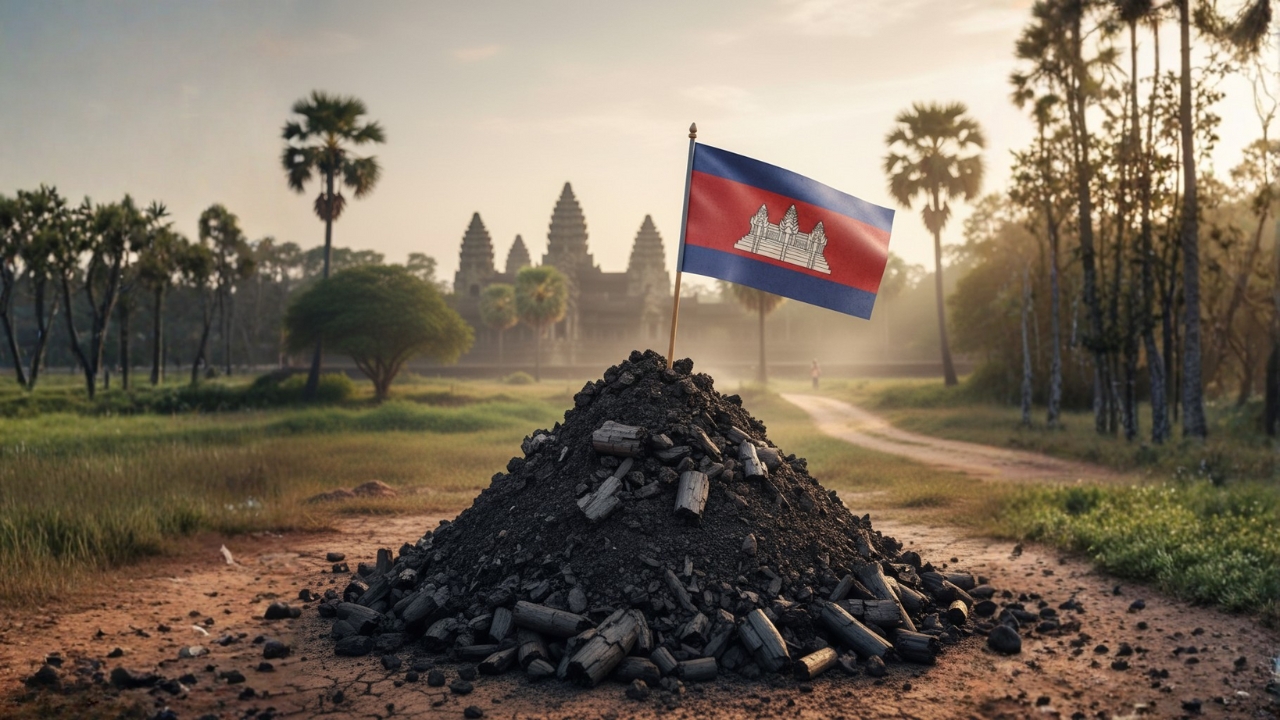
I spent a lot of my MSc researching and writing about the Mekong region; with its extensive waterways and vibrant biodiversity, you can’t help but be captivated by it. Cambodia is a nation closely tied to the Mekong, supporting its agriculture, forestry and fishing – all key to the nation’s economy. However, the sad reality is that Cambodia’s resource-intensive economy is encountering issues, due to a broad array of environmental challenges.
Cambodia is losing its forests at an alarming rate, its staple rice cultivation is a significant source of greenhouse gases, and its rural and fishing communities face severe water quality issues. By strategically deploying biocharBiochar is a carbon-rich material created from biomass decomposition in low-oxygen conditions. It has important applications in environmental remediation, soil improvement, agriculture, carbon sequestration, energy storage, and sustainable materials, promoting efficiency and reducing waste in various contexts while addressing climate change challenges. More derived from its abundant agricultural waste and forestry residues, I wish to explore how Cambodia can tackle these issues – simultaneously, pivoting from climate vulnerability to regenerative development.
The Biochar-Forest Link: Reversing Deforestation and Land Degradation
Cambodia has one of the world’s highest rates of deforestation. Between 2001 and 2024, the country lost 2.92 million hectares of tree cover, equivalent to a 33% loss of its 2000 tree cover area. This loss is largely driven by commercial agriculture expansion, logging, and the need for new farmland. There is also a socio-economic factor which centers around Cambodia’s political corruption and local vs national forest reporting. This has led to a paradoxical problem for Cambodia, as they boast a 40% land protection coverage whilst having one of the highest deforestation rates in the world. This juxtaposition can be seen in the image below:

However, to fully explore these socio-economic nuances, would require a whole other article and this is Nations of Biochar; so I’ll cut to the chase!
Biochar offers a critical role in reforestation and land rehabilitation:
- Enhancing Reforestation Success: When land is cleared, the remaining soil is often poor and nutrient-depleted, making reforestation difficult. Biochar, when incorporated into nursery soil or degraded land, acts as a soil conditioner that retains water and nutrients. Studies have shown that biochar treatments can dramatically increase the performance and survivorship of native trees in tropical ecosystems, sometimes more than doubling their growth by suppressing phytotoxic compounds and providing a stable habitat for roots. There is existing research into biochar use in the regions agricultural systems, but more should be done to understand the circular benefits for forestry that could help to sequester more carbon and recover regional forestland.
- Reducing Pressure on Forests: The pressure to clear new land for subsistence farming can be eased by boosting the productivity of existing, degraded agricultural plots. Biochar derived from forestry residues (e.g., non-commercial timber waste) or rice husks helps regenerate these soils. This shift creates a compelling economic incentive for farmers to maximize current yields rather than expanding into forest areas.
Decarbonizing the Paddy: Rice Husk Biochar and Climate Resilience
Rice is the foundation of Cambodia’s food security and economy. However, the wet cultivation practices in its vast rice paddies release significant amounts of methane (CH4) and nitrous oxide (N2O), potent greenhouse gases, when soils are kept waterlogged. Crucially, rice milling also generates enormous quantities of waste biomassBiomass is a complex biological organic or non-organic solid product derived from living or recently living organism and available naturally. Various types of wastes such as animal manure, waste paper, sludge and many industrial wastes are also treated as biomass because like natural biomass these More.
Cambodia is a major rice producer, generating an estimated 1.74 million tonnes of rice husks annually (based on 2019 data), which are often poorly managed. Turning this waste into biochar is the perfect circular-economy solution:
- Methane Mitigation and Yield Boost: Rice husk biochar (RhB) is the ideal amendment for paddy soil. Biochar incorporation has been shown in related studies to increase rice yield by 16% on average while simultaneously reducing N2O emissions from paddy soils. The application of biochar (for example, at a rate of 4 t ha−1) combined with chemical fertilizers significantly increased rice yield and also reduced nitrogen leachingLeaching is the process where nutrients are dissolved and carried away from the soil by water. This can lead to nutrient depletion and environmental pollution. Biochar can help reduce leaching by improving nutrient retention in the soil. More, ensuring nutrients stay with the crop and out of the waterways.
- Existing Success Stories: This concept is already being proven by enterprises like Husk Ventures, which has created the world’s first biochar facility in a rice mill in Cambodia, producing EBC-certified biochar from organic rice husks. Their results show that biochar application can increase crop yields by an average of 44% and boost the average income of smallholder Cambodian farmers by 23%. This model transforms a national waste stream into an affordable, high-quality fertilizer, demonstrating clear economic viability.
Unique End-Use: Biochar for Water Security in Fishing Communities
The Mekong River and the Tonle Sap Lake are vital to Cambodian life, supporting vast fishing industries and supplying water to millions. However, contamination from agricultural runoff, sewage, and general waste poses a major public health risk, particularly in rural and floating communities.
- The Filtration Imperative: Biochar offers a decentralized, low-cost solution for water purification. Its extremely porous, highly absorbent structure can bind to and remove contaminants such as heavy metals, ammonia, and excess nutrients (like nitrates and phosphates) from water. As much of Cambodia’s aquaculture depends on freshwater ecosystems, there is less of an imperative to combat salinity, so applications of biochar can be streamlined towards pollution mitigation.
- Aquaculture and Health: This is directly relevant to Cambodia’s fishing sector. In aquaculture systems, biochar can be used as a biofilter medium to improve water quality, reducing toxic levels of ammonia and nitrite, which in turn improves the health and survival rate of cultured fish species.
- Community Implementation: This approach is being developed through initiatives like the V-BIOCHAR project in Pursat Province, supported by the UNDP and ADRA, which focuses on introducing low-cost pyrolysisPyrolysis is a thermochemical process that converts waste biomass into bio-char, bio-oil, and pyro-gas. It offers significant advantages in waste valorization, turning low-value materials into economically valuable resources. Its versatility allows for tailored products based on operational conditions, presenting itself as a cost-effective and efficient More units and training local communities to make biochar from agricultural waste (like rice husks and coconut shells). The project aims to improve soil health while also providing an innovative, accessible environmental solution for local use.
The Developing Biochar Ecosystem: Gaining Ground on Regional Leaders
While neighboring countries often lead in biochar scale-up, Cambodia is leveraging its strong NGO and development sector to build a foundation focused on small-scale impact.
- Key Private Sector Leader: Husk Ventures stands out, not only for its yield results but also for its compliance with the European Biochar Certification (EBC), which allows it to generate Carbon Removal Credits (CRC). This financial mechanism helps subsidize the cost of biochar, making it affordable for smallholder farmers – a crucial step for market adoption in a developing economy.
- Development and Research Focus: The V-BIOCHAR project, mentioned previously, emphasizes technology transfer to women and youth. By training local producers to build simple, low-cost pyrolysis kilns from local materials, the project ensures that biochar production is an accessible small-scale enterprise, which is essential for a country with highly decentralized agriculture.
By focusing on these decentralized, integrated solutions, Cambodia can transform its massive rice husk residue – a source of pollution – into a strategic asset for climate mitigation, land restoration, and public health improvement, setting a compelling model for other nations facing similar challenges in the Mekong region. The focus must be on disseminating the facts about biochar, demonstrating how to use pyrolysis equipment safely and effectively to ensure Cambodia’s rich natural resources are a benefit, not a burden, in these coming decades.
Ready to see how biochar can transform another country’s future? Let me know which nation you’d like me to cover next in this series! Feel free to drop me an email at: ralph@biochartoday.com



Leave a Reply