

The world is rapidly urbanizing. In 1950, only 30% of people lived in cities, but this surged to 55% by 2018, and is expected to reach 68% by 2050. This massive shift has significant consequences for people, the environment, and development at all levels. These consequences include increased air and water pollution, changes in land use, loss of biodiversity, and damage to ecosystems. Furthermore, cities and the way they expand are major contributors to climate change through carbon emissions. This urban growth is uneven, with developing nations experiencing distinct patterns. By 2050, cities will house an additional 2.5 billion people, with nearly 90% of this increase concentrated in Asia and AfricaB(Li et al., 2022)(Das et al., 2024). Rapid urbanization, coupled with the escalating impacts of climate change, demands innovative solutions to ensure a sustainable and resilient future (Li et al., 2022).
Amidst these challenges, an ancient practice is being rediscovered and refined: the use of biocharBiochar is a carbon-rich material created from biomass decomposition in low-oxygen conditions. It has important applications in environmental remediation, soil improvement, agriculture, carbon sequestration, energy storage, and sustainable materials, promoting efficiency and reducing waste in various contexts while addressing climate change challenges. More. This seemingly simple material, born from the controlled burning of organic waste, holds immense potential for transforming our urban landscapes(Azzi et al., 2022).
The Urban Dilemma: Balancing Growth and Greenery
Over half of the world’s population now resides in cities, and this number continues to rise. While cities are engines of economic and cultural progress, they often struggle to maintain a healthy balance between built infrastructure and natural spaces. The concrete jungle, with its sealed surfaces and towering structures, creates a harsh environment for plant life(Keivani, 2010). Urban soils are frequently compacted, hindering water infiltration and nutrient uptake, leading to stressed and struggling vegetation(Varma et al., 2024).
Yet, green spaces are vital for urban well-being. They mitigate the urban heat island effect, reduce air and noise pollution, and provide essential mental health benefits(Paudel & States, 2023). The challenge lies in creating and maintaining these green spaces in the face of limited space and challenging growing conditions. This is where biochar enters the picture, offering a sustainable and effective solution (Sachini et al., 2024).
Biochar as an Ancient Solution for Modern Challenges
The use of biochar, or pyrolyzed biomassBiomass is a complex biological organic or non-organic solid product derived from living or recently living organism and available naturally. Various types of wastes such as animal manure, waste paper, sludge and many industrial wastes are also treated as biomass because like natural biomass these More, has ancient roots, dating back at least 5,000 years, with evidence of its agricultural use by various civilizations, notably in the Amazon’s ‘Terra Preta’ soils. These fertile soils, enriched by charcoalCharcoal is a black, brittle, and porous material produced by heating wood or other organic substances in a low-oxygen environment. It is primarily used as a fuel source for cooking and heating. More added centuries ago, exhibit high organic carbon content and nutrient-holding capacity, enabling sustained crop production without excessive fertilization. Modern research confirms biochar’s potential to enhance soil fertility, water retention, and nutrient uptake, while also sequestering carbon and reducing greenhouse gas emissions. Studies have shown biochar’s effectiveness in increasing crop yields and mitigating plant stress from drought, salinity, and heavy metal contamination(Semida et al., 2019). Biochar’s adaptability is consistent with sustainable development goals, making it a valuable tool for tackling global challenges such as climate change, soil degradation, and pollution control(Afshar & Mofatteh, 2024). Through Today, we are rediscovering its potential, not just for agriculture, but also for urban sustainability(Liao et al., 2023).
How Biochar Benefits Urban Environments
Enhanced Soil Health
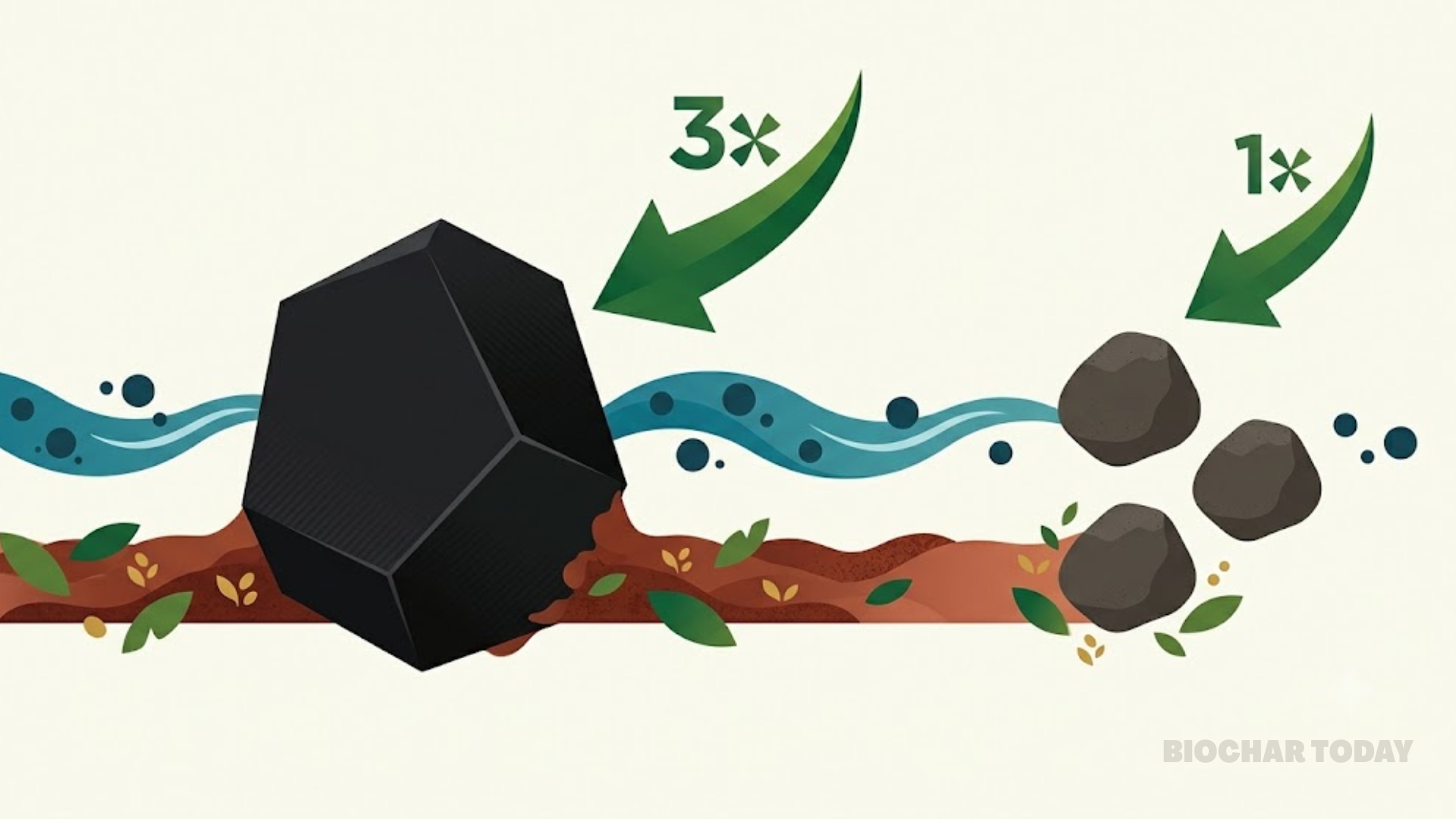
Due to degradation and compaction, urban soils often present challenging conditions for plant life. However, biochar’s porous structure offers a solution by enhancing soil aeration, water retention, and nutrient availability, thus creating a more favorable environment for root development. Acting like a sponge, biochar retains water and releases it gradually, minimizing the frequency of irrigation. Furthermore, it serves as a habitat for beneficial microorganisms, contributing to a thriving and healthy soil ecosystem(Kabir et al., 2023)
Urban Green Space Revitalization
Biochar plays a crucial role in revitalizing urban green spaces. By integrating biochar into the structural soils used for city trees, their growth and overall health are noticeably enhanced, as evidenced by successful implementations in cities like Stockholm(Nick Dühr, 2022). Furthermore, biochar facilitates the development of rooftop gardens by offering a light yet nutrient-dense growing medium. research showed that the microbial and plant biomass increased significantly when biochar was added properly, which indicated that biochar could effectively promote the stability of roof ecosystems and improve the ecological benefits of green roofs. In addition, a biochar addition in roof ecosystems causes an environmental change in the roof biology. It is mainly because of its effects on the soil properties like the soil porosityPorosity of biochar is a key factor in its effectiveness as a soil amendment and its ability to retain water and nutrients. Biochar’s porosity is influenced by feedstock type and pyrolysis temperature, and it plays a crucial role in microbial activity and overall soil health. Biochar More, water content and soil nutrients, regulating the roof soil temperature. Thereby, a biochar addition could promote soil microorganisms and plant growth, which enable biochar to become a good roof soil amendment(Chen et al., 2021).. Additionally, it has the capacity to transform degraded urban soils into fertile and productive areas for cultivation (Voruganti, 2023)(Liukas, 2020).
Stormwater Management
Traditional urban stormwater systems, relying on non-porous surfaces and outdated drainage, are struggling to manage the increased rainfall caused by urbanization. A shift towards on-site rainwater management through permeable surfaces and natural absorption is becoming essential. Biochar offers a sustainable solution, improving water retention, soil quality, and pollutant filtration. While standard Low Impact Development (LID) systems effectively control water volume, they often lack comprehensive pollutant removal. Integrating biochar, a cost-effective biomass byproduct, into infiltration-based LIDs significantly enhances contaminant capture due to its high porosity and adsorption capabilities. Moreover, biochar improves soil water retention, nutrient availability, and microbial activity, leading to better overall stormwater treatment and enabling potential water reuse in water-limited urban areas (Mohanty et al., 2018)
Carbon Sequestration
Urban green spaces can significantly contribute to offsetting city carbon emissions by increasing vegetation biomass and sequestering carbon in soils. Biochar, when used as a soil amendmentA soil amendment is any material added to the soil to enhance its physical or chemical properties, improving its suitability for plant growth. Biochar is considered a soil amendment as it can improve soil structure, water retention, nutrient availability, and microbial activity. More in urban construction projects, offers a compelling method for carbon sequestration while providing additional benefits to blue-green spaces. It improves soil structure, releases nutrients, and promotes geochemical cycling, addressing urban soil compaction and reducing water pollution. Biochar, a stable form of carbon produced through the pyrolysisPyrolysis is a thermochemical process that converts waste biomass into bio-char, bio-oil, and pyro-gas. It offers significant advantages in waste valorization, turning low-value materials into economically valuable resources. Its versatility allows for tailored products based on operational conditions, presenting itself as a cost-effective and efficient More of various feedstocks like wood chips and agricultural residues, can persist in soil for millennia. Its properties, influenced by feedstockFeedstock refers to the raw organic material used to produce biochar. This can include a wide range of materials, such as wood chips, agricultural residues, and animal manure. More and production conditions, determine its effectiveness in soil carbon sequestration. Biochar derived from agriwaste has demonstrated improvements in soil water retention, crop yields, and contaminant removal, while also fostering a healthy soil micro-environment. Utilizing local straw residues for biochar production supports a circular economy by minimizing waste and transportation. Although research on biochar’s role in urban redevelopment is limited, it shows promise for enhancing soil carbon storage and vegetation productivity in fragmented construction soils. Furthermore, integrating biochar into blue-green infrastructure and Sustainable Urban Drainage Systems (SuDS) can passively treat stormwater, contributing to sustainable urban water management (Wang et al., 2023).
Waste Management and Circular Economy
Urban organic waste, such as yard waste and garden clippings, can be Adopting circular economy (CE) principles for urban green waste transforms traditional waste management into a regenerative system, creating opportunities to valorize waste. Biochar, produced by pyrolyzing organic waste like pruning residues, exemplifies this by turning waste into a resource that sequesters carbon and improves soil long-term. This sustainable approach reduces landfill dependency and greenhouse gas emissions. Biochar enhances urban and agricultural soils by improving structure, nutrient retention, and water capacity. However, potential risks, such as heavy metal accumulation and disruptions to soil pHpH is a measure of how acidic or alkaline a substance is. A pH of 7 is neutral, while lower pH values indicate acidity and higher values indicate alkalinity. Biochars are normally alkaline and can influence soil pH, often increasing it, which can be beneficial More and microbial communities, necessitate careful feedstock selection and application strategies. Despite these challenges, biochar offers significant potential for building resilient urban ecosystems and advancing CE goals. By converting pruning waste into biochar, cities can close the waste loop, enhance ecosystem resilience, and contribute to climate change mitigation. Biochar’s successful application as a circular resource requires innovative business models that consider economic, environmental, and social impacts
Implementing Biochar in Urban Settings
Biochar is demonstrated to be a versatile tool for enhancing various aspects of urban green infrastructure. Its application ranges from improving soil conditions for tree plantations to supporting diverse green roof systems and managing stormwater. The following examples illustrate its practical use in creating more sustainable and thriving urban spaces. Below given are few project examples which were successfully executed (Gustafsson et al., 2020)
Project Examples
- Tree Plantations: Projects in Stockholm (Herrhagsvägen, Luntmakargatan) and Malmö (Agnesfridsvägen) showcase how biochar enhances soil health in urban tree plantings, promoting better growth and resilience. Woodland biotopes, as seen in Varvsparken, Malmö, also benefit from biochar applications.
- Rain Gardens: In Vellinge and Uppsala (Rosendal’s blue-green-grey system), biochar is utilized to improve the functionality of rain gardens, aiding in stormwater management through enhanced water retention and filtration.
- Perennial Plantations: Biochar’s soil-enriching properties are employed to support flourishing perennial plantations, exemplified in Malmö (Koggen inner courtyard) and Stockholm (Eksätravägen).
- Green Roofs: Diverse green roof systems benefit from biochar, including sedum roofs (Augustenborg Botanical Roof Garden, Malmö), sedum-plant-grass module systems, biotope roofs with limestone steppe character (Malmö), and lightweight rock gardens (Augustenborg Botanical Roof Garden, Malmö).
- Green Walls: Biochar is integrated into green wall systems to support plant growth and vitality, demonstrated in Alnarp (SLU) and Malmö (multi-storey car park).
- Lawns: Biochar contributes to the quality and health of various types of lawns, including football pitches in Lund (Linero) and Gärsnäs (Skåne), as well as urban meadows in Augustenborg (Malmö).
- Peat Substitution: In Malmö, biochar is used as a sustainable alternative to peat in urban gardening, specifically in lettuce beds using pallet collars.
These examples highlight the diverse and practical applications of biochar in urban settings, contributing to improved soil health, enhanced vegetation, sustainable stormwater management, and overall urban sustainability. Initiatives like the Nordic Biochar Network play a crucial role in promoting the adoption of biochar in urban areas. By bringing together researchers, practitioners, and policymakers, the network facilitates knowledge sharing and collaboration, accelerating the development and implementation of biochar-based solutions(Salo et al., 2024).
Looking Ahead: A Greener, More Resilient Urban Future
In the context of building sustainable cities and communities, biochar presents a multifaceted solution with significant potential. Its applications extend to improving stormwater drainage, enhancing green roofs, and supporting urban tree planting, even offering a tool for the remediation of urban brownfields. A core benefit lies in biochar’s capacity for carbon storage and stabilization, a crucial element in climate change mitigation. Furthermore, biochar contributes to reducing pollution through: (a) the generation of cleaner energy (syngasSyngas, or synthesis gas, is a fuel gas mixture consisting primarily of hydrogen and carbon monoxide. It is produced during gasification and can be used as a fuel source or as a feedstock for producing other chemicals and fuels. More) during its production; (b) the diversion of waste, thereby preventing potent greenhouse gas emissions like methane and nitrous oxide from decomposition; and (c) the potential to decrease the reliance on fertilizer production. While there are potential risks, such as methane and nitrous oxide emissions from incomplete pyrolysis and soil organic matter loss in unsuitable soils, biochar stands out as one of the few technologies that can actively remove carbon dioxide from the atmosphere. A thorough lifecycle analysis is essential to fully understand and optimize its climatic impact. Ultimately, by carefully assessing and implementing biochar solutions, we can minimize disruptions to the global carbon cycle, promote a greener environment, and enhance land life through reclamation, remediation, and regeneration, making it a valuable asset in the pursuit of sustainable urban development.
Yes, Biochar offers a powerful tool for cities to enhance their sustainability and resilience. By accepting and adopting this ancient technology, we can create greener, healthier, and more vibrant urban environments for generations to come. The ability to turn urban waste into a carbon sink, and to improve the very soil our cities are built upon, is an opportunity we cannot afford to miss. As cities around the world grapple with the challenges of climate change and urbanization, biochar stands as a testament to the power of nature-based solutions and the potential for ancient wisdom to guide us towards a sustainable future.
REFERENCES
Afshar, M., & Mofatteh, S. (2024). Biochar for a sustainable future: Environmentally friendly production and diverse applications. Results in Engineering, 23(April), 102433. https://doi.org/10.1016/j.rineng.2024.102433
Azzi, E. S., Karltun, E., & Sundberg, C. (2022). Life cycle assessment of urban uses of biochar and case study in Uppsala, Sweden. Biochar, 4(1), 1–17. https://doi.org/10.1007/s42773-022-00144-3
Chen, H., Du, X., Lai, M., Nazhafati, M., Li, C., & Qi, W. (2021). Biochar Improves Sustainability of Green Roofs via Regulate of Soil Microbial Communities. Agriculture (Switzerland), 11(7).
Das, S., Choudhury, M. R., Chatterjee, B., Das, P., Bagri, S., Paul, D., Bera, M., & Dutta, S. (2024). Unraveling the urban climate crisis: Exploring the nexus of urbanization, climate change, and their impacts on the environment and human well-being – A global perspective. AIMS Public Health, 11(3), 962–1000. https://doi.org/10.3934/publichealth.2024050
Gustafsson, M., Malmberg, J., Paulsson, M., Eriksson, J., Fridell, K., Hagström, J., Pettersson, L., & Syrén, B. (2020). THE BIOCHAR HANDBOOK-for users. http://www.biokol.org
Kabir, E., Kim, K. H., & Kwon, E. E. (2023). Biochar as a tool for the improvement of soil and environment. Frontiers in Environmental Science, 11(December), 1–17. https://doi.org/10.3389/fenvs.2023.1324533
Keivani, R. (2010). A review of the main challenges to urban sustainability. International Journal of Urban Sustainable Development, 1(1–2), 5–16. https://doi.org/10.1080/19463131003704213
Li, X., Stringer, L. C., & Dallimer, M. (2022). The Impacts of Urbanisation and Climate Change on the Urban Thermal Environment in Africa. Climate, 10(11), 1–21. https://doi.org/10.3390/cli10110164
Liao, W., Halim, M. A., Kayes, I., Drake, J. A. P., & Thomas, S. C. (2023). Biochar Benefits Green Infrastructure: Global Meta-Analysis and Synthesis. In Environmental Science and Technology (Vol. 57, Issue 41, pp. 15475–15486). https://doi.org/10.1021/acs.est.3c04185
Liukas, C. (2020). How to use biochar for structured soil plant beds in urban areas _ by Charlotta Liukas _ carboculture _ Medium.
Mohanty, S. K., Valenca, R., Berger, A. W., Yu, I. K. M., Xiong, X., Saunders, T. M., & Tsang, D. C. W. (2018). Plenty of room for carbon on the ground: Potential applications of biochar for stormwater treatment. Science of the Total Environment, 625, 1644–1658. https://doi.org/10.1016/j.scitotenv.2018.01.037
Nick Dühr. (2022). Biochar for Urban Trees _ biochar zero.
Paudel, S., & States, S. L. (2023). Urban Forestry & Urban Greening Urban green spaces and sustainability : Exploring the ecosystem services and disservices of grassy lawns versus floral meadows. Urban Forestry & Urban Greening, 84, 127932. https://doi.org/10.1016/j.ufug.2023.127932
Sachini Supunsala Senadheera, Piumi Amasha Withana, Juin Yau Lim, Siming You,d Scott X. Chang, Fang Wang, J. H. R. and Y. S. O. (2024). Carbon negative biochar systems contribute to sustainable urban green infrastructure: a critical review. Green Chemistry, 26.
Salo, E., Weber, K., Hagner, M., & Näyhä, A. (2024). Nordic perspectives on the emerging biochar business. Journal of Cleaner Production, 475(July). https://doi.org/10.1016/j.jclepro.2024.143660
Semida, W. M., Beheiry, H. R., Sétamou, M., Simpson, C. R., Abd El-Mageed, T. A., Rady, M. M., & Nelson, S. D. (2019). Biochar implications for sustainable agriculture and environment: A review. South African Journal of Botany, 127, 333–347. https://doi.org/10.1016/j.sajb.2019.11.015
Varma, S., Shivamogga, H. S., & Nagaraja, M. S. (2024). Urban Soils : Characteristics , Functions and Management. In Modern Approaches in Soil Science (Issue April).
Voruganti, C. (2023). Biochar Applications in Soil Restoration : Enhancing Soil Health and Carbon Sequestration. 04.
Wang, J., Manning, D. A. C., Stirling, R., Lopez-Capel, E., & Werner, D. (2023). Biochar benefits carbon off-setting in blue-green infrastructure soils – A lysimeter study. Journal of Environmental Management, 325(PB), 116639. https://doi.org/10.1016/j.jenvman.2022.116639



Leave a Reply