
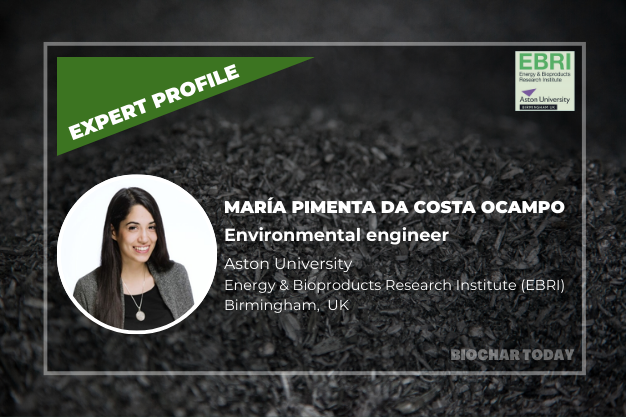
I am joining with Maria Pimenta da Costa Ocampo, an environmental engineer and Research Associate at Aston University’s Energy & Bioproducts Research Institute (EBRI)in this session. With a research background spanning a decade, Maria has extensive experience in waste valorization through thermal treatments such as pyrolysisPyrolysis is a thermochemical process that converts waste biomass into bio-char, bio-oil, and pyro-gas. It offers significant advantages in waste valorization, turning low-value materials into economically valuable resources. Its versatility allows for tailored products based on operational conditions, presenting itself as a cost-effective and efficient More and hydrothermal carbonization.
Maria’s journey into the field began while she was a student at the Polytechnic University of Madrid, where a lecture on biocharBiochar is a carbon-rich material created from biomass decomposition in low-oxygen conditions. It has important applications in environmental remediation, soil improvement, agriculture, carbon sequestration, energy storage, and sustainable materials, promoting efficiency and reducing waste in various contexts while addressing climate change challenges. More and its potential for carbon storage shifted the direction of her career. She went on to earn her PhD from Cranfield University, where her thesis focused on evaluating the use of pyrochar and hydrochar from sewage sludge as alternative phosphorus fertilizers.
Currently, Maria’s work involves the Biochar Cleantech Innovation Accelerator project, where she is developing a pyrolysis demonstrator plant to convert biomassBiomass is a complex biological organic or non-organic solid product derived from living or recently living organism and available naturally. Various types of wastes such as animal manure, waste paper, sludge and many industrial wastes are also treated as biomass because like natural biomass these More into biochar and other by-products. Her role includes conducting Life Cycle Assessments (LCA) to evaluate the environmental impact and carbon sequestration potential of these products. She is also exploring novel applications for biochar beyond traditional soil amendments, such as its use in composite resins for building materials. Maria is also the founder of a zero-waste company, My Minimal Co, which complements her scientific work with a practical focus on sustainability.
I am honored to feature Maria Pimenta da Costa Ocampo— an all-time biochar researcher — in our expert interview series. Enjoy the conversation!!!
Shanthi Prabha: I am always curious to hear about the journeys of experts in this field. What was the golden moment or key experience that first led you into the fascinating biochar and waste valorisation world, particularly with a focus on sewage sludge?
Maria Pimenta da Costa Ocampo: The key moment for me was the first time I learned about biochar at the Polytechnic University of Madrid because that’s when my life changed direction. Professor Gabriel Gasco Guerrero brought a tiny vial filled with a carbon material and told us how through pyrolysis we could obtain a product that was stable to degradation, effectively storing carbon. This piqued my curiosity, so I raised my hand and asked for more information after the lecture, which led to an opportunity to do my master’s thesis with him and Professor Ana Maria Mendez in between the departments of Agriculture, Energy and Mines. A couple of years later, I was given the opportunity to continue the research in the UK through a PhD in collaboration with with Dr. Ruben Sakrabani and Dr. Wilfred Otten, for which I would be forever grateful. I was particularly interested in evaluating the effects of thermal treatments on a complex waste, and sewage sludge was ideal for this. The nutrient content in the sewage sludge are further concentrated in the char but also the heavy metals, with differences in soil and plant availability, and the high humidity of the sludge presented a challenge itself. Pyrolysis and Hydrothermal Carbonisation were compared as a pre-treatment of sewage sludge for phosphorus re-cycle in soil in this case.
SP: You’ve worked on a project to develop a pyrolysis demonstrator plant to convert biomass from the West Midlands into biochar and other by-products. What was your most unexpected challenge during this project, and how did you overcome it?
MO: I joined EBRI team after my PhD when the demonstrator started to be operative. Now that we have processed a number of biomass feedstocks under different conditions and characterized the products, the challenge that we are facing is mainly related to the different degrees of the market maturity across all pyrolysis products and policy constrains. Although pyrolysis has been quite a popular treatment of biomass over the last decades (if not centuries) and there is scientific evidence of the benefits of the use of all the products in different areas, the market is still very much focused on biochar for soil application worldwide, relegating other uses and the other pyrolysis products to niche markets. I was quite surprised when we found out that there are a few pyrolysis products out there that don’t follow the current regulations, but also how tedious the process can be to legally register such products here in the UK. Our team is currently looking at different market opportunities and the process to opening these while ensuring compliancy.
SP: As a Research Associate for the Biochar Cleantech Innovation Accelerator project, you are currently evaluating the environmental impact and carbon sequestration potential of pyrolysis products. Can you share some of the initial findings or challenges you’ve encountered when using Life Cycle Assessment (LCA) to analyse the use of biochar for carbon sequestration in both soil and composite resins?
MO: One of the main questions that comes up when comparing different application routes, is which methodology should be used to assess the carbon sequestration potential, and thus which variables should be taken into account to calculate this. Applying biochar to composites and soil for example, are bound to have a different carbon permanence. A leading crediting platform for engineered carbon removal suggests a calculation that takes into account the organic carbon content and the temperature of the soil to generate a factor to include the possible degradation over time while its use in construction materials assumes no degradation and so a higher carbon sequestration potential. This is the one I’ve been using, but in this case the effect of the organic matter in soil, rotation of crops or the changes in humidity and other soil variables are not taken into consideration. In the end, an LCA would always provide an approximation, a value that is orientative, to compare scenarios under the same conditions. The assumptions we take would have a great weight in how we interpret the results, and these decisions need to be addressed and shared for transparency.
SP: Life Cycle Assessment (LCA) is a key part of your work. What’s one surprising insight you’ve gained about the environmental impact of biochar production and application that you think people might not be aware of?
MO: When looking at different LCA studies I found it shocking how difficult it still is to compare results between case scenarios. Even though in essence we all follow the same methodology, use similar tools and report following in the same structure, there is still plenty of room for leverage when it comes to decide system boundaries, functional units, data-sets and allocation of the impacts. Studies that report the effects of different variables, feedstocks and scenarios using the same system are rare but quite valuable for this reason, which is something I would like to continue working on.
SP: You’ve been involved in developing biochar-based composite materials for offices. How do you see the future of biochar expanding beyond traditional soil applications and into other products like building materials?
MO: Yes, that was a fantastic opportunity and frankly quite an enjoyable one. We partnered up with a local solicitor firm which moved to a new office in the city. We produced bespoke items for their offices and meeting rooms using a resin mixed with powder biochar from our demonstrator, not only to decorate the offices but also to store carbon, promote circularity and create awareness. I think biochar has great potential as a substitute to conventional products such as anthracite and activated carbonActivated carbon is a form of carbon that has been processed to create a vast network of tiny pores, increasing its surface area significantly. This extensive surface area makes activated carbon exceptionally effective at trapping and holding impurities, like a molecular sponge. It is commonly More as a powder dye, reducing associated emissions due to the displacement of the formers. We have seen some companies starting to develop these composites in Europe with remarkable success and it is only natural that we would see more emerging in the upcoming years. This not will allow us to lock more carbon and create a vast variety of carbon sink elements using different types of matrix (concrete, cement, clay, asphalts, composites, aggregates, wood, paper, textiles, etc), but it will effectively bring biochar’s carbon sequestration potential into the cities.
SP: Your work has included collaborating with various organizations, from coffee roasteries to forestry companies. What have you learned from working with such diverse groups, and how does this collaboration help provide net-zero solutions?
MO: Collaborating with different companies over the last year has been extremely rewarding. Every project brings its own specific objectives and yet they all have the same thing in common, they produce a co-product from biomass in large quantities, which needs an alternative end use to reduce its disposed and maximise revenue. Through this, I’ve learned that the type of feedstockFeedstock refers to the raw organic material used to produce biochar. This can include a wide range of materials, such as wood chips, agricultural residues, and animal manure. More has a major impact on the products, not only on the yields but also on the physical-chemical characteristics which can open different avenues to different companies. Some feedstocks for example, would produce a biochar that is great as a soil amendmentA soil amendment is any material added to the soil to enhance its physical or chemical properties, improving its suitability for plant growth. Biochar is considered a soil amendment as it can improve soil structure, water retention, nutrient availability, and microbial activity. More, while others with a higher ashAsh is the non-combustible inorganic residue that remains after organic matter, like wood or biomass, is completely burned. It consists mainly of minerals and is different from biochar, which is produced through incomplete combustion. Ash Ash is the residue that remains after the complete More content may in turn contain elements that could increase the adsorption capacity of nutrients/pollutants if used as a filter material instead.
SP: As a business owner of a zero-waste company, My Minimal Co, and a biochar expert, what connections do you see between these two roles? How does your entrepreneurial spirit influence your scientific work?
MO: In both roles the motivation is to offer an alternative product with a minimal environmental impact, if not a positive one, and the creativity aspect behind it. In the case of biochar, there are as many applications as one could imagine, we just need to think outside the box, and I am grateful that I’ve been given the opportunity to bring up some ideas that have been put into practice outside the University grounds. For example, in between runs where we use different feedstocks, we end up collecting mixed biochar. Instead of disposing it, I use as a dummy to test other applications that don’t require a specific quality. With them I’m making tiles, jewellery and other elements like buttons, as a way to reduce the waste associated to our activity. On the other hand, one thing I’ve learned during this project is that the selection of feedstock takes a major share on the environmental impact from the whole life cycle, so choosing sustainable producers for my candle company when possible has been key. For the wax for example I use Ecosoya which doesn’t come from deforestation practices, craft paper packaging instead of plastic clamps of single use for my wax melts and donate to plant a tree with every item through One Tree Planted to partially compensate for the emissions.
SP: Your research involved a two-year pot experiment with spring wheat to evaluate biochar as an alternative fertilizer. What was your most significant or surprising observation about how the biochar affected the soil properties or the wheat itself over that extended period?
MO: In this case the feedstock I used was sewage sludge, so we can’t call it biochar by definition. I compared two types of pyrochar and two types of hydrochar obtained at different temperatures. The experiment conducted during two seasons showed that the phosphorous concentrated in the char was slowly released over time in which case the pyrochar ones offered a buffer effect of the soil pHpH is a measure of how acidic or alkaline a substance is. A pH of 7 is neutral, while lower pH values indicate acidity and higher values indicate alkalinity. Biochars are normally alkaline and can influence soil pH, often increasing it, which can be beneficial More and a constant increment in soil organic matter. With regards to the crop response, this one varied greatly indicating a different uptake of heavy metals in the grains and a different stress response probably due to the presence of aluminium in the sewage sludge, which ironically was dosed as a way of removing phosphorous from the wastewater in the first place. This shows that small decisions such as choosing between dosing FeCl3 or AlCl3 during the chemical treatment could have a decisive impact on the end use of the sludge down the line.
SP: You have experience training other technicians and supervising students. What do you enjoy most about mentoring others, and what’s one piece of advice you’d give to someone just starting their journey in biochar research?
MO: I really enjoy working as a team and share what I was taught by others. I often end up learning from them as well as they come up with new ideas once they have learned the basics, often providing a fresh perspective. I would advise anyone to read as much as possible and keep updated of new developments. There are multiple guides like the European Biochar Certificate standard (EBC) that will provide the most basic and relevant information, and plenty review papers that are free and would answer more complex questions in depth. In summary, read, be curious and ask questions – you will never know where it will take you.
SP: What’s the most exciting development you’ve seen recently in the biochar industry, and where do you think the greatest opportunities for innovation lie in the next five years?
MO: A favourite of mine is the use of biochar in composites such as thermoplastics because the applications that it opens are endless. There is a company called “Made of Air” that I enjoy checking from time to time, always to find out that they have come up with new interesting products. Biochar will definitely expand from its traditional use in agricultural soil and expand to produce alternative materials in the near future.
SP: What is the one thing you are most excited about in your current work at Aston University’s Energy & Bioproducts Research Institute (EBRI)?
MO: We have spent a few years preparing the background work for the commercialisation of pyrolysis by-products (technology development, production, characterisation, analysis) and now we have started a few collaborations with companies from diverse sectors that are moving forward. To be able to see the practical application of these materials and, hopefully, a shift the policy to facilitate the creation of new markets based on renewable materials obtained from biomass is something I’m really looking forward to.
SP: I’d love for our readers to learn more about you. Where can people find more information about your work and connect with you?
MO: I’m happy to connect via LinkedIn(https://uk.linkedin.com/in/maría-pimenta-da-costa-ocampo-971728134) or for specific enquiries through my Aston University e-mail (pimentam@aston.ac.uk)


Leave a Reply