
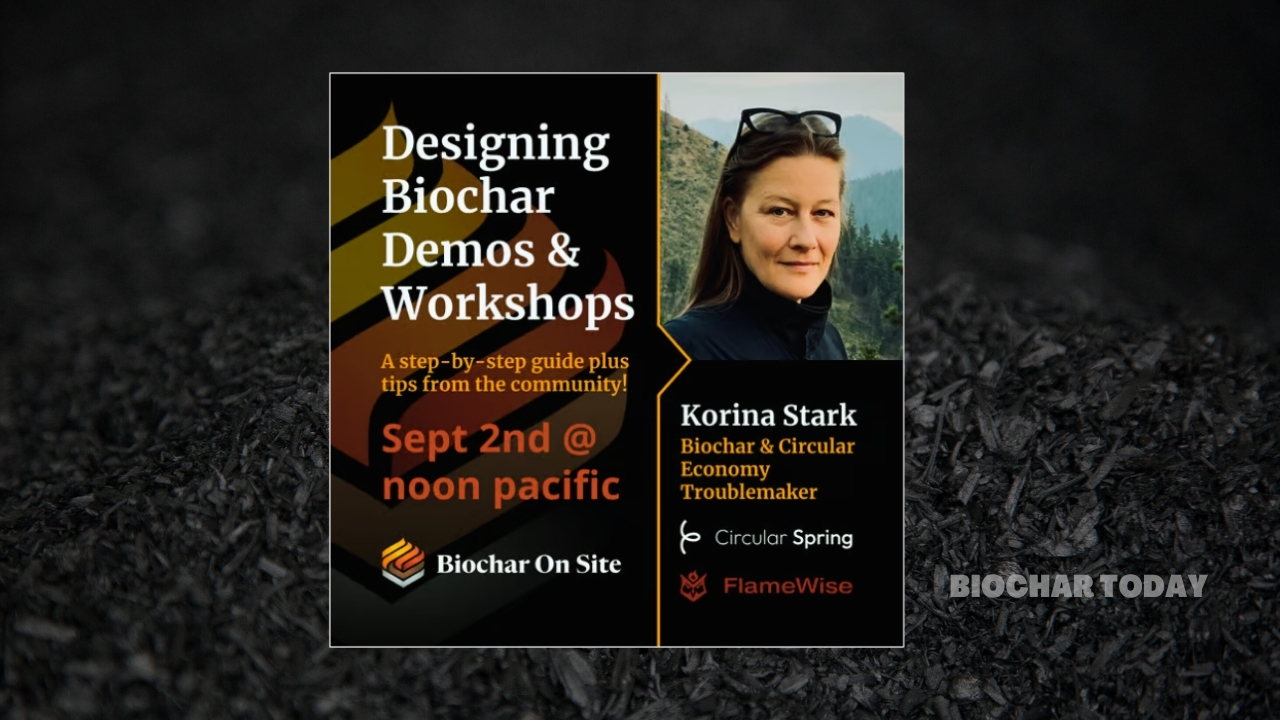
BiocharBiochar is a carbon-rich material created from biomass decomposition in low-oxygen conditions. It has important applications in environmental remediation, soil improvement, agriculture, carbon sequestration, energy storage, and sustainable materials, promoting efficiency and reducing waste in various contexts while addressing climate change challenges. More On Site, in collaboration with FlameWise and Circular Spring, is hosting a virtual workshop on September 2 aimed at training sector stakeholders in designing field demonstrations. Led by program director Korina Stark, the event targeted a diverse group including forestry crews, policymakers, and educators. The session provided a framework for conveying technical concepts, operational mechanics, and functional applications to diverse groups. By establishing clear parameters for event structure and engagement, the initiative seeks to improve broad-based understanding and field execution of decentralized pyrolytic practices.
A persistent issue in the sector involves translating technical thermochemical processes into accessible, real-world educational experiences. Public events and practitioner workshops frequently struggle to maintain audience engagement or adapt content for groups with varying technical backgrounds, such as forestry professionals versus municipal policy leaders. This disconnect limits community adoption, impedes regulatory support, and hampers the scaling of local biomassBiomass is a complex biological organic or non-organic solid product derived from living or recently living organism and available naturally. Various types of wastes such as animal manure, waste paper, sludge and many industrial wastes are also treated as biomass because like natural biomass these More conversion efforts. Without standardized frameworks for field-level outreach, valuable technical methodologies risk remaining underutilized by key regional actors.
To address these training gaps, Stark presented field-tested strategies derived from ongoing consulting work for the United States Department of Agriculture (USDA) Forest Service and the Climate Smart Communities Initiative. The solution focuses on modular demo design, combining practical operation of flat-pack, personal-sized flame-cap kilns with tailored narrative structures. The methodology emphasizes adapting technical depth, flow, and material handling depending on target demographics, ensuring that safety, biochar quality, and feedstockFeedstock refers to the raw organic material used to produce biochar. This can include a wide range of materials, such as wood chips, agricultural residues, and animal manure. More processing are effectively demonstrated across varied settings.
The event established an operational knowledge-sharing platform within the Biochar On Site community, fostering a standardized approach to regional outreach. By equipping operators and educators with practical instructional tools, the session improves local capacity for executing effective field events. These standardized outreach methods support expanded deployment of decentralized biomass conversion, facilitating broader adoption among forest managers, community leaders, and agricultural stakeholders in the United States.

![Eucalyptus Wood Waste-Derived Biochar Achieves a Ninety-Eight Percent Removal Efficiency for Benzo[ghi]perylene in Vehicle-Wash Wastewater](https://biochartoday.com/wp-content/uploads/2026/10/SCIENCE-BLOGS-2026-2026-10-19T160523.703.jpg)


Leave a Reply