
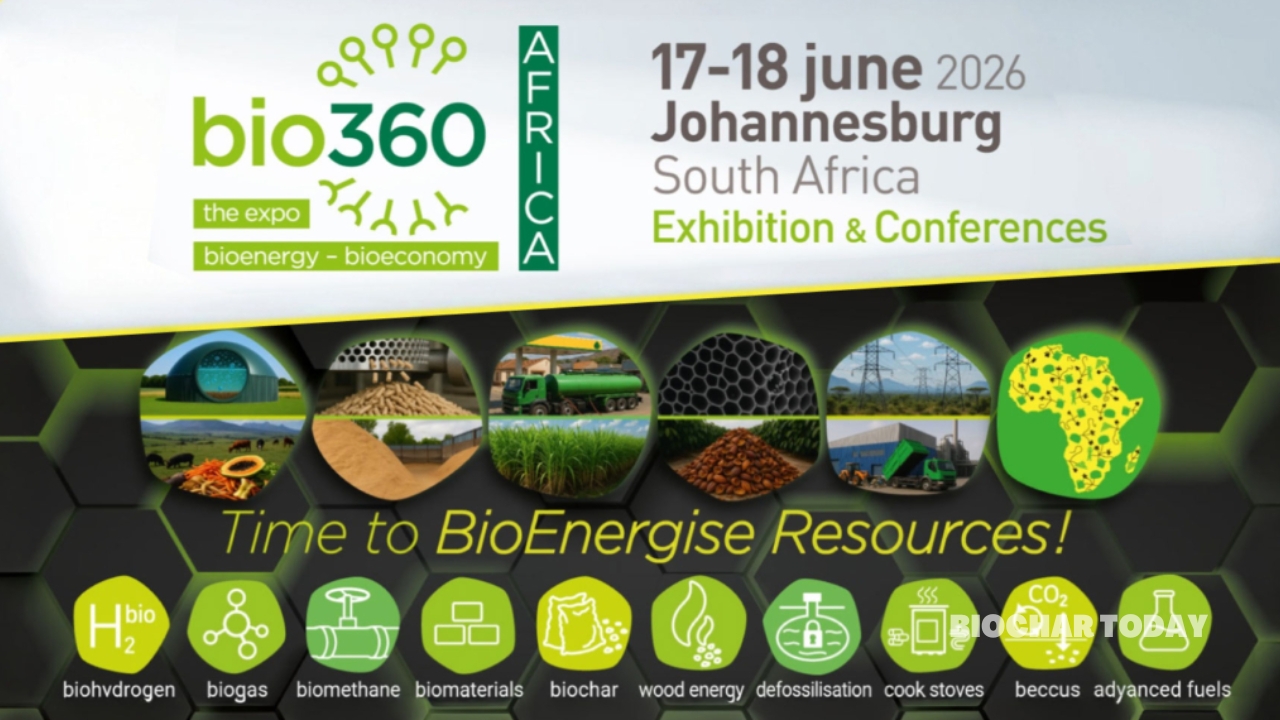
The inaugural Bio360 Africa exhibition and the EU-funded BIO4Africa project are collaborating to advance the bioresource economy across the African continent. This initiative focuses on the conversion of agricultural residues—such as cassava peels, cocoa husks, and cashew shells—into high-value products including biocharBiochar is a carbon-rich material created from biomass decomposition in low-oxygen conditions. It has important applications in environmental remediation, soil improvement, agriculture, carbon sequestration, energy storage, and sustainable materials, promoting efficiency and reducing waste in various contexts while addressing climate change challenges. More, biofuels, and livestock feed. By establishing a pan-African platform in Johannesburg, Bio360 Africa bridges the gap between international technology providers and local stakeholders, while BIO4Africa provides the practical framework for deploying small-scale circular technologies in rural communities across Côte d’Ivoire, Ghana, Senegal, and Uganda.
A primary challenge addressed by these organizations is the systemic mismanagement of agricultural waste and the resulting environmental degradation. Approximately 25% of productive land in Africa suffers from nutrient loss due to continuous cropping, while the open burning or decomposition of residues contributes nearly 7% of the continent’s greenhouse gas emissions. Smallholder farmers frequently lack the technical infrastructure and capital necessary to intercept these waste streams. Consequently, valuable biomassBiomass is a complex biological organic or non-organic solid product derived from living or recently living organism and available naturally. Various types of wastes such as animal manure, waste paper, sludge and many industrial wastes are also treated as biomass because like natural biomass these More that could bolster food security and soil health is lost, leaving rural populations vulnerable to both economic instability and the escalating effects of climate change.
The solution implemented by the BIO4Africa consortium involves the deployment of climate-resilient, small-scale technologies tailored for rural applications. These include pyrolysisPyrolysis is a thermochemical process that converts waste biomass into bio-char, bio-oil, and pyro-gas. It offers significant advantages in waste valorization, turning low-value materials into economically valuable resources. Its versatility allows for tailored products based on operational conditions, presenting itself as a cost-effective and efficient More kilns for biochar production, hydrothermal carbonization (HTC), and green biorefineries. By testing these technologies at pilot sites with over 300 farmers and cooperatives, the project demonstrates the commercial viability of transforming waste into marketable commodities. Furthermore, Bio360 Africa serves as a strategic hub for decision-makers in the agriculture, forestry, and energy sectors to share expertise and secure the financing required to scale these circular solutions beyond the pilot phase.
The outcomes of these efforts manifest in increased income diversification and improved environmental resilience. In Côte d’Ivoire, the Kapatchiva cooperative successfully adopted pyrolysis to produce biochar and livestock feed, showcasing a model for cooperative-led technology uptake. In Uganda, green biorefineries have produced protein-rich feed that increased dairy milk yields by 25%. On a broader scale, the stabilization of carbon through biochar production provides a pathway for farmers to access global carbon markets. These initiatives collectively transition agricultural residues from environmental liabilities into strategic assets for soil restoration and rural economic development.



Leave a Reply