
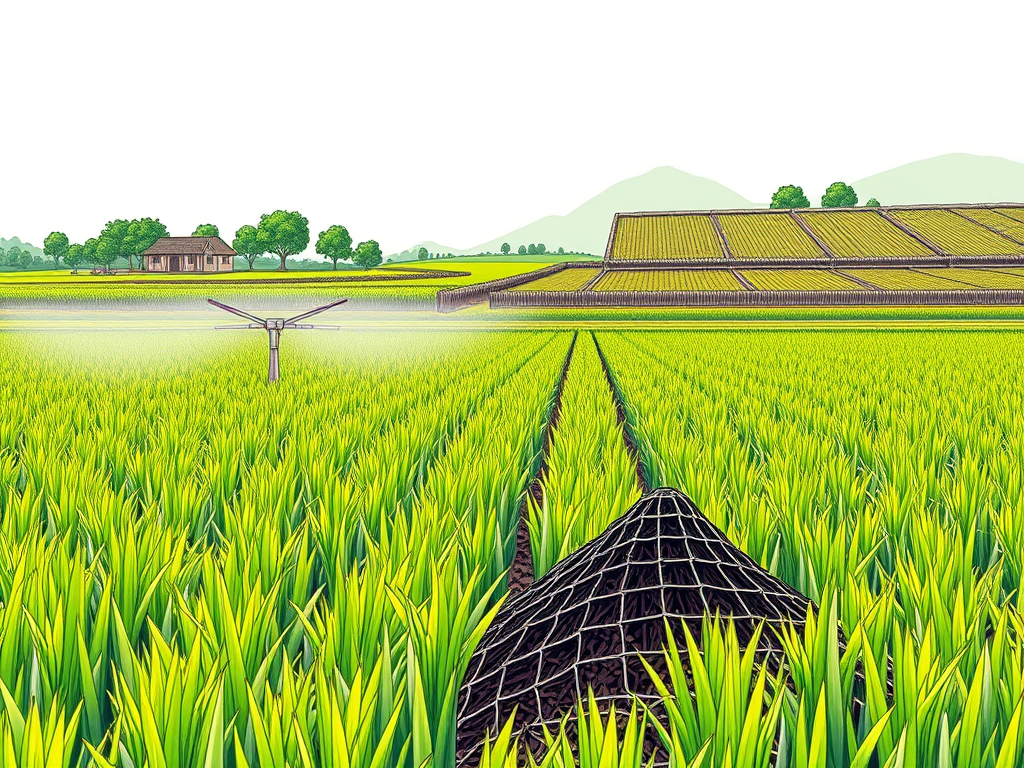
Rice cultivation, a global staple, traditionally relies on flooding, a practice that significantly contributes to greenhouse gas (GHG) emissions, particularly methane (CH4). A recent study in Soil & Tillage Research by Antonio López-Piñeiro, Damián Fernández-Rodríguez, Luis Vicente, David Peña Abades, Ángel Albarrán Liso, Jose Manuel Rato Nunes, and David Paulo Fangueiro, investigates sustainable agricultural practices to mitigate these emissions in Mediterranean rice crops. The research explored the effects of different irrigation methods (permanent flooding and sprinkler) and tillage practices (conventional tillage and no-tillage), with and without biocharBiochar is a carbon-rich material created from biomass decomposition in low-oxygen conditions. It has important applications in environmental remediation, soil improvement, agriculture, carbon sequestration, energy storage, and sustainable materials, promoting efficiency and reducing waste in various contexts while addressing climate change challenges. More application (28 t ha−1), on CH4, carbon dioxide (CO2), and nitrous oxide (N2O) emissions.
The study found that flooding irrigation led to substantial CH4 emissions, averaging 350 kg CH4−C ha−1 across treatments. In contrast, sprinkler irrigation acted as a CH4 sink, with a mean value of −2.40 kg CH4−C ha−1. This stark difference highlights how anaerobic conditions in flooded fields promote methanogenesis, while aerobic conditions under sprinkler irrigation inhibit CH4 production and facilitate its oxidation. However, the transition from flooding to sprinkler irrigation, regardless of tillage, significantly increased N2O emissions, reaching up to 0.7 kg N2O−N ha−1. This is consistent with sprinkler irrigation favoring nitrification, a process that promotes N2O emissions.
Biochar application proved crucial in counteracting the rise in N2O emissions under sprinkler irrigation, bringing values statistically similar to those of permanent flooding. Specifically, N2O emissions in sprinkler irrigation with soil tillage and biochar (SST-B) were 3.70 times lower than in SST in the short term, and 2.73 times lower in the medium term. Similarly, sprinkler irrigation with no-tillage and biochar (SSNT-B) showed N2O emissions 2.83 and 2.57 times lower than SSNT in fresh and aged effects, respectively. This reduction is hypothesized to be due to biochar increasing soil pHpH is a measure of how acidic or alkaline a substance is. A pH of 7 is neutral, while lower pH values indicate acidity and higher values indicate alkalinity. Biochars are normally alkaline and can influence soil pH, often increasing it, which can be beneficial More, which enhances the activity of the N2O reductase enzyme, converting more N2O to N2. Additionally, biochar’s pore structure can adsorb NH-N, reducing its bioavailability for nitrification and subsequently decreasing N2O emissions.
The Global Warming Potential (GWP) varied significantly among treatments. The conventional flood irrigation with soil tillage (FST) had the highest GWP at 17.8 Mg CO2 eq ha−1. Transitioning to intermittent sprinkler irrigation notably reduced GWP, primarily due to lower CH4 emissions. In the medium term (2019), FST-B showed a 34% GWP reduction compared to FST, with values decreasing from 21.5 Mg CO2 eq ha−1 in 2018 to 12.9 Mg CO2 eq ha−1 in 2019, demonstrating the stronger mitigating effect of aged biochar. The lowest yield-scaled GWP (GWP-y) was consistently observed under the SST-B treatment.
Biochar also positively influenced the Net Ecosystem Carbon Balance (NECB), contributing to a further rise regardless of irrigation and tillage methods. While non-amended treatments generally showed negative NECB values, indicating carbon output exceeding input, biochar-amended treatments had higher carbon inputs. For example, biochar application increased the organic matter content by 21,588 kg C ha−1 in the first year.
Source: López-Piñeiro, A., Fernández-Rodríguez, D., Vicente, L., Peña Abades, D., Albarrán Liso, A., Rato Nunes, J. M., & Fangueiro, D. P. (2025). Biochar enhances mitigation of CH_4 and N_2O emissions from rice fields under different irrigation and tillage managements. Soil & Tillage Research, 253, 106660.



Leave a Reply